The Evolving Landscape of Content and Artificial Intelligence
The rapid evolution of artificial intelligence is undeniably transforming how content is created, discovered, and consumed. Content strategists currently face the critical challenge of ensuring their efforts remain visible and valuable in an AI-driven ecosystem, where understanding how AI processes information is paramount. This article provides a strategic guide to developing an AI-ready content blueprint, designed for enduring success. The immediate value lies in recognizing that a proactively architected blueprint, optimizing for AI comprehension and discoverability, is no longer optional. It is a fundamental requirement for navigating platforms like those discussed in Google AI search optimization. This timeless framework will empower you to thrive.
Defining an AI-Ready Content Blueprint for the Modern Era
An AI-ready content blueprint is a strategic, adaptable framework meticulously designed to optimize content for seamless interaction with artificial intelligence systems across its lifecycle.
Its primary purpose is threefold: to facilitate efficient AI-assisted content creation, enabling intelligent tools to generate relevant and high-quality material effectively. It also aims to enhance AI analysis and understanding, allowing algorithms to accurately comprehend content meaning, intent, and context for improved indexing. Finally, it optimizes for AI-driven distribution, ensuring content achieves maximum discoverability and reaches target audiences through intelligent recommendation engines and search algorithms. This proactive blueprint is crucial for future-proofing content strategy, safeguarding digital presence and ensuring enduring relevance amidst continuous technological shifts in how information is processed and consumed.
Essential Components of an AI-Optimized Content Strategy
Crafting an AI-optimized content strategy hinges on several critical components. Data Quality and Governance form the bedrock, ensuring AI systems process clean, accurate, and ethically managed information. This foundation is crucial for AI's ability to truly comprehend and generate valuable insights. Crucially, Semantic Markup and Structure utilize structured data formats (like Schema.org) and clear content hierarchies. This explicitly signals relationships and context to AI, thereby enhancing its understanding.
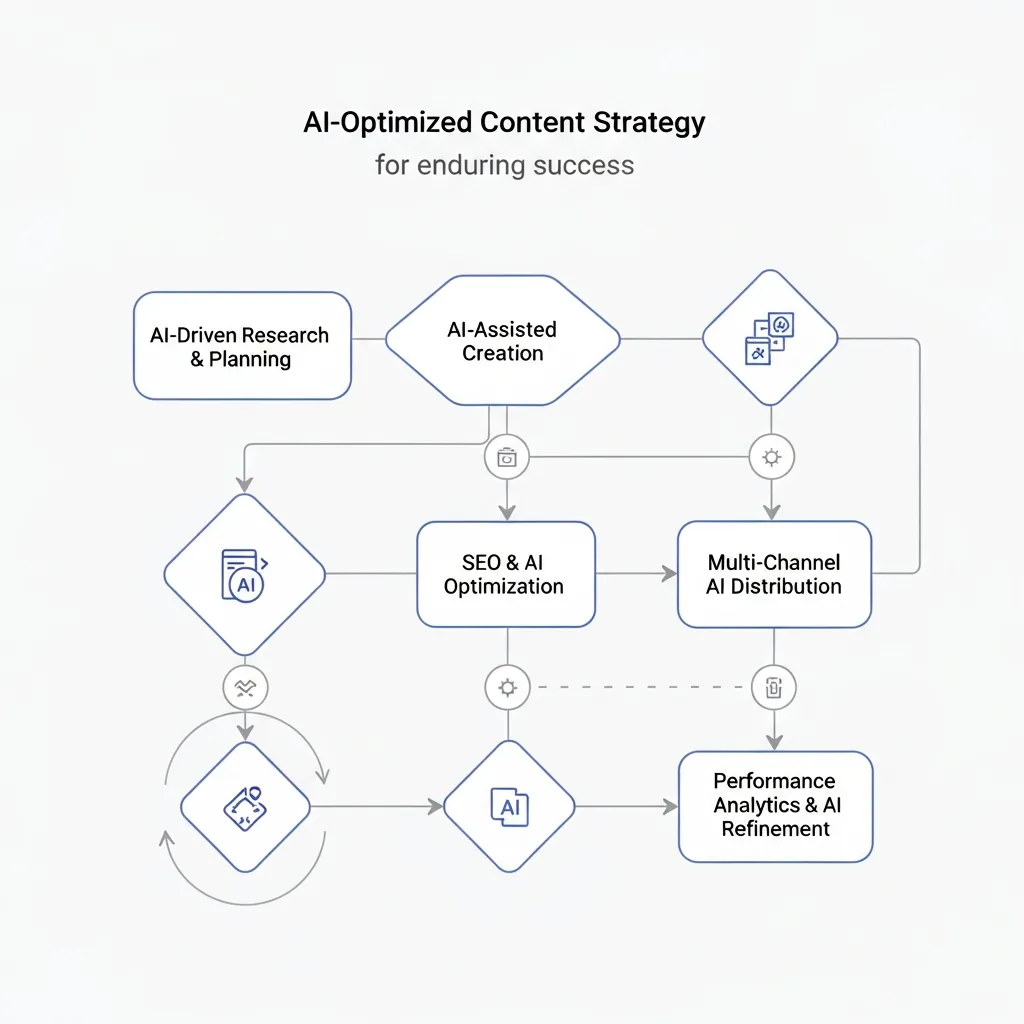
Content Modularity and Reusability break down content into granular, tagged components (e.g., individual facts, FAQs, product benefits). This allows AI to efficiently assemble and repurpose content for diverse applications and channels. Furthermore, Audience and Intent Mapping leverages AI to analyze user behavior and search queries, enabling precision targeting and dynamic personalization of content delivery. The final, continuous loop involves Performance Measurement and Iteration, where AI-powered analytics track content effectiveness, providing actionable insights for ongoing optimization and strategic refinement, ensuring content remains relevant and impactful.
Architecting Content for Optimal AI Processing and Understanding
Architecting content for optimal AI processing and understanding is paramount for any content strategy aiming for enduring success in an AI-driven landscape. This involves a deliberate approach to how content is structured, segmented, and informed by data, ensuring it is not merely readable by humans but also highly intelligible and actionable for artificial intelligence.
Embracing Semantic Structure and Markup
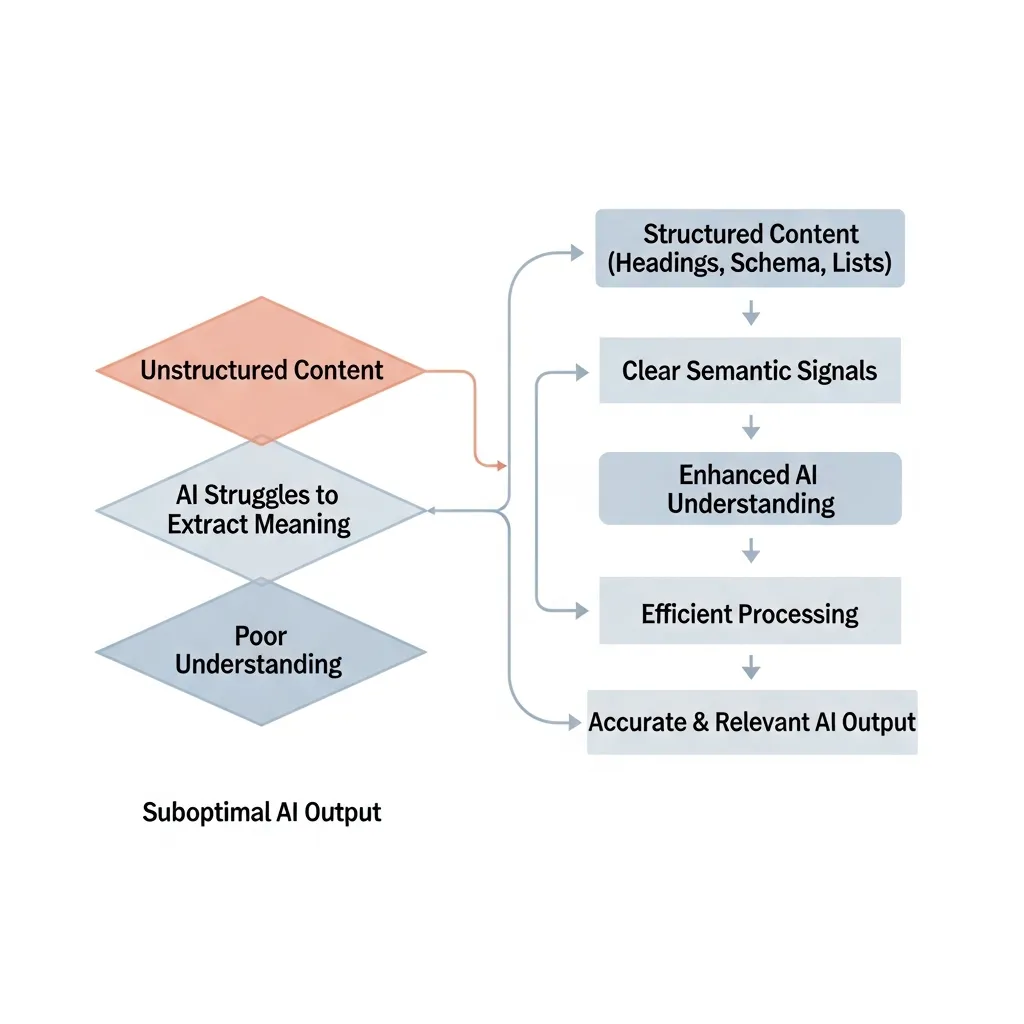
The foundation of AI-ready content lies in its semantic structure and explicit markup. AI models, whether for search, summarization, or generation, rely heavily on understanding the relationships between different pieces of information. Utilizing clear headings (H1, H2, H3) and subheadings provides a hierarchical map of your content, guiding AI through its logical flow and identifying key themes. Beyond visual structure, embedding structured data via Schema.org markup is critical. This provides explicit, machine-readable definitions for entities, actions, and relationships within your content, such as identifying an article's author, publication date, or a product's price and availability. Similarly, robust metadata – including title tags, meta descriptions, and alt text for images – offers crucial context that AI can interpret. The language itself must be clear, concise, and unambiguous, minimizing jargon where possible and ensuring that each sentence conveys its intended meaning directly, facilitating accurate AI comprehension.
Modularity and Reusability for AI Efficiency
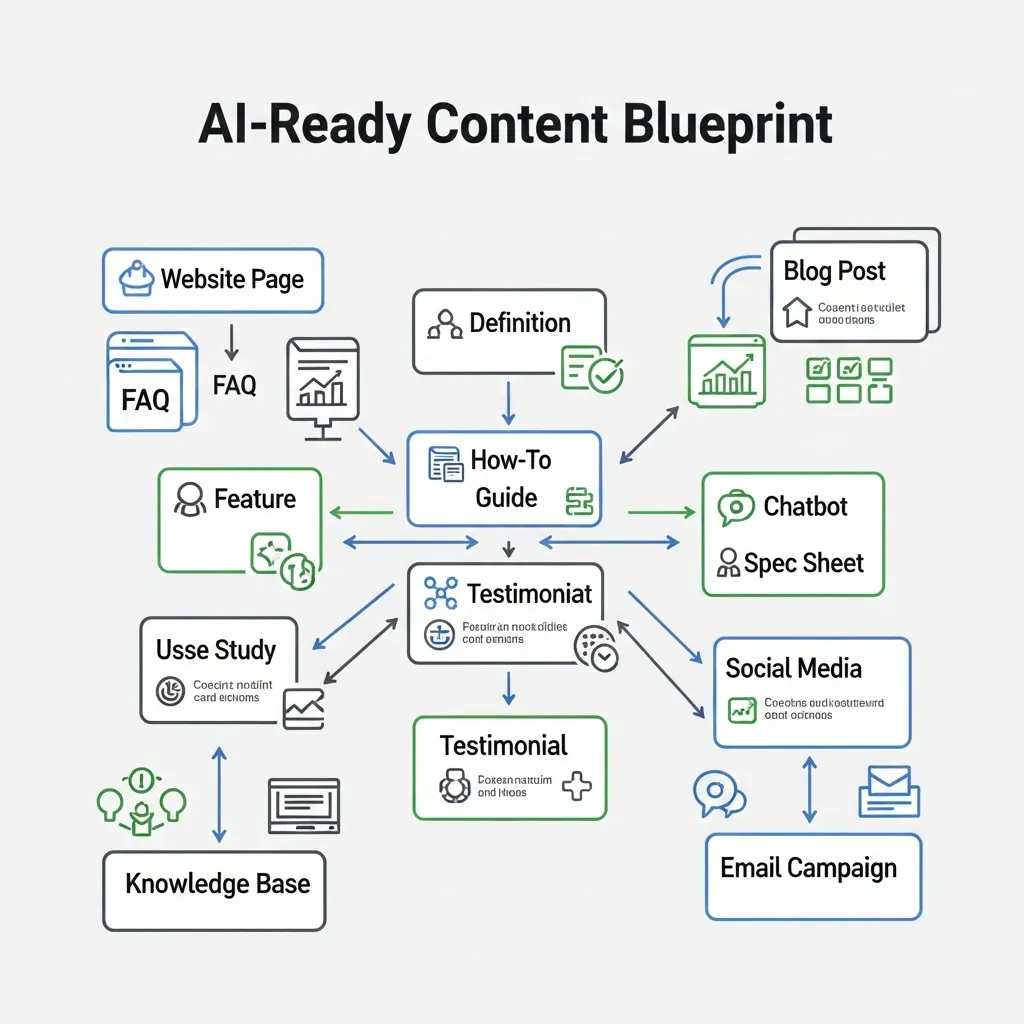
To truly leverage AI, content must evolve beyond monolithic blocks into atomic, reusable components. This principle, often called modular content, involves breaking down information into small, self-contained units that can be easily assembled, disassembled, and repurposed by AI systems. Imagine your content as a set of LEGO bricks rather than a single sculpture. This modularity offers significant benefits for AI-driven content generation, allowing AI to select and combine relevant modules to create new, unique pieces of content. It also enhances repurposing, enabling a single fact or definition to be used across multiple articles, social media posts, or chatbots without manual rewriting. Furthermore, it underpins advanced personalization efforts, as AI can dynamically assemble content relevant to an individual user's preferences or stage in the customer journey. Practical examples include defining FAQs as independent question-and-answer pairs, creating standalone definitions for industry terms, or isolating product features and benefits into distinct data points.
Data-Driven Content Design Principles
An AI-ready content blueprint is inherently data-driven. Content strategists must integrate advanced analytical techniques, often powered by AI tools themselves, to inform content creation from the outset. This includes sophisticated keyword research that moves beyond simple volume to uncover deep user intent and semantic relationships. User intent analysis is paramount, ensuring content directly addresses the questions and needs of the target audience. Leveraging AI for competitive insights helps identify content gaps and opportunities within your niche. Tools capable of topic clustering can reveal comprehensive content landscapes, allowing for the creation of authoritative content hubs rather than disconnected articles. Furthermore, continuous attention to factual accuracy and data integrity is non-negotiable. AI models learn from the data they process; if the source content is inaccurate or inconsistent, any AI-generated or AI-processed output will inherit these flaws, undermining trust and effectiveness.
Practical Examples of AI-Ready Content Structures
Applying these principles transforms how content is structured. Consider a blog post: instead of a single narrative, it might feature a prominent H1, followed by H2 sections that are self-contained logical units. Within each H2, H3s could introduce specific concepts, each with concise paragraphs and potentially bulleted lists. Important terms could be linked to modular definitions. The post might conclude with a dedicated FAQ section marked up with FAQPage Schema. For a product description, instead of a long paragraph, AI-ready content would feature distinct, structured attributes (e.g., product name, SKU, price, color, material) and a modular list of benefits and features, each explicitly tagged. An FAQ section itself would consist of clear question-and-answer pairs, each marked with Question and Answer Schema, ensuring AI can easily extract and utilize this information for direct answers in search results or chatbots.
Here’s a checklist to ensure your content is architected for optimal AI processing:
The AI Content Architecture Readiness Checklist
- Semantic Hierarchy: Is every piece of content structured with a logical H1-H3 (or H4) heading hierarchy?
- Schema Markup: Is relevant Schema.org markup applied consistently to clearly define content types (e.g., Article, Product, FAQPage, HowTo)?
- Metadata Richness: Are title tags, meta descriptions, and alt text concise, descriptive, and keyword-optimized for AI understanding?
- Clarity & Conciseness: Is the language direct, unambiguous, and free from excessive jargon or overly complex sentence structures?
- Modularity: Can individual facts, definitions, FAQs, or feature descriptions be easily extracted and repurposed as standalone content units?
- Data-Driven Topics: Is content creation informed by advanced user intent analysis, topic clustering, and competitive insights derived from AI tools?
- Factual Integrity: Is all content verified for accuracy, consistency, and up-to-date information to ensure reliable AI interpretation?
Unlocking Strategic Advantages with an AI-Ready Content Approach
An AI-ready content approach unlocks significant strategic advantages for modern organizations. It ensures enhanced discoverability and superior SEO performance within the dynamic landscape of AI-driven search, allowing content to reach target audiences more effectively. This framework also delivers increased efficiency across the entire content lifecycle, from initial creation and meticulous optimization to strategic repurposing workflows, saving valuable resources. By leveraging AI's analytical power, businesses can offer improved personalization capabilities, crafting a more engaging and relevant user experience that fosters deeper connections. Moreover, this approach enables better data analysis and deeper performance insights, moving beyond superficial metrics to empower truly informed, data-driven decision-making. Crucially, an AI-ready blueprint provides robust scalability for all future content initiatives, ensuring seamless adaptation to evolving AI capabilities and market shifts, guaranteeing enduring relevance.
Navigating Ethical Considerations and Data Governance in AI Content
Integrating AI into content workflows demands careful consideration of ethical boundaries and robust governance. Organizations must proactively address potential biases in AI-generated content, implementing mitigation strategies such as diverse training datasets and regular bias detection audits. Ensuring robust data privacy and security measures for all content inputs and outputs is equally crucial, safeguarding proprietary information and user data throughout the content lifecycle.
Maintaining a distinctive brand voice, authenticity, and human oversight remains paramount in AI-assisted creation, preventing generic outputs and preserving genuine connection with the audience. This necessitates the critical role of human fact-checking and editorial review to validate accuracy, quality, and contextual relevance. Ultimately, establishing clear data governance policies and responsible AI practices form the foundational framework for ethical, effective, and trustworthy AI content creation.
Cultivating an AI-Empowered Content Team and Workflow
Cultivating an AI-empowered content team begins with comprehensive upskilling. This involves robust training on specific AI tools, understanding core AI principles, and strictly adhering to ethical usage guidelines. Simultaneously, fostering a culture of experimentation and continuous learning is crucial, empowering teams to adapt swiftly to evolving AI capabilities and integrate them creatively. The goal is seamless integration of AI into existing content workflows through a hybrid approach, where human insight and strategic direction remain central, augmenting processes rather than replacing them. This evolution often necessitates defining new roles and responsibilities, such as prompt engineers or AI-driven content strategists, to optimize AI outputs. Finally, establishing clear strategies for measuring the ROI of AI-driven content initiatives, by tracking efficiency gains, content performance metrics, and audience engagement, is vital to demonstrate tangible business value and inform future investments.
The Enduring Value of an AI-Ready Content Blueprint
An AI-ready content blueprint is paramount for sustained success. It strategically integrates human ingenuity with AI's analytical power, forging an unstoppable synergy. This proactive approach ensures content remains relevant and impactful, adapting continuously to evolving digital landscapes. Embracing this framework cultivates a sustainable competitive advantage, moving beyond temporary gains to secure enduring market leadership. It's about designing content that consistently thrives, leveraging intelligent automation without sacrificing creative depth. This blueprint is the cornerstone for delivering high-performing content. Start now with step 1: Assess your current content inventory for AI readiness.
Frequently Asked Questions
What is an AI-ready content blueprint?
An AI-ready content blueprint is a strategic framework designed to optimize content for seamless interaction with artificial intelligence systems across its lifecycle, facilitating efficient creation, analysis, and distribution.
Why is an AI-ready content blueprint crucial for content strategy?
It is crucial for future-proofing content strategy, ensuring enduring relevance and discoverability in an AI-driven ecosystem by optimizing for AI comprehension and distribution.
What are the essential components of an AI-optimized content strategy?
Key components include Data Quality and Governance, Semantic Markup and Structure, Content Modularity and Reusability, Audience and Intent Mapping, and continuous Performance Measurement and Iteration.
How does semantic markup help AI understand content?
Semantic markup, such as structured data (Schema.org) and clear headings, provides explicit, machine-readable definitions and hierarchical structure, guiding AI through content's logical flow and identifying key themes for accurate comprehension.