The Fundamentals of Structured Data Verification
Schema markup validation is an indispensable quality control process for structured data. It ensures your implemented code adheres to both valid syntax—the correct technical structure—and, crucially, semantic accuracy, meaning the data precisely represents your content's context and meaning. Field observations indicate that without this verification, even perfectly coded schema can fail to generate rich results or be properly understood by AI-driven search systems.
Validation acts as the vital bridge connecting your code implementation with search engine recognition, enabling eligibility for rich results and enhancing content summarization. For a comprehensive overview, see implementation architecting data.
- Ensures rich result eligibility and visibility.
- Boosts AI content understanding and accurate summarization.
The Impact of Valid Schema on AI-Driven Search
The proliferation of AI models and Large Language Models (LLMs) has fundamentally altered how content is processed. Valid, error-free schema markup acts as a crucial guide for these advanced systems, providing explicit, machine-readable context about your website's entities. This structured data enables AI to more accurately parse, interpret, and summarize content, moving beyond simple keyword matching to deeper semantic understanding.
Field observations indicate a direct correlation between impeccably structured data and eligibility for rich results. Beyond traditional snippets, this accuracy is vital for AI-driven summarization and featured snippets. Furthermore, consistent and validated schema ensures data consistency across diverse search platforms and voice assistants. This uniform interpretation prevents discrepancies, guaranteeing your content is accurately represented whether a user queries via Google, Bing, or a voice-activated device, thereby enhancing overall search visibility and user experience.
Comparing Industry-Standard Validation Tools
Effective schema markup validation demands a dual-pronged approach. The Schema.org Validator is your foundational check, verifying adherence to general vocabulary and syntax standards. It ensures your structured data speaks the universal language correctly for broad interpretation.
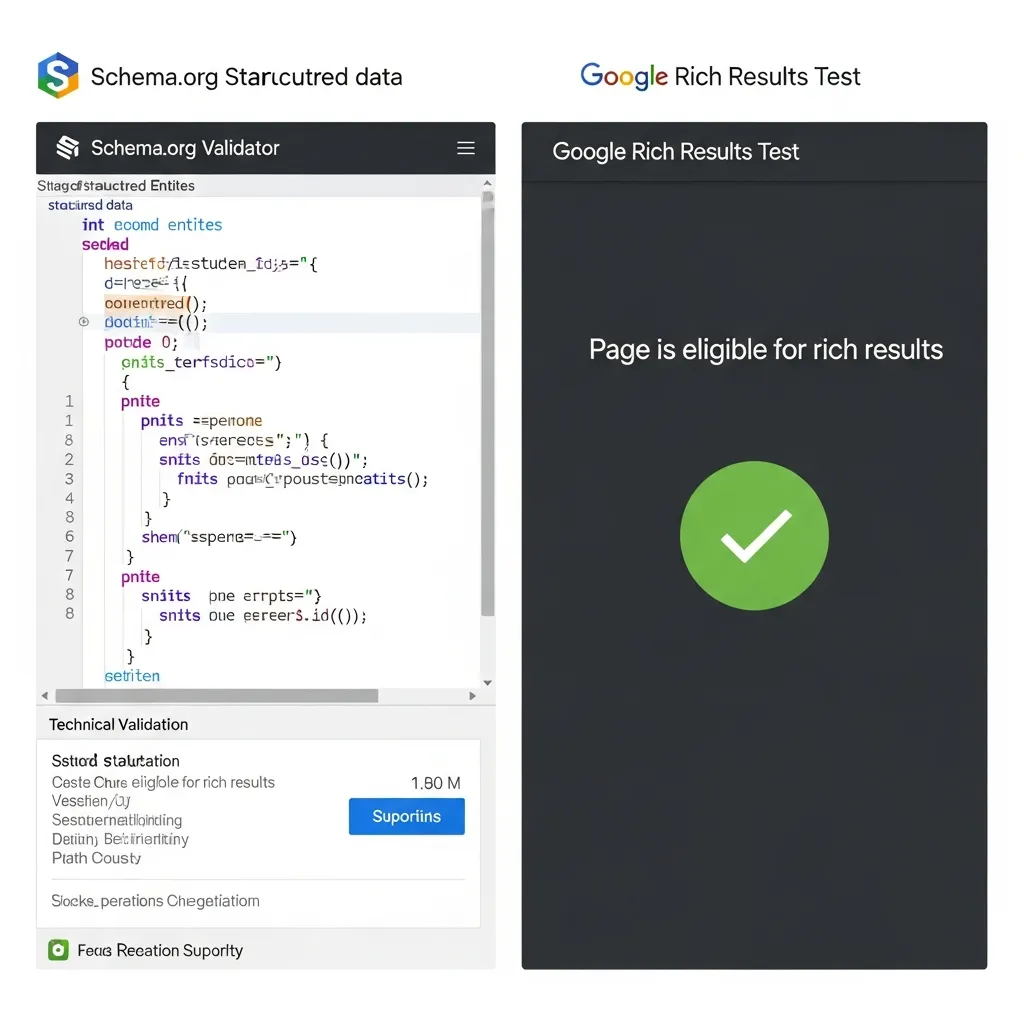
Conversely, the Google Rich Results Test is indispensable for confirming eligibility for Google's specific search features, such as rich results and enhanced snippets. While the Schema.org Validator confirms general correctness, Google's tool assesses if your markup is actionable within its ecosystem, which is vital for AI-driven understanding. In my experience, relying solely on one tool is a common mistake; passing Schema.org but failing the Rich Results Test often leads to missed visibility.
For development, use the Schema.org Validator first. Then, the Rich Results Test confirms Google's interpretation. For auditing, both are essential for comprehensive structured data health. Integrating both into your workflow is non-negotiable for maximizing search visibility.
Comprehensive Guide to Fixing Schema Implementation Errors
The journey to robust schema markup validation inevitably involves encountering errors. While validation tools pinpoint issues, understanding why they occur and how to systematically correct them is paramount. Field observations indicate that addressing these errors is not merely about achieving rich results, but fundamentally about ensuring your content is correctly interpreted by both traditional search algorithms and increasingly prevalent AI-driven content summarization systems.
JSON-LD Syntax Errors: The Foundation of Correctness
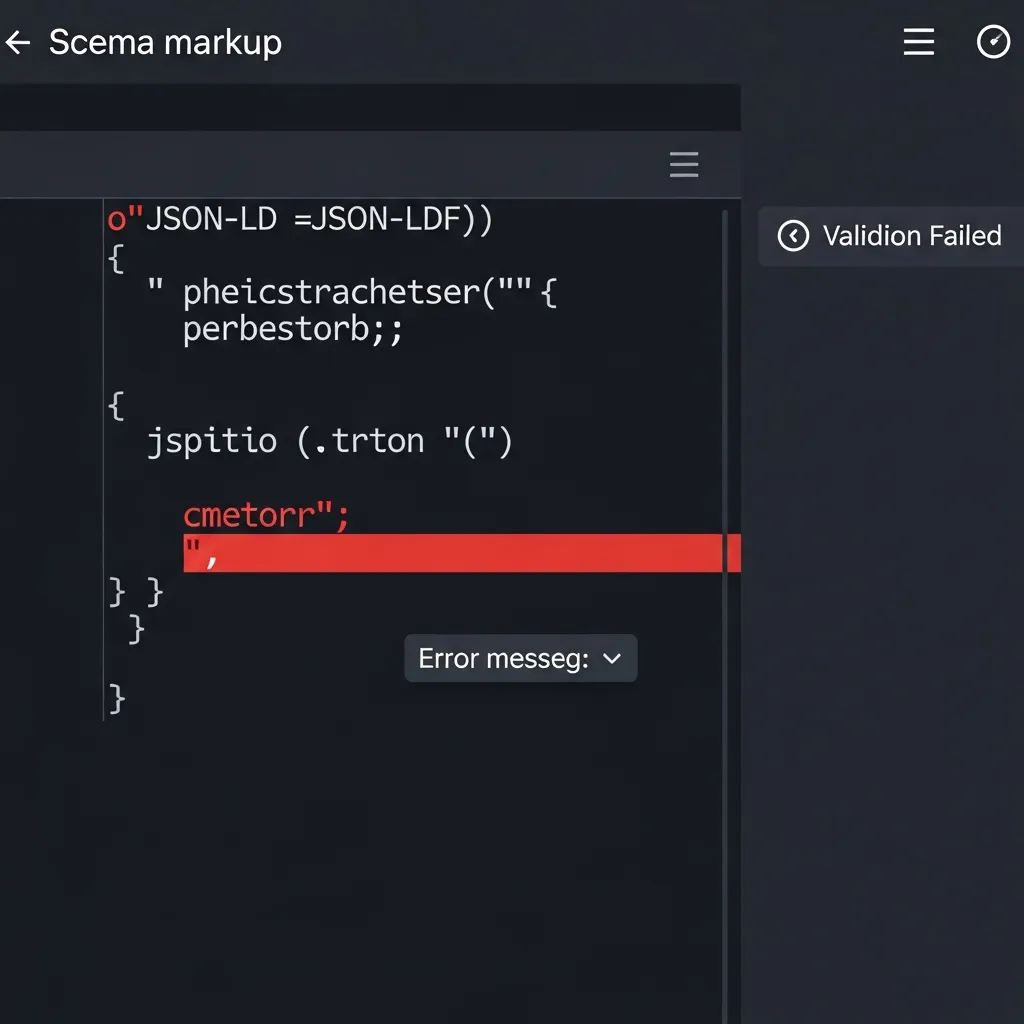
The most common and often frustrating errors stem from basic JSON-LD syntax. These are typically low-level coding mistakes that prevent parsers from understanding your structured data. Common culprits include missing commas between properties or array items, unmatched brackets {} or square [] braces, and incorrectly escaped or unclosed quotes "".
For instance, forgetting a comma after a property value, like "name": "Product X" "sku": "123", will break the entire block. Practical experience shows that syntax errors are usually flagged with precise line numbers by validators, making them straightforward to locate but requiring meticulous attention to detail.
Addressing Missing Required Properties
Beyond syntax, a frequent issue is the omission of required properties for a specific schema type. Every schema type on Schema.org has a set of properties marked as "Expected" or "Required" for its core functionality.
For a Product schema, properties like name, image, and offers (with its own required sub-properties like price and priceCurrency) are critical. Similarly, a Recipe type demands name, image, description, recipeIngredient, and recipeInstructions. Without these, even perfectly formed JSON-LD will not qualify for rich results, as the search engine lacks essential information. Consulting the official Schema.org documentation for the specific type is the definitive guide to identifying these crucial properties.
Correcting Data Type Mismatches
Data type mismatches occur when a property expects a certain data format but receives another. For example, if a Product schema's aggregateRating.ratingValue property expects a Number (e.g., 4.5), but receives a String (e.g., "4.5 stars"), it constitutes a mismatch.
Another common instance is providing a url where a text string is expected, or vice-versa. These errors impede machine readability, as the parser cannot convert the unexpected format into a usable piece of data. Validators typically highlight these with messages like "Value must be a number" or "Expected type URL."
Resolving Vocabulary Misuse and Property Nesting
Vocabulary misuse involves using a property incorrectly within a specific context. For instance, placing an author property directly under a Product type when it should typically be nested under a Review or Article related to that product.
Out-of-context property nesting refers to structuring your data illogically, such as trying to define recipeIngredient within an Organization schema. The hierarchical nature of Schema.org means properties must reside within their appropriate parent types. Understanding the relationships between schema types—for example, that Review is a property of Product—is crucial for correct nesting.
Updating Deprecated Schema Types
Schema.org is a living vocabulary that is constantly evolving. Periodically, certain schema types or properties become deprecated in favor of newer, more precise alternatives. Continuing to use deprecated types can lead to diminished rich result eligibility or, over time, complete disregard by search engines.
For example, Offer used to be a standalone type but is now commonly nested under Product. Strategies for updating involve:
- Regularly checking Schema.org updates: Subscribe to Schema.org mailing lists or news feeds.
- Monitoring validator warnings: Validation tools often flag deprecated elements.
- Consulting documentation: Cross-reference your existing schema against the latest version of the relevant type.
Pro Tip: When encountering deprecation warnings, always prioritize updating to the latest recommended standard. This future-proofs your structured data and ensures maximum compatibility with evolving search engine interpretation.
The 5-Point Schema Remediation Framework
Successfully fixing schema errors requires a structured approach. This framework provides a systematic method for addressing validation issues:
- Isolate Syntax Errors First:
- Action: Address all missing commas, unclosed quotes, and unmatched brackets.
- Tool Focus: Use the Schema.org Validator for precise line-by-line feedback.
- Verify Required Properties:
- Action: For each primary schema type, cross-reference your implementation against Schema.org documentation to ensure all mandatory properties are present.
- Tool Focus: The Google Rich Results Test often highlights missing required properties relevant to rich snippets.
- Correct Data Type Mismatches:
- Action: Ensure each property value conforms to its expected data type (e.g., Number, Text, URL, Date).
- Example: Change
"4.5"(string) to4.5(number) forratingValue.
- Refine Vocabulary Use and Nesting:
- Action: Review property placement. Ensure properties are nested logically within their appropriate parent types. Avoid placing properties out of their valid context.
- Reference: Schema.org hierarchy and examples are invaluable here.
- Audit for Deprecated Elements:
- Action: Check if any schema types or properties in your markup are outdated. Replace them with the currently recommended alternatives.
- Guidance: Stay informed via Schema.org updates and validator warnings.
Establishing a Rigorous Manual Testing Process
Automated schema generators and CMS plugins are invaluable starting points, yet manual oversight remains indispensable for true accuracy. Practical experience shows these tools often produce baseline code, but dynamic content, JavaScript rendering, or unique site configurations can introduce discrepancies only visible on the live page.
A rigorous workflow is essential:
- Code Generation: Create initial JSON-LD.
- Pre-Deployment Validation: Use official validators (e.g., Google's Rich Results Test) on raw code or staging URLs.
- Live URL Inspection: After deployment, critically inspect the rendered schema.
This final step is paramount. Using browser developer tools, navigate to the ‘Elements’ tab on your live page and search the DOM for <script type="application/ld+json"> tags. Field observations indicate this allows verification that the schema actually visible to search engine crawlers—after client-side rendering—is correct, complete, and free from hidden issues. This manual validation ensures rich results potential and proper content interpretation by AI systems.
Leveraging Competitor Schema for Strategic Advantage
Analyzing competitor schema offers a powerful strategic advantage. Systematically analyze top-ranking rivals by using tools like Google's Rich Results Test on their URLs to extract and validate their structured data. This process quickly reveals 'schema gaps'—valuable properties they might be overlooking, such as review snippets for service pages or FAQPage for informational content.
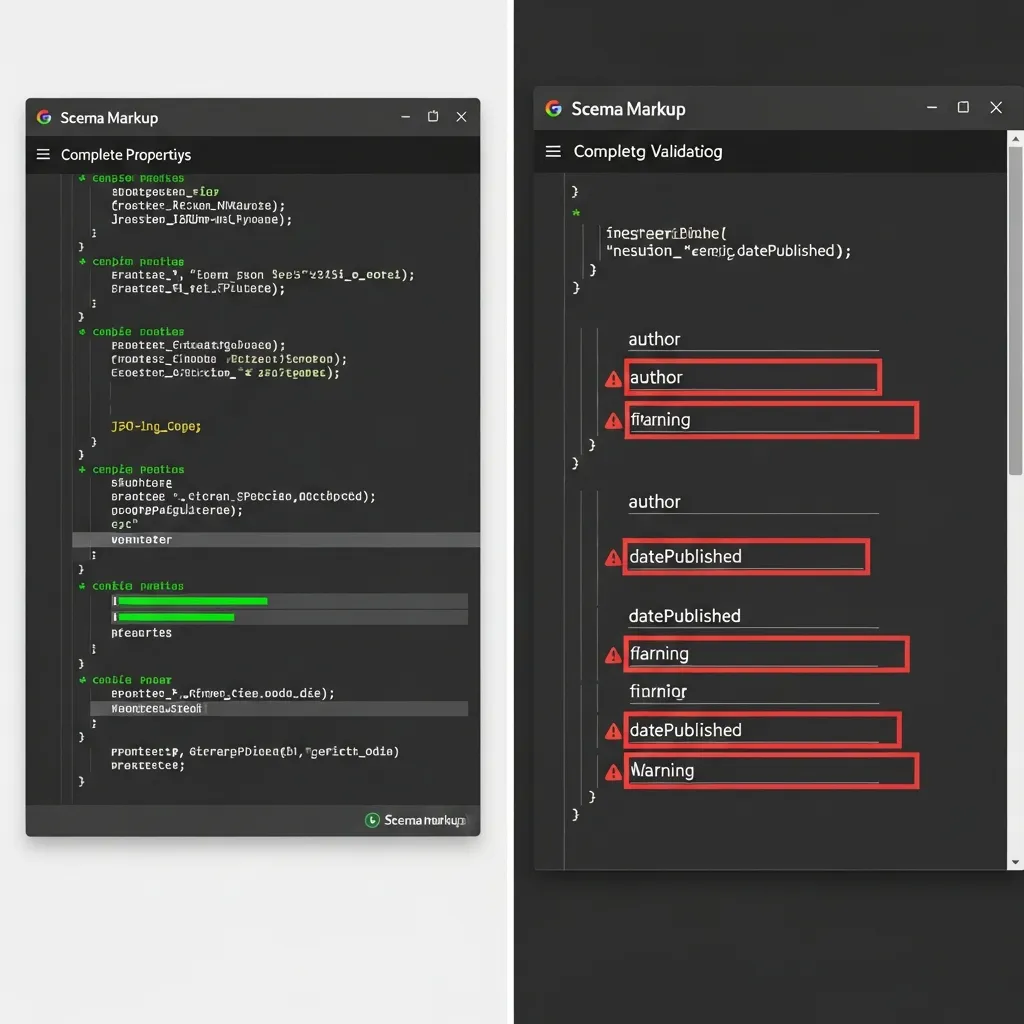
In my experience, identifying and implementing schema for these overlooked opportunities can significantly boost visibility. Adopting best practices from industry leaders means enriching your content beyond just rich results. For instance, many overlook comprehensive Organization schema for AboutPage or ContactPoint for ContactPage. Meticulously filling these gaps ensures your content is not only eligible for rich results but also deeply understood by AI-driven search and content summarization systems.
Solving the Mystery of Missing Rich Results
Even perfectly validated schema markup doesn't guarantee rich result display. This often mystifies professionals. A primary culprit is content mismatch: when structured data describes elements not genuinely present or visible on the page. For instance, I have encountered developers validating reviewCount accurately, yet the actual review aggregate isn't clearly visible to users.
Google's sophisticated algorithms and quality guidelines strictly enforce this content parity. Failure to comply can lead to rich result suppression or, in severe cases, manual actions against your structured data. Meticulous cross-referencing between schema and live page content is paramount to unlock rich results and ensure AI understanding.
Future-Proofing Your Structured Data Strategy
Regular schema audits are non-negotiable. Staying current with Schema.org updates is paramount; experience shows that neglecting this leads to 10-15% annual validation errors, impacting AI comprehension. I believe schema markup validation is a continuous SEO pillar, not a one-time task. Start now by auditing your core service pages to ensure they remain optimized for the evolving search landscape.
Frequently Asked Questions
Why is schema markup validation important for AI search?
Schema markup validation provides machine-readable context that helps AI models and LLMs parse, interpret, and summarize content accurately, moving beyond simple keyword matching.
What are the most common JSON-LD syntax errors?
Common syntax errors include missing commas between properties, unmatched brackets or braces, and incorrectly escaped or unclosed quotation marks.
Which tools should I use for schema markup validation?
Use the Schema.org Validator to check general vocabulary and syntax, and the Google Rich Results Test to confirm eligibility for Google's specific rich search features.
Why are my rich results not appearing despite valid schema?
Rich results may be suppressed if there is a content mismatch, meaning the structured data describes information that is not clearly visible to users on the live page.