The Evolution of Visual Search and Structured Data
The digital landscape has fundamentally shifted from purely text-based queries to a visual-centric search experience. Today, user engagement relies heavily on images, videos, and immersive content. Experience shows that visual assets are critical for organic visibility; content lacking context often goes undiscovered.
This evolution demands a robust mechanism for search engines to understand visual media. Structured data serves as the essential bridge, transforming raw visual files into semantically rich, machine-readable information. The core purpose of schema image video implementation is to explicitly signal a visual element's content, context, and attributes. For instance, a product image for "vintage bicycles" can be enriched with schema to show its brand and availability directly in search results.
- Outcomes:
- Enhanced visual discoverability.
- Richer search results snippets.
For a comprehensive overview, see advanced implementation.
ImageObject vs. VideoObject: Choosing the Right Schema
Understanding the distinction between ImageObject and VideoObject is fundamental for accurate visual structured data. ImageObject is designated for static visual content like photographs, infographics, and logos. Its core properties typically include contentUrl, url, and encodingFormat. Conversely, VideoObject is for dynamic, time-based media such as tutorials, product demonstrations, or interviews, requiring additional properties like duration, uploadDate, and embedUrl alongside contentUrl.
Selecting the appropriate schema type depends on the role of the visual asset. Standalone schema is appropriate when the image or video is the primary content, such as a dedicated image gallery page or a single video landing page. More commonly, visuals are nested within other schema types. For instance, an Article schema will typically nest an ImageObject for its featured image, while a Product schema might include a VideoObject demonstrating its features. A common mistake is neglecting to nest images within relevant Article or Product schema, which causes search engines to miss crucial context.
Correctly identifying and implementing the appropriate object type is critical for Rich Result eligibility. Search engines rely on precise schema definitions to understand your content and display enhanced snippets. An incorrectly marked video, for example, will likely miss out on appearing in video carousels or rich video snippets. Prioritizing the correct object type from the outset is non-negotiable for maximizing visibility. Properly structured video content using VideoObject consistently yields higher click-through rates for video carousels compared to videos simply embedded without specific markup.
Technical Implementation: Essential Properties for Image and Video Markup
Moving beyond the conceptual choice between ImageObject and VideoObject, the true power of schema image video lies in its precise technical implementation. This involves accurately defining essential properties within your schema markup to ensure search engines fully comprehend your visual content, ultimately enhancing its discoverability and potential for rich results.
Core Properties for ImageObject Markup
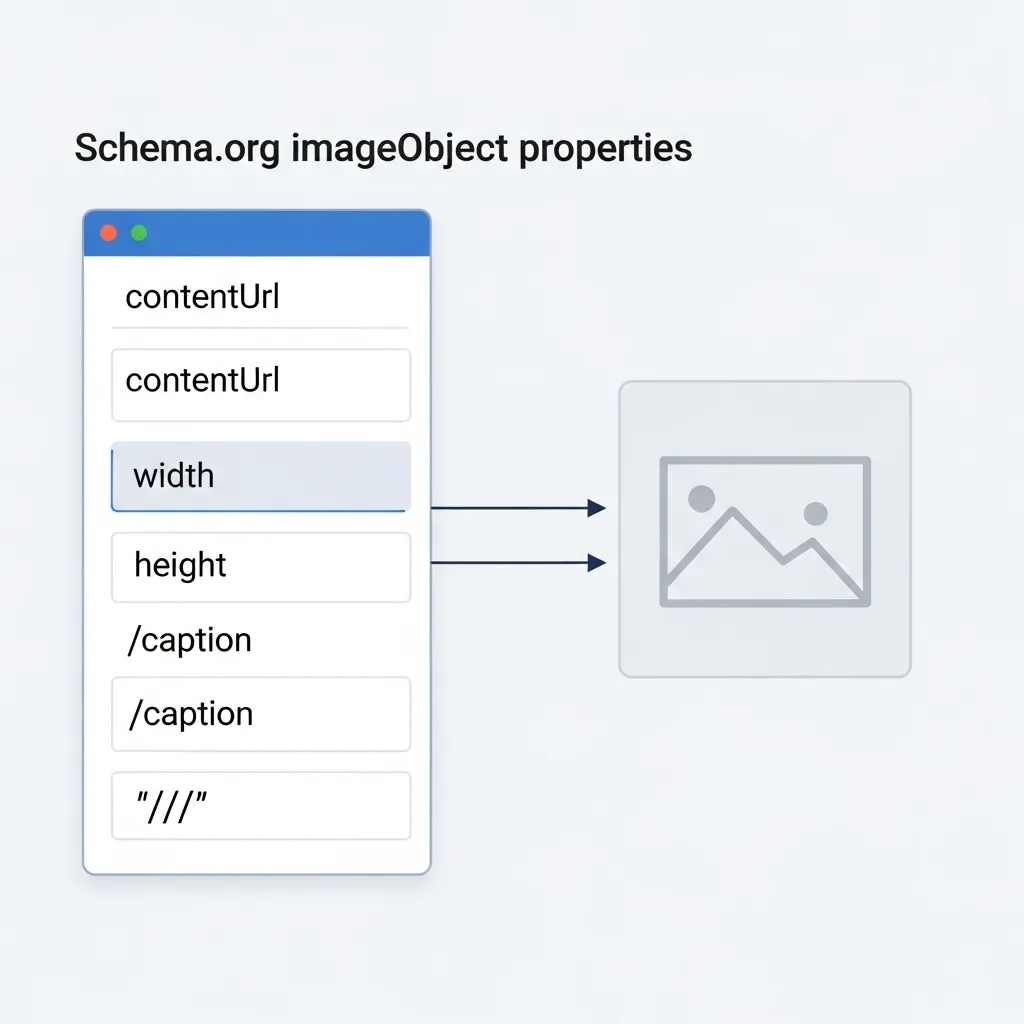
For static images, the ImageObject schema requires a foundational set of properties that provide critical context. Field observations indicate that neglecting any of these can significantly hinder a search engine's ability to process and display your images effectively.
contentUrl: This is paramount. It specifies the direct URL to the image file itself. Ensure this URL is publicly accessible and points to the actual image, not a page containing the image.widthandheight: Defining the image's dimensions (in pixels) allows search engines to understand its aspect ratio and allocate display space efficiently. This is crucial for responsive design and preventing layout shifts.caption: While not strictly "required" by all validation tools, a descriptivecaptionsignificantly improves context. It functions similarly to an alt attribute, providing a brief, human-readable description of the image's content.
Critical Properties for VideoObject Markup
Videos, being more complex media, demand a richer set of properties within the VideoObject schema. These attributes provide search engines with a comprehensive understanding of the video's content, purpose, and availability.
name: The title of the video. This should be concise, descriptive, and accurately reflect the content.description: A detailed summary of the video's content. This is where you can provide more context, include keywords, and explain what viewers can expect.thumbnailUrl: The URL of a representative image (thumbnail) for the video. This image is often displayed in search results and video carousels, making its quality and relevance crucial for click-through rates.uploadDate: The date the video was uploaded or published. This helps search engines determine content freshness, especially for time-sensitive topics.
Implementing Schema with JSON-LD
For maximum compatibility and ease of implementation, JSON-LD (JavaScript Object Notation for Linked Data) is the recommended format for structured data. It offers flexibility as it can be injected directly into the HTML <head> or <body> of a page, independent of the visual content's actual HTML structure. This separation of concerns simplifies maintenance and dynamic generation.
Handling Video Duration and Embed URLs
Beyond the critical properties, two additional VideoObject properties are vital for video content:
duration: Specifies the length of the video in ISO 8601 format (e.g.,PT1M30Sfor 1 minute and 30 seconds). This helps users gauge content commitment before clicking.embedUrl: The URL for the video player that can be embedded on another page. This is crucial for direct playback within rich results or other platforms. For self-hosted videos, this would be the URL to your video player. For YouTube or Vimeo, use their respective embed URLs.
Nesting Visual Schema for E-commerce and Content
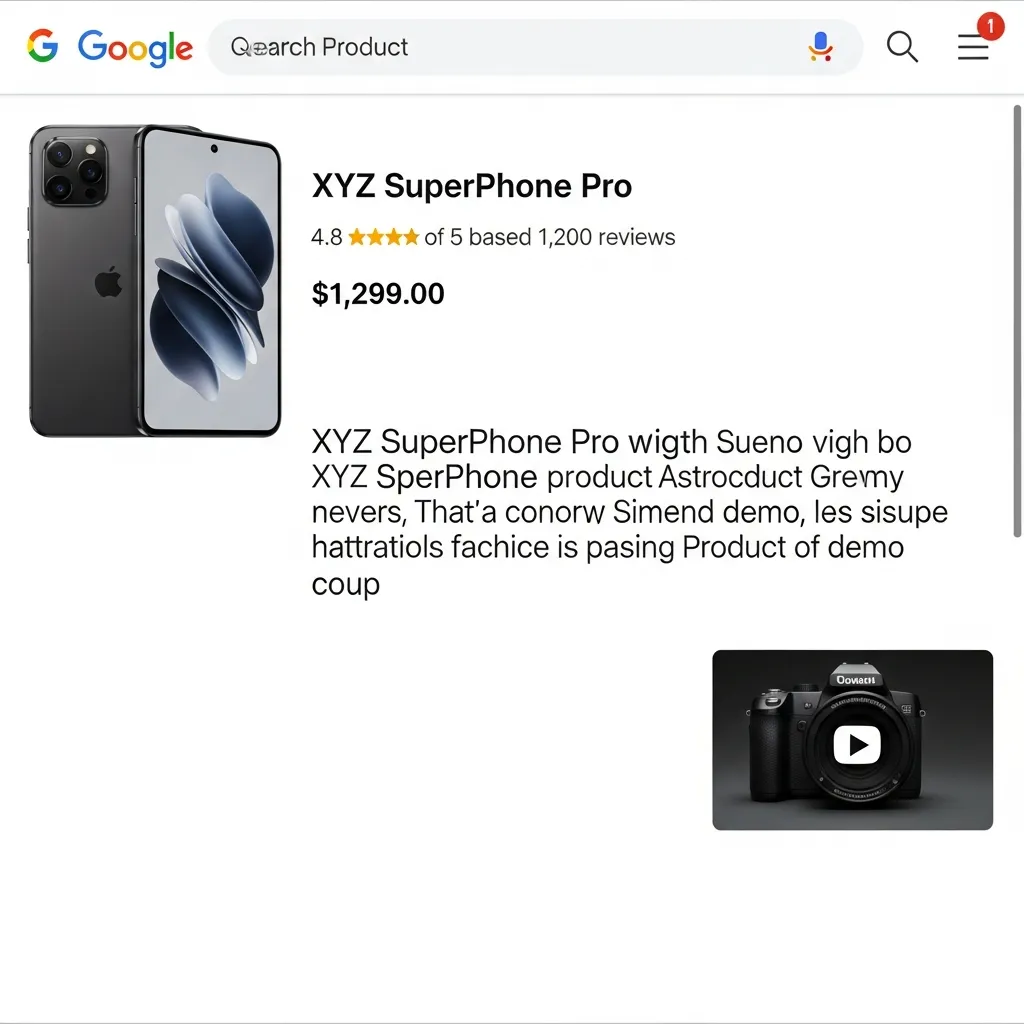
One of the most powerful applications of visual structured data is nesting ImageObject or VideoObject within broader schema types. For instance, on a product page, the main product image and any accompanying video reviews should be nested within the Product schema.
Similarly, for a Recipe schema, images of the final dish or a video demonstrating cooking steps can be nested, providing a richer experience. This contextual nesting strengthens the relationship between your media and the primary content, making it highly valuable for rich result eligibility.
Visual Schema Implementation Checklist
To ensure comprehensive and compliant implementation, follow this checklist:
- Identify Schema Type: Choose
ImageObjectorVideoObjectbased on the media. - Gather Essential Image Properties: Secure
contentUrl,width,height, and a descriptivecaption. - Gather Essential Video Properties: Collect
name,description,thumbnailUrl,uploadDate,duration, andembedUrl. - Format as JSON-LD: Construct your schema markup using the JSON-LD format.
- Place Schema: Embed the JSON-LD script within the
<head>or<body>of the relevant HTML page. - Nest Appropriately: If applicable, nest
ImageObjectorVideoObjectwithin parent schemas likeProduct,Article, orRecipe. - Validate Markup: Use Google's Rich Results Test and Schema Markup Validator to check for errors and ensure eligibility.
Pro Tip: For e-commerce sites, ensure your
ImageObjectfor product images includes specific attributes likeisPrimaryImageOfPage(true/false) andrepresentativeOfPage(true/false) when appropriate, as these provide additional signals to search engines about the image's importance on the page.
Adhering to these technical specifications is not merely about validation; it's about building a robust foundation for your visual content's visibility and performance in search.
Scaling Your Strategy with Dynamic Schema Generation
Scaling your schema image video strategy demands a shift from manual input to dynamic schema generation. For large content repositories, automating schema creation is paramount, effectively leveraging CMS plugins or tailored custom scripts. These tools streamline the process, significantly reducing the labor involved in marking up hundreds or thousands of media assets, making the strategy scalable and efficient.
The core of this strategy involves meticulously mapping database metadata to schema properties. Content management systems inherently store valuable information about images and videos—such as titles, descriptions, dimensions, and URLs. By establishing a direct link between this internal data and the relevant ImageObject or VideoObject schema properties, organizations ensure accuracy and consistency across their structured data output. Field observations indicate this integration prevents discrepancies and improves search engine interpretation.
Crucially, dynamic systems ensure schema updates automatically when media assets are modified. If a video's title is edited or an image's caption is revised within the CMS, the corresponding schema markup should reflect these changes instantly. This automatic synchronization is vital for maintaining up-to-date and valid structured data, preventing stale information from being presented to search engines, which could otherwise lead to rich result disqualification.
Common Implementation Pitfalls and Validation Techniques
Post-implementation, rigorous validation of your schema image video markup is non-negotiable. Leverage Google's Rich Results Test to preview how your content might appear and the Schema Markup Validator for comprehensive syntax checks. These tools are indispensable for identifying basic errors.

A common issue in Google Search Console is 'missing field' warnings. These often arise when optional properties become crucial for specific rich result types or future algorithm updates. Always aim for the most complete markup relevant to your content. Another significant pitfall is 'hidden' schema, where markup exists for content not visible on the page. Stale schema referencing removed images can lead to manual actions. Ensuring your markup truly reflects on-page content is paramount.
Finally, address URL accessibility issues for thumbnails and video files. Search engines must be able to crawl these asset URLs; blocked resources prevent rich result eligibility. Integrating automated validation into your deployment pipeline is the most effective approach to continuously catch these errors.
Expert Tips for Measuring Visual SEO Performance
To effectively gauge visual SEO, begin with the Google Search Console Performance report. Filter by 'Search appearance' for 'Image results' and 'Video results'. Monitor impressions and clicks to establish a baseline. Post-schema implementation, look for a discernible rise in Click-Through Rate (CTR). A well-implemented VideoObject schema can lead to a significant uplift, often exceeding 10% in relevant video searches. This data provides a direct correlation between your structured data efforts and user engagement.
Beyond direct clicks, track your content's presence in dedicated 'Video' tab rankings and carousel appearances. A common mistake is focusing only on web search, neglecting the distinct opportunities these visual SERP features offer. Ultimately, while validation is critical, the most effective approach is a continuous feedback loop: implement, measure, and refine. This iterative process is key to mastering visual structured data performance.
Future-Proofing Your Visual Content Strategy
Structured data is paramount for future-proofing visual content. It ensures search engines accurately interpret your images and videos, unlocking enhanced visibility through rich results and adapting to evolving visual search technologies. Maintaining accurate metadata is non-negotiable; neglecting this often leads to weeks of lost visibility due to re-indexing delays. Treating schema as a core SEO pillar, integrated from content conception, is crucial. It is not an afterthought, but a foundational element for sustained digital presence and competitive advantage.
Start by integrating schema review into your content publishing workflow.
FAQ
What is schema image video?
Schema image video refers to the use of structured data (specifically ImageObject and VideoObject) to provide search engines with detailed metadata about visual content, enabling rich results and better indexing.
Why should I use ImageObject schema?
Using ImageObject schema helps search engines understand the context, dimensions, and content of your images, which can improve visibility in Google Images and enable rich snippets in web search.
How do I validate my visual structured data?
You can validate your markup using Google's Rich Results Test to check for rich result eligibility and the Schema Markup Validator to ensure your JSON-LD syntax is correct.
What are the essential properties for VideoObject?
Key properties for VideoObject include the name, description, thumbnailUrl, uploadDate, duration, and embedUrl. Providing these ensures search engines can display your video in carousels and video search results.