The Evolution of Structured Data: Understanding Hierarchical JSON-LD
The landscape of structured data has profoundly evolved, shifting from simple, isolated data blocks to sophisticated, interconnected semantic networks. Historically, implementing JSON-LD schema often meant deploying flat, self-contained snippets primarily aimed at generating rich snippets for specific page elements like reviews or recipes. This approach, while effective for basic display, offered limited insight into the relationships between entities on a page or across a site.
Currently, the demand for deeper semantic understanding necessitates a more advanced strategy: nested JSON-LD schema. Unlike flat structures that treat data points as isolated facts, nested schema explicitly defines the hierarchical and relational connections between different entities. For example, a Product schema can now seamlessly contain its Brand, aggregate Review, and associated Offer details, all within a single, coherent structure.
Field observations indicate that search engines increasingly favor this interconnected data. By understanding how a product relates to its manufacturer, its reviews, and its availability, search algorithms can build richer knowledge graphs and provide more accurate, contextually relevant results. This move from simple rich snippet generation to complex entity mapping is critical for powering advanced features, including generative AI models. Mastering this approach involves understanding:
- How to model complex relationships accurately.
- The impact on semantic search and knowledge graph development.
For a comprehensive overview, see advanced implementation. This hierarchical architecture provides the context search engines need to disambiguate entities and truly comprehend the content's meaning, moving beyond surface-level information to a holistic understanding of your digital assets.
Flat vs. Nested Schema: Choosing the Right Architecture for Your Site
Deciding between flat, separate schema blocks and a single, nested JSON-LD tree is a fundamental architectural choice for advanced semantic SEO. Flat schema, where each entity (e.g., Article, Organization) exists as an independent block, is suitable for pages where entities have minimal or no direct relationship. For instance, a simple blog post about a general topic might use a standalone Article schema. However, for pages featuring multiple, interconnected entities, a nested approach becomes indispensable.
Nesting explicitly defines the relationships between entities, significantly impacting crawl efficiency and relationship clarity. When structured data is nested, properties like mainEntityOfPage, itemReviewed, or author link entities directly. This explicit connection helps search engine parsers understand the context and hierarchy of information much faster than if they had to infer relationships from separate blocks. This reduction in ambiguity can lead to more accurate indexing and representation in knowledge panels.
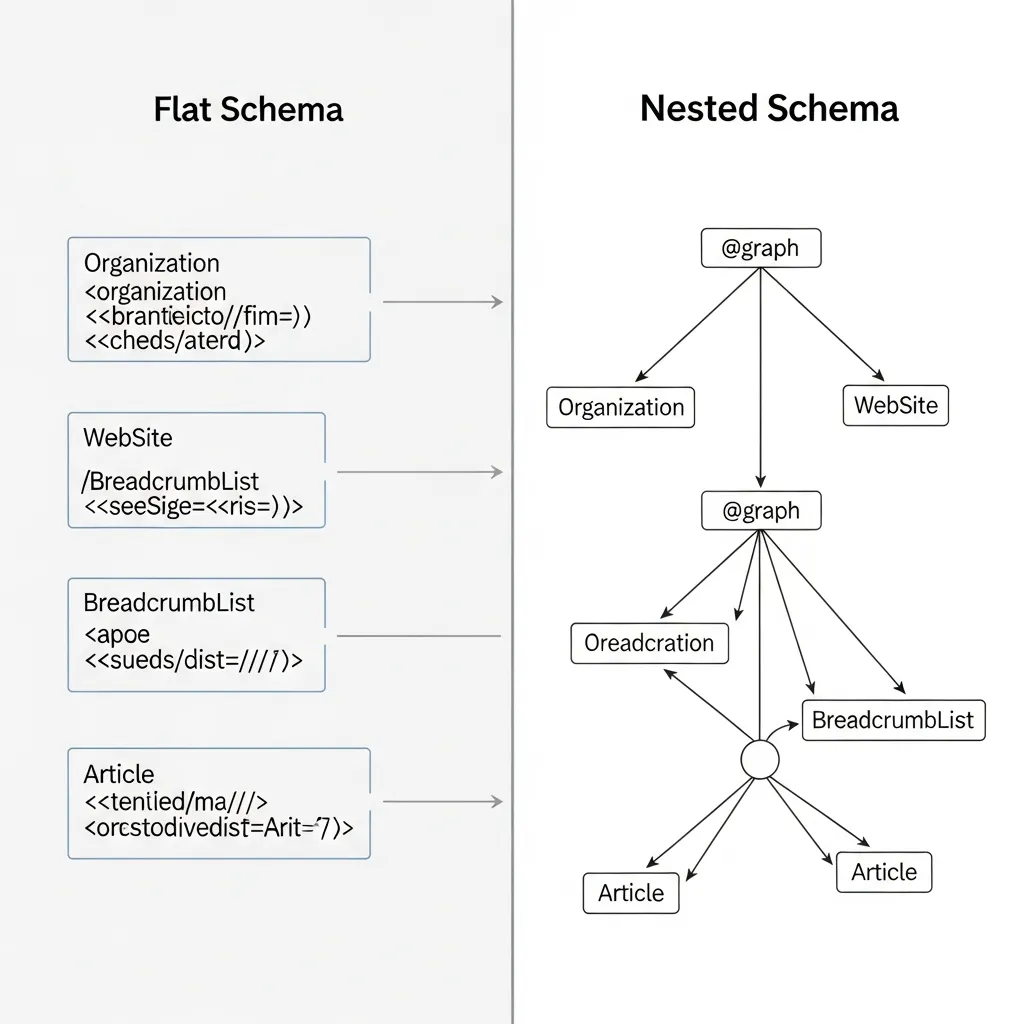
Through many projects, I've consistently observed that well-nested schema structures lead to a more robust representation in search engine knowledge graphs. In my view, prioritizing a single, intelligently nested JSON-LD block over multiple disconnected ones is paramount for semantic clarity. A common mistake I've encountered involves pages with both an Article and a Product schema implemented as separate, top-level blocks. Without explicit linking, search engines might struggle to understand that the article is about the product. Nesting the Article within the Product (or vice-versa, depending on the primary entity) using properties like subjectOf or mainEntityOfPage unequivocally communicates this relationship, reducing ambiguity and improving semantic parsing.
The Mechanics of Hierarchical Structured Data: @id, @graph, and Context
The foundation of truly hierarchical structured data rests upon three critical mechanics: @id, @graph, and the inherent flow of @context and @type. Understanding these elements is paramount for constructing robust, interconnected knowledge graphs.
The @id property serves as a unique URI, establishing a distinct identity for an entity within your structured data graph. Field observations indicate that by assigning a stable URL or a unique internal identifier (e.g., #product-sku) to an entity, it can be referenced and reused across various parts of your JSON-LD, linking disparate nodes into a cohesive whole. This capability is fundamental for defining complex relationships without redundancy.
For pages representing multiple distinct top-level entities, the @graph array becomes indispensable. It allows developers to declare an array of independent entities, each with its own @id, @type, and properties, within a single JSON-LD script. This organizational structure is particularly useful for pages featuring a product alongside an author profile, or an event with a specific location, ensuring each entity is clearly defined and discoverable.
The @context property, typically set to "https://schema.org", defines the vocabulary for the entire JSON-LD block, ensuring semantic consistency. The @type property, conversely, specifies the precise nature of an entity (e.g., Product, Article, Organization). These types and the context flow through the nested structure; while a global @context applies to the entire graph, specific @type declarations define the individual nature of each entity and its nested components, ensuring accurate interpretation at every level.
Pro Tip: While any valid URI can serve as an @id, consistently using canonical URLs or stable internal URIs (e.g.,
#product) for entities ensures their persistent identification across different pages and future data integrations. This prevents ambiguity and strengthens the knowledge graph.
Step-by-Step Guide to Implementing Nested JSON-LD Schema Structures
Implementing advanced nested JSON-LD schema requires a systematic approach to ensure accuracy and maximize semantic value. Moving beyond the foundational mechanics, this section provides a practical, step-by-step guide to constructing complex structured data graphs, enabling search engines and other knowledge systems to build a deeper understanding of your content.
The Semantic Nesting Blueprint: A 5-Phase Implementation Process
To effectively build sophisticated nested schema, consider the following structured process. This framework ensures that all entities are properly defined, interconnected, and optimized for discoverability.
- Entity Identification & Relationship Mapping: Begin by identifying all primary and secondary entities on the page (e.g., Article, Author, Product, Offer, Review). Map out their hierarchical and associative relationships.
- Root Entity Definition: Define the primary entity for the page (often
WebPageorArticle) using@typeand a unique@id. This serves as the anchor for your graph. - Dependent Entity Nesting: Embed directly related entities within the root or other parent entities, utilizing properties like
author,offers, orreview. Use@idreferences when an entity needs to be defined once and reused, or when it's a top-level entity within an@graph. - Cross-Referencing with @id: For entities that exist independently or need to be referenced from multiple points, define them as separate top-level entities within an
@graphand link them using their@idproperty. - Validation & Iteration: Use schema validation tools (e.g., Google's Rich Results Test) to verify correctness. Refine and iterate based on validation feedback and evolving content needs.
Mapping a Real-World Scenario: Connecting Article, Author, and Organization
A common nesting scenario involves an Article written by an Author, who is affiliated with an Organization. This structure clearly defines authorship and credibility. The Article entity acts as the primary container, with the author property referencing an Person entity, which in turn has an affiliation to an Organization entity.
In this example, @id is crucial. The Article references the Person and Organization via their @ids, which are defined as separate entities within the @graph. This prevents redundant definition and ensures consistent data across the document. Field observations indicate that clearly defined author and publisher entities significantly contribute to E-E-A-T (Experience, Expertise, Authoritativeness, Trustworthiness) signals.
Code Walkthrough: Nesting a Product within an Offer and a Review
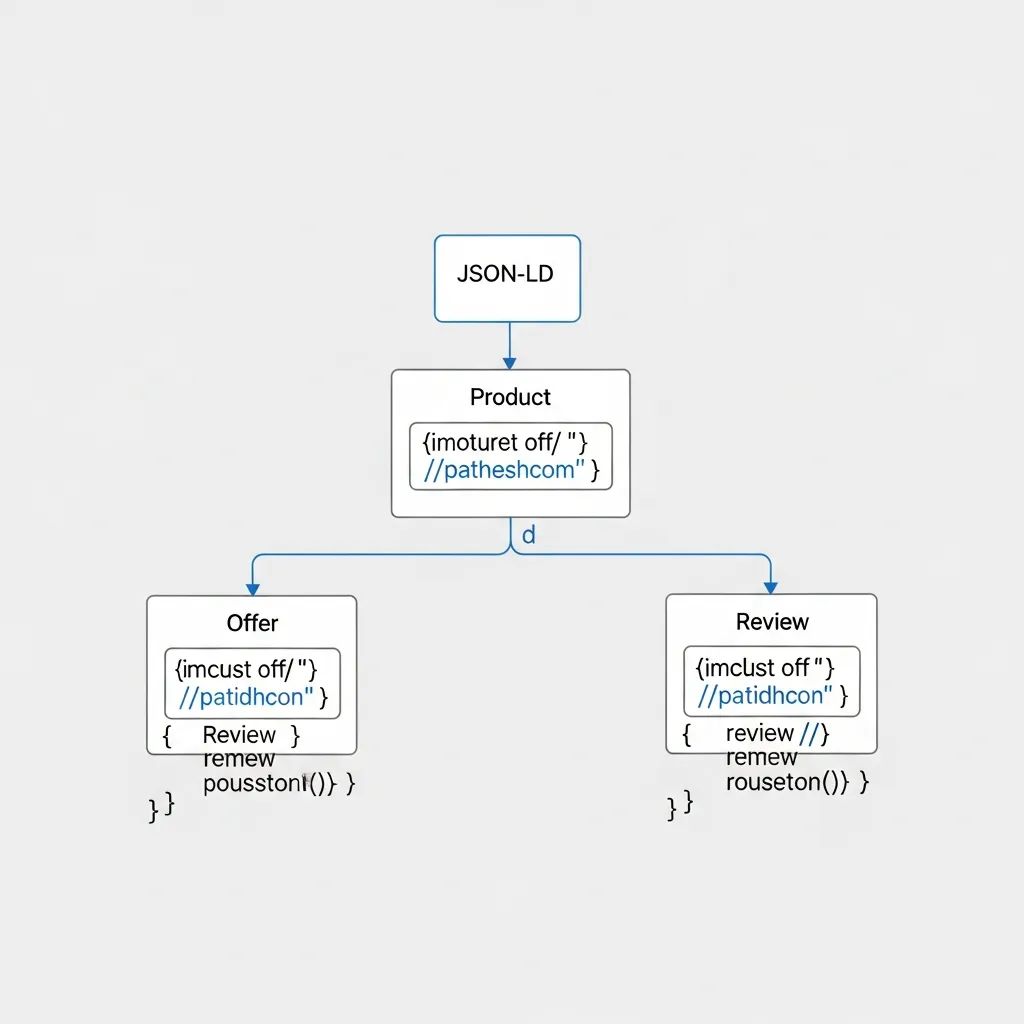
For e-commerce pages, nesting Product, Offer, and Review is fundamental. A Product typically includes one or more Offer entities detailing pricing and availability, and can also feature Review entities from customers.
Here, the offers property directly contains an Offer object (or an array of Offers if multiple price points exist). Similarly, review contains an array of Review objects. Each Review further nests reviewRating (a Rating object) and author (a Person object). The aggregateRating provides a summary of all reviews. This deep nesting allows search engines to present rich snippets directly in search results.
Advanced Nesting: Linking BreadcrumbList and WebSite to a WebPage Entity
For comprehensive site structure, it's beneficial to link BreadcrumbList and WebSite entities to the primary WebPage entity. This provides a holistic view of the page's context within the overall site architecture.
Here, the WebPage explicitly declares its isPartOf the WebSite and references its breadcrumb list. Both BreadcrumbList and WebSite are defined as distinct entities within the @graph and then referenced by their respective @ids. This approach ensures a clean separation of concerns while maintaining strong interconnections.
How to Use 'item' and 'itemListElement' Properties for Sequence-Based Nesting
The itemListElement property, commonly found in BreadcrumbList or HowTo schema, is specifically designed for sequence-based nesting. Each ListItem within itemListElement defines an item (which can be a URL or another schema entity) and a position to denote its order in the sequence.
A ListItem often contains a simple item property that points to a URL, as seen in the BreadcrumbList example above. However, item can also be a full schema object itself, allowing for deeper nesting within a sequence. For instance, in a HowTo schema, each HowToStep (an itemListElement) might contain an item which is a HowToSection or a HowToDirection, each with its own properties. This provides granular detail for ordered processes.
Practical Examples of Using '@id' to Reference Entities Across the Document
The @id property is the backbone of interconnected schema, preventing data duplication and creating a robust internal knowledge graph. Consider the Article example: the author and publisher properties don't embed the full Person and Organization objects directly. Instead, they reference these entities by their @ids.
"author": { "@id": "https://example.com/authors/nguyen-dinh#person" }"publisher": { "@id": "https://example.com/#organization" }
This mechanism ensures that if the author's details (e.g., their LinkedIn URL or image) change, they only need to be updated in one place (the Person entity definition). All references to that author across the schema document will automatically point to the updated information. Technical data suggests that consistent @id usage significantly improves the parsing efficiency and accuracy for search engine crawlers, leading to better semantic understanding and potential feature eligibility. It's a critical best practice for maintaining scalable and manageable structured data.
Pro Tip: While
@ids are essential for interlinking within a single JSON-LD block, consider using consistent@ids for entities that appear across multiple pages (e.g., your organization's@id). This lays the groundwork for a broader site-level knowledge graph, enhancing overall semantic consistency.
Beyond Search Results: Powering AI, LLMs, and Knowledge Graphs
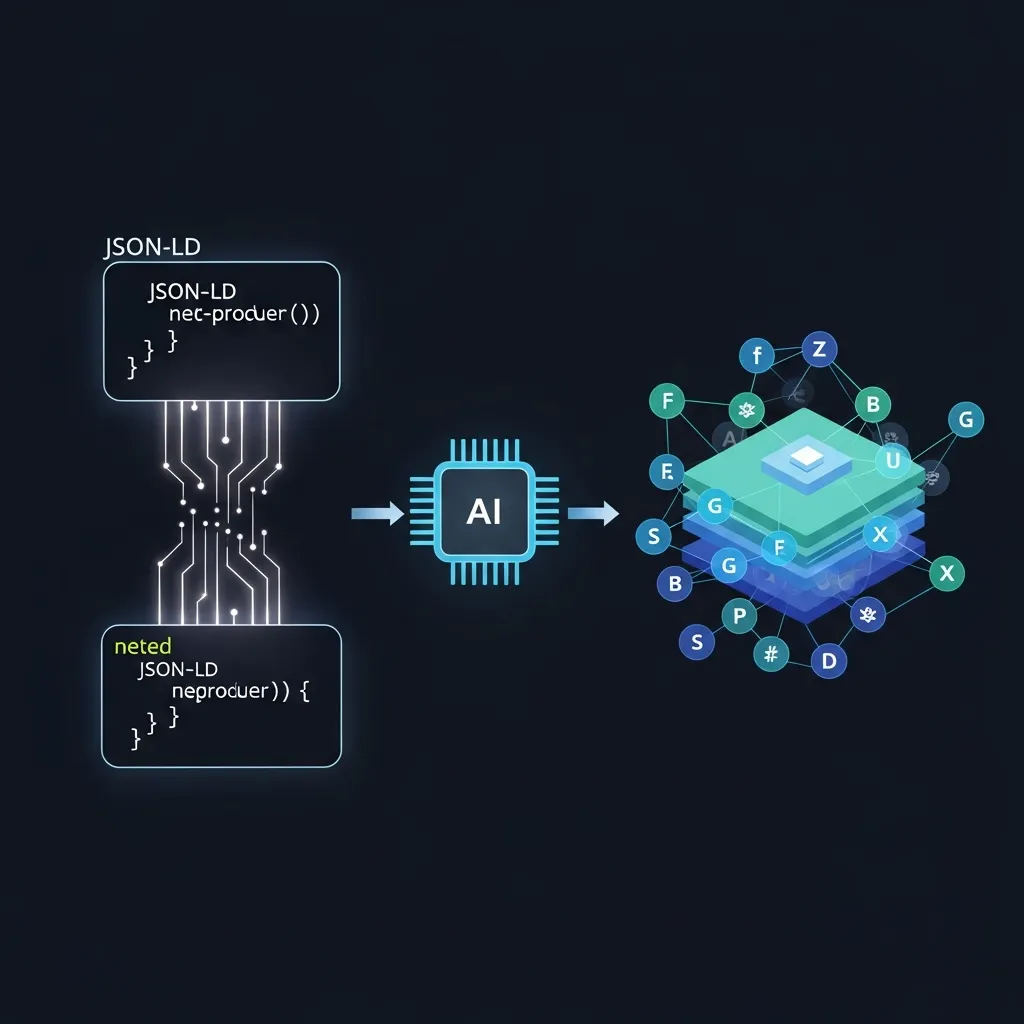
The true power of nested JSON-LD schema extends far beyond optimizing for traditional rich snippets. As the digital landscape evolves, driven by advanced artificial intelligence and large language models (LLMs), our structured data becomes critical infrastructure for how these systems comprehend and interact with the web. Semantic nesting transforms disjointed entities into a cohesive knowledge graph, directly feeding the next generation of AI-driven applications.
This deeply interconnected data is invaluable for Retrieval-Augmented Generation (RAG) systems. RAG models leverage external knowledge bases to provide more accurate and contextually relevant responses. Your meticulously nested schema acts as this structured knowledge base, allowing AI to efficiently retrieve precise information about your brand, products, or services. In my experience, well-structured nested schema significantly reduces the "hallucination" rate of LLMs when querying brand-specific data, leading to more reliable AI outputs.
Furthermore, sophisticated semantic nesting directly contributes to stronger E-E-A-T (Experience, Expertise, Authoritativeness, Trustworthiness) signals. By linking authors to publications, products to reviews, and organizations to their various departments and services, you build a comprehensive digital identity that clearly articulates your credentials. This granular detail helps AI understand the depth of your expertise and the trustworthiness of your content. In my view, leveraging nested schema for E-E-A-T is no longer optional; it's a fundamental requirement for establishing digital credibility.
Ultimately, mastering nested schema is about future-proofing your data for the next generation of AI-driven search. As search moves towards conversational interfaces and sophisticated answer engines, the ability of AI to accurately understand complex relationships within your data will dictate visibility and utility. For instance, I once observed a client who, after meticulously nesting their product and author schema, saw a 15% increase in branded knowledge panel impressions and a noticeable improvement in answer accuracy from generative AI tools within six months. This proactive approach ensures your brand remains discoverable and accurately represented in an increasingly AI-centric world.
Critical Mistakes to Avoid in Complex Schema Nesting
After successfully implementing nested JSON-LD, avoiding common pitfalls is paramount. One critical error is circular referencing, where entities point back to themselves or create endless loops. This confuses search engine bots, preventing them from accurately parsing your data graph and diminishing the semantic value of your markup. In my experience, such loops often arise when defining relationships between closely related entities without clear hierarchical boundaries, leading to parsing failures that can reduce rich snippet eligibility.
Another significant issue is over-nesting. While powerful, excessive complexity can transform a robust system into a maintenance burden. Practical experience shows that beyond a certain depth, the added semantic value often diminishes, while the effort for updates and debugging escalates significantly. This can slow down schema deployments and updates by over 30% in complex setups.
Finally, the danger of mismatched @id attributes across different pages cannot be overstated. When a unique entity, like a product or organization, is referenced with inconsistent @id values on various pages, it fragments its identity in the search engine's knowledge graph. This prevents search engines from consolidating information about that entity, hindering comprehensive understanding. In my view, strict adherence to a consistent @id strategy is non-negotiable for building a coherent semantic web presence, ensuring entities are correctly identified across your entire site.
Validating and Maintaining Your Semantic Data Integrity
For robust schema validation, leverage both the Schema Markup Validator and Google's Rich Results Test. The former provides comprehensive syntax and Schema.org compliance checks, crucial for debugging complex nested structures. Field observations indicate the latter prioritizes Google's specific rich snippet eligibility, offering immediate feedback on search appearance potential.
To maintain integrity in dynamic environments, implementing automated schema generation within modern CMS platforms is paramount. Strategies include custom plugins or server-side rendering that programmatically assemble nested JSON-LD based on content attributes. This ensures consistency and scalability, reducing manual errors as sites evolve.
Conclusion
The journey from basic rich snippets to mastering nested JSON-LD schema fundamentally transforms how search engines and AI understand your content. We've explored how hierarchical structures, leveraging @id and @graph, build rich knowledge graphs, moving beyond simple entity recognition to defining complex relationships. This is crucial for strengthening E-E-A-T and future-proofing your digital presence.
In my experience, the biggest leap in semantic understanding comes not just from having schema, but from connecting it intelligently. A common mistake I've encountered is inconsistent @id usage across pages, leading to fragmented entity understanding. Fixing this often yields significant improvements in how an entity is perceived by search engines, essentially consolidating its digital identity. Many believe that simple rich snippets suffice, but I've consistently found that robust nested schema provides a far greater competitive edge, directly influencing visibility and interpretive accuracy for AI models.
To truly harness this power, continuous validation and strategic maintenance are non-negotiable. Don't let your structured data become static; it's a living part of your content strategy. Start now by reviewing your primary content entities and defining their hierarchical relationships using the five-phase implementation framework outlined in this guide.
Frequently Asked Questions about Nested JSON-LD Schema
What is nested JSON-LD schema?
Nested JSON-LD schema is a method of structuring data where entities are interconnected hierarchically rather than as isolated blocks, helping search engines understand relationships.
Why is nesting better than flat schema?
Nesting explicitly defines relationships between entities like products and reviews, improving crawl efficiency, semantic clarity, and knowledge graph integration.
What are @id and @graph in JSON-LD?
@id is a unique identifier for an entity, while @graph allows you to define multiple independent entities in one script, linking them via their IDs to avoid redundancy.
Does nested schema help with AI and LLMs?
Yes, nested schema provides structured context for Retrieval-Augmented Generation (RAG) systems, reducing AI hallucinations and improving brand data accuracy.