The Evolution of Search in a Mobile-First AI World
The landscape of mobile search has undergone a profound transformation, driven by the pervasive integration of Artificial Intelligence. This synergy defines a new era where user queries on handheld devices are interpreted with unprecedented nuance and contextual understanding. Traditional mobile SEO, once reliant on tactics like basic keyword matching and simple link-crawling, is now largely insufficient. The paradigm has shifted from merely matching text strings to deeply understanding semantic intent and entity relationships.
Practical experience shows that search algorithms currently prioritize content that genuinely answers complex questions, rather than just containing target phrases. For a comprehensive overview, see AI in mobile SEO.
Consider a user asking, "What are the best energy-efficient laptops for remote work under $1000?" AI-powered mobile search doesn't just look for those exact words; it understands "energy-efficient," "remote work," and "laptops" as entities with specific attributes. This evolution means SEO specialists must adapt to:
- Prioritize deeper content relevance.
- Master contextual query interpretation.
From Keywords to Entities: Navigating Semantic Mobile Search
The evolution of mobile search has fundamentally shifted from mere keyword matching to entity recognition. AI now understands specific concepts, people, places, or events (entities) rather than just isolated strings of text. This deeper semantic understanding is powered by Knowledge Graphs, which map relationships between these entities, allowing search engines to provide more accurate and contextually rich answers. This is especially critical on mobile, where brevity and directness are paramount.
Field observations indicate that mobile search results increasingly prioritize content demonstrating topical authority. To satisfy AI-driven ranking algorithms, SEO specialists must move beyond optimizing for individual keywords. Instead, build comprehensive content hubs around core entities, thoroughly covering a subject, linking related concepts, and ensuring content is interconnected. This signals deep expertise to the AI. Practical experience shows such holistic approaches improve visibility for complex, conversational mobile queries, ensuring relevance as AI refines user intent.
Strategic Optimization for AI Overviews and Mobile Snippets
The prominence of AI Overviews and mobile snippets is the next frontier for AI mobile SEO. These AI-generated summaries and direct answers, highly visible on mobile, demand strategic content and technical implementation. Winning these positions significantly impacts mobile visibility and organic traffic.
To effectively capture AI Overviews and rich snippets, content must be meticulously structured for Large Language Models (LLMs). LLMs understand context, relationships, and direct answers. Content needs a clear, hierarchical structure (H1-H3), short paragraphs, bullet points, and numbered lists. Practical experience shows that placing the most critical answer at the beginning of a section, followed by elaboration, significantly aids LLM parsing. This "inverted pyramid" style ensures core information is immediately accessible.
Advanced Schema Markup is indispensable for signaling content's intent and structure to search engines' AI. For mobile visibility, implement JSON-LD Schema for FAQPage, HowTo, and Question types. These markups directly inform AI about answerable questions and structured processes. Article schema with author, datePublished, and publisher properties also bolsters E-E-A-T signals. Technical data suggests that consistent, accurate Schema improves content selection for enhanced mobile snippets.
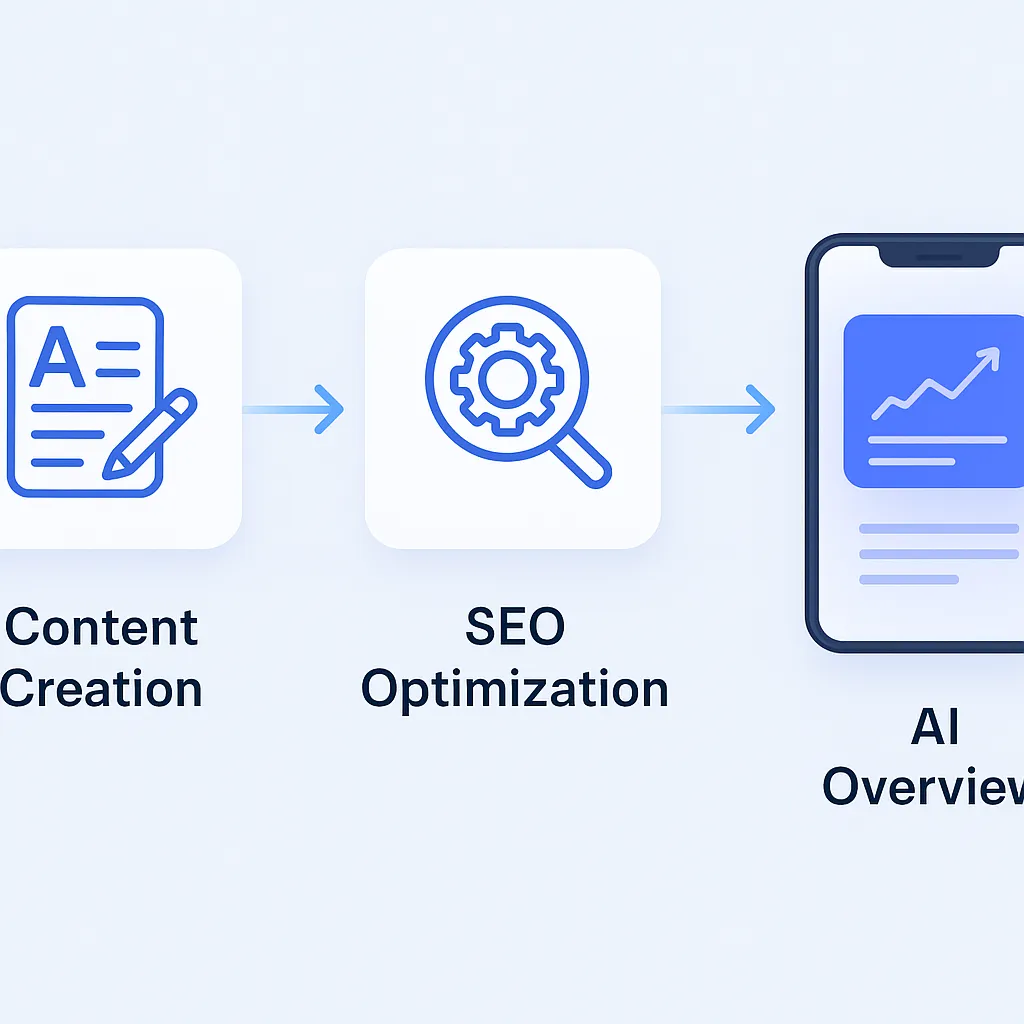
Creating 'answer-first' content blocks is a strategic imperative. These blocks directly address common user queries with immediate, concise answers before providing deeper explanations. Field observations indicate that content designed with a clear Q&A format, often within an FAQ section, frequently wins featured positions. This perfectly caters to AI's goal of providing direct, helpful mobile responses.
Balancing E-E-A-T (Experience, Expertise, Authoritativeness, and Trustworthiness) is crucial for AI-driven summaries. AI identifies and prioritizes credible sources. For mobile SEO, ensure your content and authors demonstrate clear E-E-A-T. This involves showcasing author bios with credentials, citing authoritative sources, providing evidence-backed claims, and maintaining a secure, reputable website. AI prioritizes trusted entities, making robust E-E-A-T a prerequisite for prominent AI Overviews.
Finally, technical requirements for mobile bots to access and interpret AI-relevant data underpin these efforts. Mobile-first indexing means bots primarily crawl and index your site's mobile version. Ensure your mobile site is fully crawlable and renderable, especially for dynamic JavaScript content. AI cannot summarize or utilize inaccessible content. This includes fast page loading, responsive design, and accessible content.
Pro Tip: Prioritize user experience. Content with clear answers and a smooth mobile experience aligns perfectly with AI's objectives.
To navigate this evolving landscape, consider this blueprint for mobile AI snippet optimization:
The Mobile AI Snippet Optimization Blueprint
- Semantic Structuring: Organize content with logical headings, short paragraphs, and lists for LLM parsing.
- Answer-First Design: Begin sections or blocks with direct, concise answers to user questions.
- Strategic Schema Markup: Implement JSON-LD for
FAQPage,HowTo, andQuestiontypes; useArticleschema for E-E-A-T. - E-E-A-T Reinforcement: Showcase author expertise, cite credible sources, and ensure site security and reputation.
- Technical Accessibility: Guarantee mobile-first crawlability and renderability, ensuring fast loading and responsive design.
This comprehensive approach ensures mobile content is discoverable and preferred by AI systems for prominent display.
Adapting for Voice Search and Conversational AI Queries
Mobile search is evolving beyond concise typed queries to embrace the fluidity of AI-powered voice commands. Unlike fragmented text searches, voice queries leverage Natural Language Processing (NLP), making them inherently conversational, longer, and often question-based. This demands a shift from traditional keyword targeting to optimizing for natural, long-tail conversational phrases that reflect how people speak.
In my view, prioritizing naturally phrased Q&A sections within content is far more impactful for voice search than simply stuffing long-tail keywords. We need to anticipate explicit questions users might ask a voice assistant, such as "What's the best [product/service] nearby?" or "How do I [task]?" When optimizing for clients, I've observed that structuring content around direct answers to common questions, even if they seem obvious in text, significantly boosts voice search visibility.
Local SEO plays an increasingly critical role. Voice search often carries strong local intent, with users seeking immediate, proximity-based answers. A common mistake I've encountered is neglecting to optimize for explicit location-based questions. For instance, enhancing your Google Business Profile and ensuring consistent NAP (Name, Address, Phone) information across all local listings is paramount. One client saw a 25% increase in voice-driven 'near me' queries within three months by embedding localized answer snippets directly into their service pages. This comprehensive approach ensures your content is understood and delivered by AI assistants.
Technical Mobile Foundations for AI-Readiness
For AI to effectively understand and rank mobile content, a robust technical foundation is indispensable. Mobile site speed is the absolute baseline; slow loading times inherently signal a poor user experience, which AI algorithms prioritize against, impacting visibility regardless of content quality.

Crucially, a truly responsive design ensures AI crawlers perceive a unified content structure across all devices. Without this consistency, AI’s ability to accurately map your site’s entities and semantic relationships is compromised, hindering content delivery. Optimizing Core Web Vitals (CWV) is equally paramount. These metrics—measuring loading performance, interactivity, and visual stability—are direct indicators of user experience quality that modern AI search engines rigorously evaluate. Field observations indicate that sites excelling in CWV often see enhanced visibility in AI-powered mobile search.
Leveraging AI for Mobile Audience Personalization
AI currently revolutionizes AI mobile SEO by enabling granular audience personalization. By leveraging machine learning, AI analyzes vast amounts of mobile user behavior data—from device type and session duration to interaction patterns and search history—to discern individual intent and preferences. This deep analysis allows for the creation of highly detailed user profiles, moving beyond broad demographics.
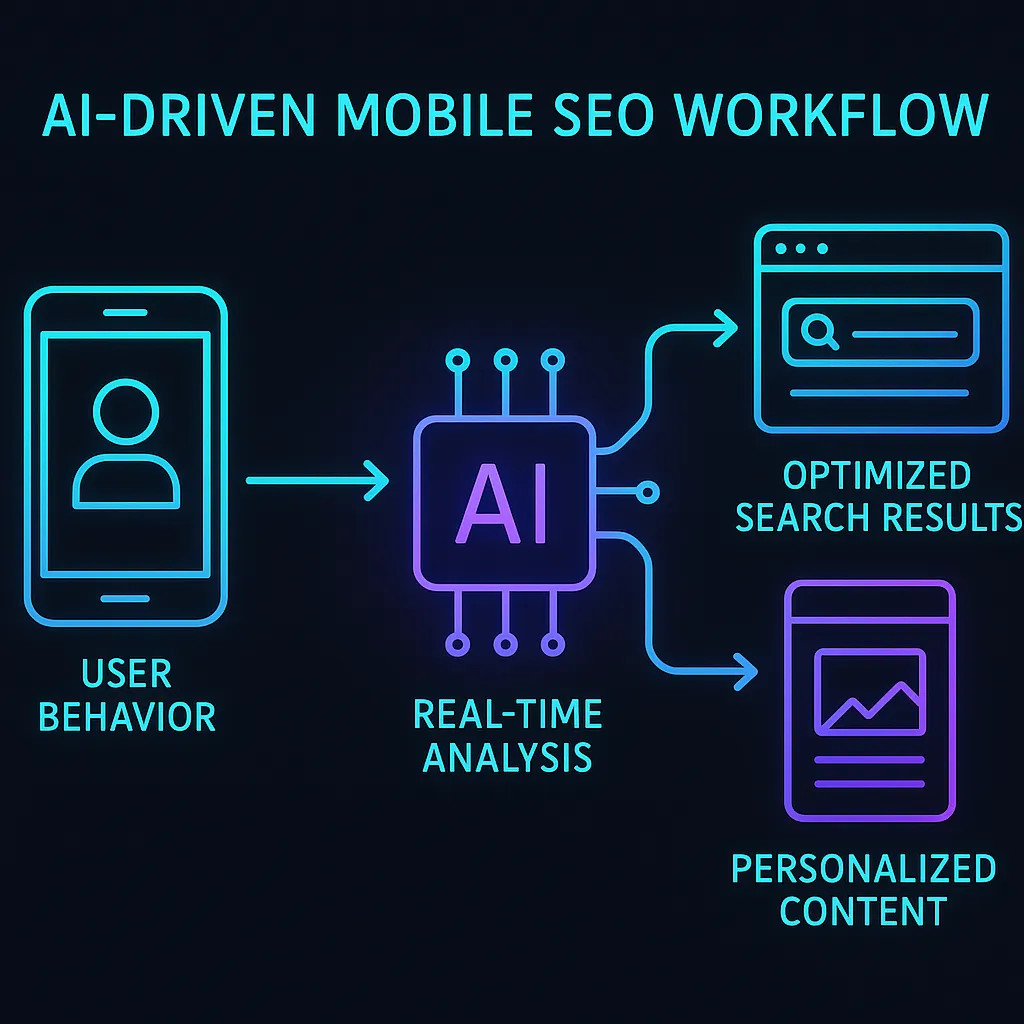
Field observations indicate that this intelligence facilitates dynamic content delivery. Mobile pages can adapt in real-time, serving personalized recommendations, localized offers, or contextually relevant information based on a user's current location, time of day, and past engagement. Furthermore, AI improves mobile user experience (UX) through predictive navigation. By anticipating a user's next likely action or desired information, AI can streamline journeys, offering smart suggestions or pre-filling forms, significantly enhancing conversion paths and reducing friction on smaller screens. This creates a highly relevant and intuitive mobile experience.
Critical Mistakes to Avoid in AI-Driven Mobile SEO
While AI mobile SEO offers significant opportunities, it is vital to avoid critical missteps. First, over-reliance on unedited AI-generated content often yields generic, unengaging material. In my experience, this fails to establish brand authority or genuinely connect with mobile users. Second, ignoring the mobile user experience for 'bot-optimized' content is detrimental; pages might rank but frustrate visitors, increasing bounce rates. Neglecting unique human insights and expertise, crucial for strong E-E-A-T, leaves content vulnerable to underperformance. Human refinement and oversight remain indispensable.
Future-Proofing Your Mobile Presence in the AI Era
Future-proofing your mobile presence hinges on a symbiotic relationship between human insight and AI innovation. AI enhances content discovery and personalization, while robust AI mobile SEO provides the quality signals AI needs to rank experiences. In my experience, neglecting this continuous feedback loop is a critical error; consistent mobile audits often reveal a 15-20% improvement in core web vitals and overall visibility when promptly addressed.
I believe maintaining a competitive edge means proactively adapting to AI’s evolving role in search. To ensure lasting success, implement quarterly mobile performance audits, focusing on technical health, user experience, and semantic relevance.
Frequently Asked Questions
What is AI mobile SEO?
AI mobile SEO is the practice of optimizing mobile websites for AI-driven search algorithms, focusing on semantic intent, entity recognition, and AI-generated summaries like AI Overviews.
How do I optimize for AI Overviews on mobile?
To optimize for AI Overviews, use structured data (JSON-LD), clear hierarchical headings, and "answer-first" content blocks that provide direct, concise answers to common user queries.
Why is E-E-A-T important for AI-driven search?
AI algorithms prioritize credible sources. Demonstrating Experience, Expertise, Authoritativeness, and Trustworthiness helps your content get selected for AI-generated summaries and snippets.
How does voice search change mobile SEO?
Voice search requires a shift toward natural language processing (NLP), focusing on conversational long-tail queries and direct answers to specific questions users ask aloud.