The Shift from Keywords to Topical Authority
The landscape of search engine optimization has undergone a seismic transformation. Search algorithms currently prioritize semantic understanding, interpreting user intent and contextual relationships between queries rather than simple keyword matching. This shift renders individual keyword targeting, while foundational, insufficient for securing top rankings.
Observations indicate that websites focusing on isolated terms often struggle to establish true authority. Imagine a marketer optimizing for "email marketing tips" but neglecting "segmentation strategies." This fragmented approach fails to signal comprehensive expertise.
- Challenges: Fragmented content, missed ranking opportunities.
- Outcome: Diminished visibility.
This evolution necessitates a move towards keyword research topic clusters, a strategic framework organizing content around broad themes. This method, which refines traditional keyword research, ensures holistic coverage of user queries and builds genuine topical authority.
The Strategic Benefits of Implementing Topic Clusters
Implementing topic clusters fundamentally reshapes website structure, creating a logical, interlinked hierarchy that significantly improves site architecture and crawlability. By organizing content around a central pillar page and supporting cluster content, search engines can more efficiently discover, understand, and index your entire knowledge base. Industry data suggests this structured approach optimizes crawler efficiency.
This systematic organization is paramount for establishing topical authority and expertise within a specific niche. When your site comprehensively covers a subject from multiple angles, search engines recognize you as a definitive source, rewarding you with higher rankings across a wider array of related queries. Simultaneously, this enhances the user experience by providing comprehensive answers; users navigate seamlessly from broad overviews to detailed sub-topics.
Furthermore, implementing topic clusters is a powerful strategy for reducing the risk of keyword cannibalization. By clearly defining the primary focus of each content piece—a central pillar for broad topics and spokes for specific long-tail queries—you prevent multiple pages from inadvertently competing for the same search terms. Practical experience shows this clarity strengthens individual page rankings and overall search visibility.
Distinguishing Keyword Clusters from Topic Clusters
Keyword clusters group similar search terms sharing a common intent, all targeting a single, authoritative page. For instance, related terms like "best CRM software" and "top CRM platforms" optimize one comprehensive content piece. This approach captures diverse phrasing for the same core user need, enhancing a page's relevance for related queries.
Conversely, topic clusters represent a broader structural model. This strategy organizes multiple interlinked pages: a central pillar page (high-level overview) and several supporting cluster content pages (in-depth sub-topics). Observations indicate this creates a cohesive content map, enhancing topical authority.
These two concepts work together seamlessly. Each individual page within a topic cluster, whether pillar or supporting, is itself optimized using a keyword cluster approach. This ensures granular page-level optimization within a robust keyword research topic clusters structure.
The ultimate determinant for cluster boundaries is search intent. If different keywords signal distinct user needs requiring separate, in-depth responses, they warrant dedicated cluster content pages. If multiple keywords reflect variations of the same fundamental query, they should be consolidated into a single page's keyword cluster.
A Comprehensive Guide to Building Your Topic Cluster Framework
Building a robust keyword research topic clusters framework is the cornerstone of modern SEO, enabling content marketers to establish topical authority and capture a wider net of relevant search queries. This strategic approach moves beyond individual keyword rankings to position your brand as the definitive resource within your niche. A well-structured framework not only boosts search engine visibility but also significantly enhances user experience and content discoverability.
Identifying Core Pillar Topics
The initial step involves identifying your core pillar topics. These are broad, high-volume subjects that represent the fundamental aspects of your business or industry. Think of them as the overarching themes that your audience frequently searches for. To uncover these, begin with high-level keyword research, focusing on broad terms that typically have significant search volume and reflect a wide range of user intent.
For instance, a business in the sustainable agriculture sector might identify "organic farming practices" or "soil health management" as potential pillars. These terms should be comprehensive enough to warrant extensive coverage but not so broad as to become unfocused. Effective pillars are typically those that can be broken down into at least 10-20 distinct sub-topics.
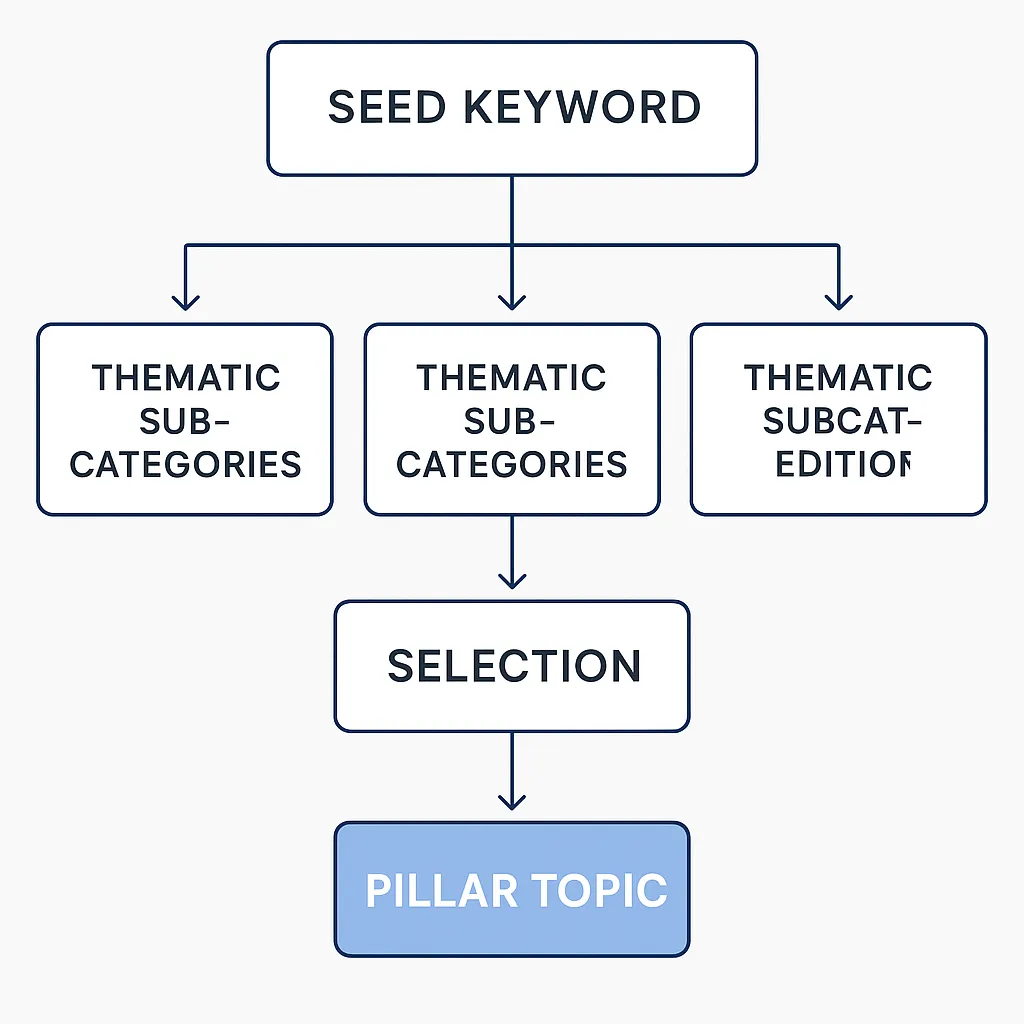
The Topical Authority Blueprint: A 5-Phase Cluster Framework
To systematically construct your topic clusters, experts advocate for a structured, phased approach. This framework ensures comprehensive coverage and logical content progression.
- Pillar Keyword Identification: Research and select broad, high-volume keywords that define your core business areas. These should be foundational to your overall strategy and capable of supporting numerous related sub-topics.
- Cluster Keyword Expansion: Conduct in-depth keyword research around each identified pillar. Utilize tools to uncover long-tail keywords, related questions, and semantic variations. Focus on informational and investigational intent.
- Intent-Based Grouping & Structuring: Group the expanded keywords into logical sub-topics or 'spokes'. Analyze search intent (informational, commercial, navigational, transactional) to determine if a keyword warrants its own dedicated content piece. Semantic relevance is paramount; ensure each group addresses a distinct facet of the pillar.
- Content Creation & Optimization: Develop the pillar page as the ultimate, comprehensive guide for its core topic. Subsequently, create individual cluster content pieces, each optimized for its specific sub-topic keywords and search intent.
- Internal Linking Strategy & Mapping: Establish a robust internal linking structure. The pillar page should link to all its cluster content, and cluster pages should link back to the pillar and to other relevant cluster pages. Map the content journey to ensure a logical flow from broad awareness to specific solutions.
Creating the Pillar Page: The Ultimate Resource
The pillar page serves as the central hub of your topic cluster. It is a comprehensive, high-level overview of the chosen pillar topic, designed to be the definitive resource on that subject. This page should be exceptionally well-researched, detailed, and regularly updated. While it covers the broad topic, it doesn't delve into exhaustive detail on every sub-point; instead, it provides strong internal links to the dedicated cluster content pages for deeper exploration.
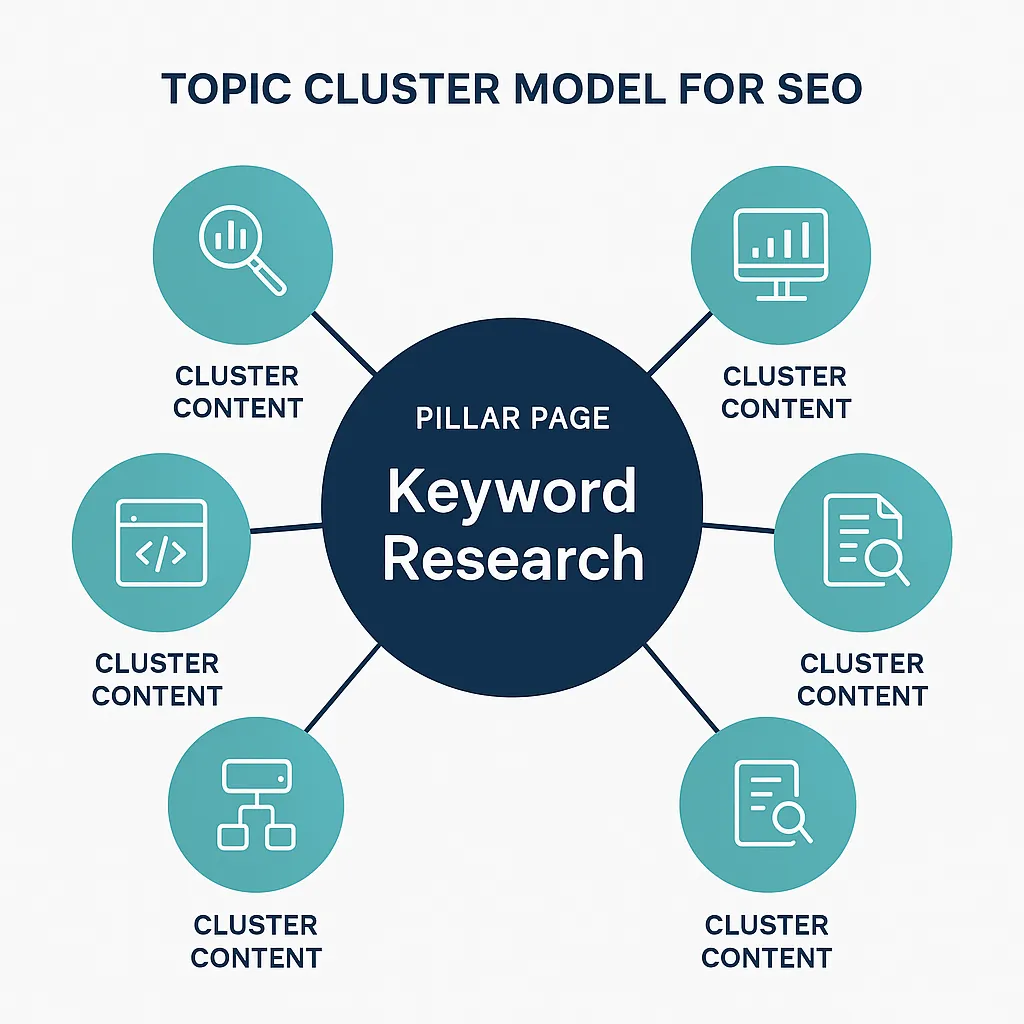
Developing Cluster Content: Addressing Specific Questions
Cluster content (or 'spoke' content) comprises individual articles, guides, or blog posts that delve deeply into the specific sub-topics identified during your keyword expansion. Each piece of cluster content should target a specific set of long-tail keywords, address particular questions, or explore a nuanced aspect of the pillar topic. For example, if your pillar is "digital marketing analytics," cluster content might include articles like "Understanding Google Analytics Custom Reports" or "ROI Measurement for Social Media Campaigns." These pages provide the detailed answers that users seek after encountering the broader pillar content.
Mapping the Content Journey
A crucial aspect of topic cluster implementation is mapping the content journey from awareness to conversion. Each piece of content should ideally serve a specific stage of the buyer's journey. Pillar pages often cater to the "awareness" stage, while cluster content can address "consideration" by offering solutions to specific problems, or "decision" by comparing products. By strategically aligning your content with user intent, you guide potential customers through a logical path, building trust and authority.
Key Insight: Don't just link internally; ensure those links logically progress a user's understanding or decision-making process. Think of it as constructing a cohesive narrative across your site, where each piece of content contributes to a larger story.
The Architecture of Internal Linking Within Clusters
The effectiveness of a topic cluster hinges significantly on its meticulously designed internal linking architecture. This structure primarily employs a 'Hub and Spoke' model, where the central pillar page acts as the hub, linking out to all supporting cluster articles (spokes). Crucially, this relationship must be bidirectional; each cluster article must link back to its overarching pillar page. Observations consistently indicate this reciprocal linking strongly reinforces the topical relationship for search engines, signaling comprehensive coverage of the subject matter.
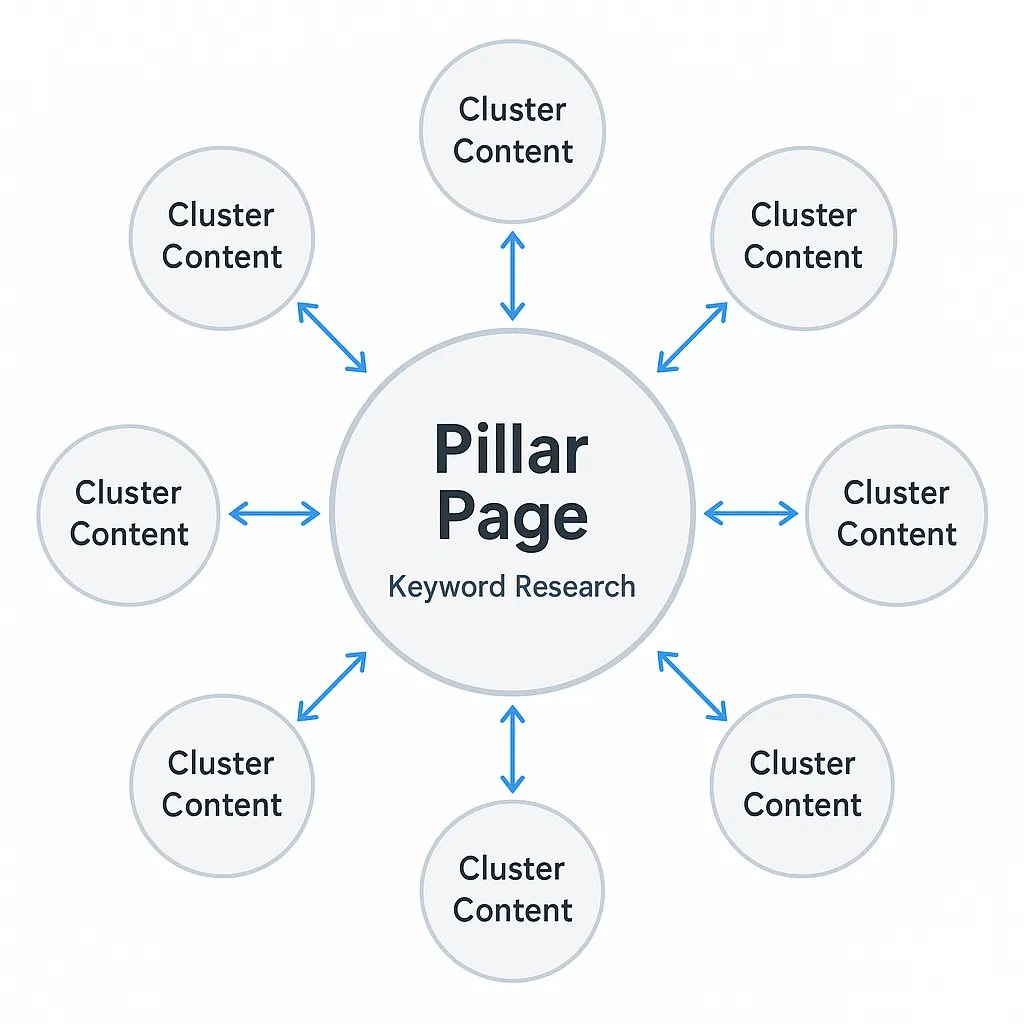
Using descriptive anchor text is paramount. Instead of generic phrases like "click here," anchors should clearly state the topic of the linked page, incorporating relevant keywords. This not only enhances user navigation but also signals strong topical relevance to search engines, aiding their understanding of your content hierarchy. This strategy is vital for ensuring link equity is effectively distributed across the entire cluster. When the pillar page accrues external backlinks, its equity flows through these internal links to the supporting cluster content, boosting individual ranking potential.
Avoiding Common Mistakes in Cluster Implementation
Even with a solid framework, effective cluster implementation requires vigilance to avoid common pitfalls. A frequent mistake is creating clusters that are either too narrow, missing broader search opportunities, or too broad, diluting topical authority and confusing search engines. In my experience, teams often struggle to maintain focus when clusters become unwieldy, leading to fragmented content rather than cohesive resources.
Another critical error is neglecting to update pillar pages as new supporting cluster content is published. This breaks the intended internal linking flow. Furthermore, over-optimizing anchor text with exact-match keywords risks search engine penalties. Diversifying anchor text with natural, varied phrases is paramount for safety and effectiveness.
Finally, ignoring dynamic search intent shifts can render an entire cluster irrelevant. What was once a high-value topic might evolve, requiring significant content adjustments. In my view, the most effective approach involves continuous monitoring and adaptation to ensure clusters remain aligned with user needs and algorithmic changes.
Strategic Insights: Outperforming Competitors with Topical Depth
Outperforming competitors requires a surgical approach to topical depth. Begin by meticulously identifying content gaps within their established clusters. This isn't just about what they've missed, but where their coverage lacks true depth. Concurrently, analyze the internal linking density of top-ranking sites to understand their authority signals.
Practical experience shows that leveraging 'People Also Ask' (PAA) and related search queries is invaluable for uncovering overlooked sub-topics. These insights provide unique angles to enrich your cluster.
A common mistake I’ve encountered is the pursuit of sheer content quantity. In my view, quality and depth consistently outperform a broader, yet superficial, content offering. When applying this method, I’ve found that a single, comprehensively explored sub-topic piece within a cluster often drives significantly more organic traffic than multiple shallow articles. This strategic focus ensures maximum topical relevance and ranking potential.
Future-Proofing Your Content Strategy
The implementation of keyword research topic clusters is the bedrock of a future-proof SEO strategy. They build sustained topical authority, ensuring your content remains relevant amidst evolving search algorithms. In my experience, neglecting cluster maintenance can lead to decay; a common mistake is treating clusters as static rather than dynamic entities.
Regular auditing—at least quarterly—is vital to identify content gaps and expand sub-topics. This proactive approach ensures your expertise continues to resonate. Moving beyond the pursuit of individual keywords, true topical mastery cultivates a robust, interconnected content ecosystem that consistently drives organic traffic. My opinion is that this holistic view dramatically outperforms siloed keyword efforts.
Start now by applying the Topic Cluster Audit Checklist to your highest-traffic content.
Frequently Asked Questions
What is the difference between keyword clusters and topic clusters?
Keyword clusters group similar search terms for a single page, while topic clusters are a structural model linking a central pillar page to multiple supporting cluster pages.
Why are topic clusters important for SEO?
They help establish topical authority, improve site architecture, reduce keyword cannibalization, and enhance user experience by providing comprehensive coverage.
How many sub-topics should a pillar page have?
An effective pillar page is typically broad enough to be broken down into at least 10-20 distinct sub-topics or cluster content pieces.
What is the hub-and-spoke model in SEO?
It is an internal linking strategy where a central pillar page (the hub) links to supporting cluster articles (the spokes), and those articles link back to the pillar.