The Evolution of Search Intelligence
The landscape of search engine optimization is undergoing a profound transformation. Traditionally, keyword research focused on high-volume terms and their immediate variations. However, with sophisticated search algorithms and conversational user queries, this approach often falls short. Currently, the intersection of SEO and keyword research RAG marks a pivotal evolution, moving beyond mere keywords to understanding complex user intent. Industry observations indicate that users now expect direct, comprehensive answers rather than just lists of links.
This shift necessitates an agile, intelligent approach. Imagine a content team spending days manually sifting through data, only to miss crucial long-tail opportunities. The efficiency of AI-driven workflows, powered by Retrieval-Augmented Generation, offers unprecedented advantages. This new paradigm redefines how we discover and leverage search insights, enabling us to:
- Uncover deeply relevant user intent.
- Streamline content ideation.
- Achieve superior search visibility.
As discussed in optimizing content, this allows for the rapid identification of nuanced queries, significantly enhancing content relevance.
How Retrieval-Augmented Generation Works for SEO
Keyword research RAG revolutionizes SEO by operating in three distinct, interconnected phases. The process begins with the Retrieval phase, where AI systems actively source live, dynamic search data. This involves meticulously analyzing current search engine results pages (SERPs), trending queries, and related user questions across platforms. Observations indicate that this real-time data acquisition is crucial, providing an up-to-the-minute understanding of actual user behavior and search engine responses, unlike static historical databases.
Next, the Augmentation phase takes this raw data and enriches it with profound context. AI models delve beyond mere keywords to decipher the underlying user intent. This involves understanding the semantic relationships between queries, identifying synonyms, and categorizing intent—whether informational, navigational, or transactional. Technical analysis suggests that accurately establishing this intent is paramount for crafting highly relevant content that genuinely addresses user needs.
Finally, the Generation phase translates these augmented insights into tangible content strategies. The system synthesizes contextualized keywords and identified intents to propose actionable content clusters and comprehensive topic hierarchies. This output guides content creators in developing robust content that addresses multifaceted user queries, ensuring superior search visibility and direct relevance. Practical experience shows this holistic approach transforms disparate data into a cohesive, impactful content blueprint.
A Step-by-Step Framework for RAG-Driven Keyword Discovery
Mastering modern search demands an understanding of user intent and semantic relationships beyond simple keyword identification. While RAG excels at contextual content generation, its true power for SEO lies in systematically uncovering valuable keyword opportunities. Practical experience shows a structured approach is essential to harness this capability effectively.
The Semantic Search Blueprint: A RAG-Driven Framework
Field observations indicate that successful RAG implementation for keyword discovery follows a distinct, iterative process. This framework ensures the AI's analytical prowess is directed toward strategic outcomes, moving beyond keyword lists to comprehensive topical insights.
-
Data Ingestion & Enrichment: A robust RAG system requires diverse, high-quality data. Feed the architecture with Google Search Console (GSC) performance data for current visibility and user queries. Augment this with extensive competitor URLs to analyze their content strategies. Crucially, integrate industry reports, whitepapers, and authoritative niche publications for a deep contextual understanding of market trends, jargon, and evolving user needs. This comprehensive data acts as the "retrieval" corpus, providing a rich factual base.
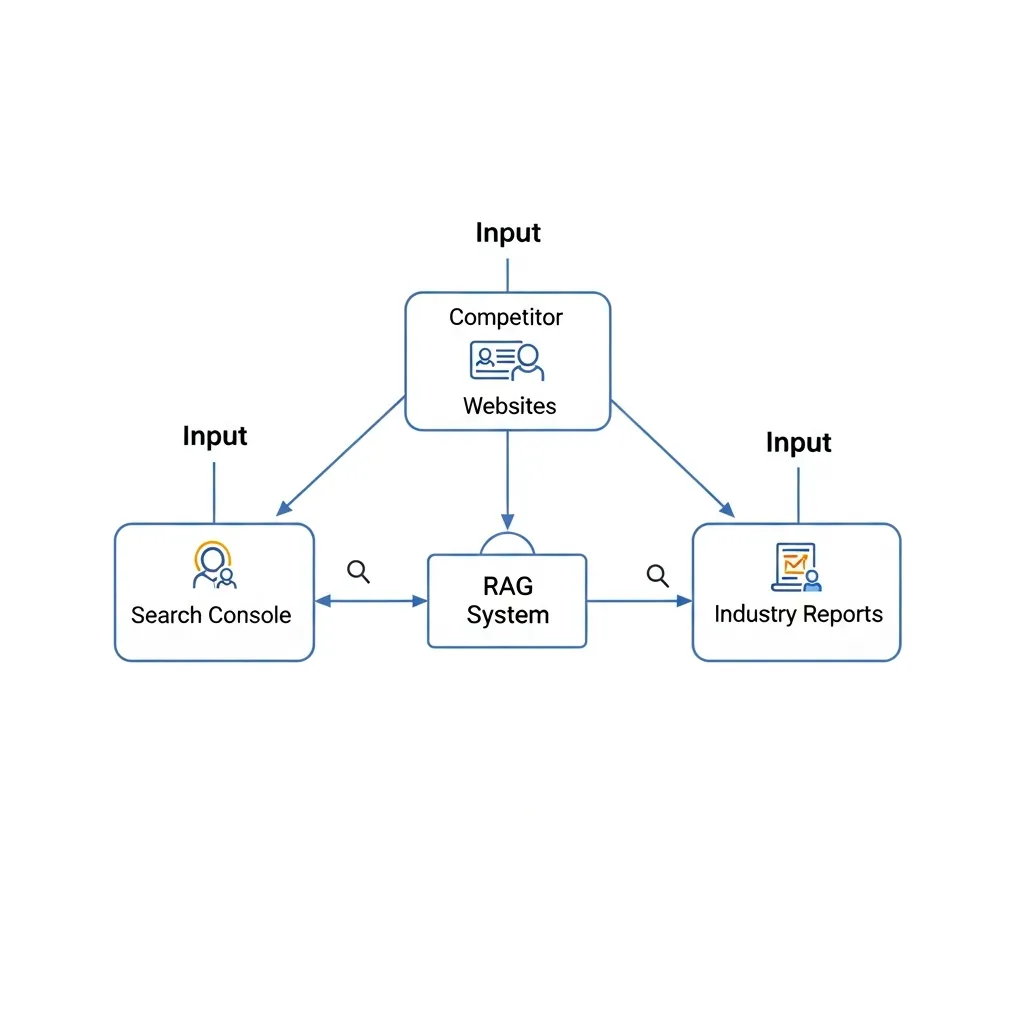
Diagram showing GSC, competitor data, and industry reports feeding a RAG keyword research system.
-
Intent Vectorization & Semantic Mapping: Once data is ingested, RAG transforms textual information into vector embeddings. This is critical for understanding semantic relationships and underlying user intent, moving beyond literal keywords. Each query or content piece is represented as a point in high-dimensional space; proximity indicates semantic similarity. For instance, "best CRM for small business" and "affordable client management software" vectorize closely, revealing shared intent. This allows RAG to identify latent connections and uncover long-tail opportunities.
-
LLM-Powered Filtering & Prioritization: With semantic relationships established, the RAG system's LLM filters and prioritizes keywords by evaluating vectorized queries against enriched data. It discerns between high-volume keywords (potentially competitive) and high-intent keywords (signaling strong conversion likelihood, even with lower volume). Technical analysis suggests that by analyzing related documents and GSC-inferred user behavior, the LLM assigns a "relevance score" that transcends search volume, focusing on commercial intent, informational depth, or transactional potential.
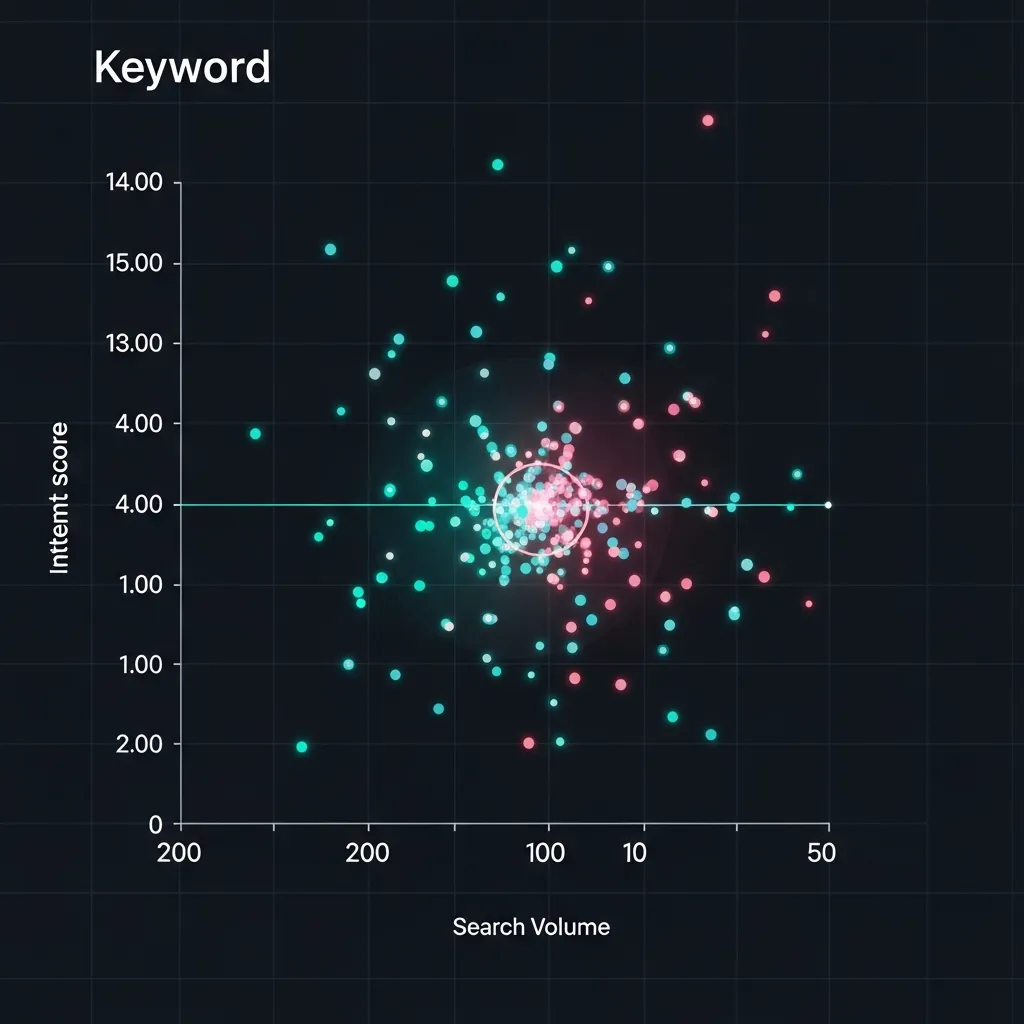
Scatter plot chart showing keyword search volume versus intent score for AI-driven SEO research.
-
Automated Topical Clustering for Authority: RAG's powerful automation groups semantically related keywords into coherent content clusters and topic hierarchies by identifying dense regions within the vector space. For example, "sustainable packaging solutions" and "eco-friendly shipping materials" would cluster under "Green Logistics." This is vital for building topical authority, signaling to search engines that your content comprehensively covers a subject, not just isolated keywords.
-
Human-in-the-Loop Validation & Refinement: While RAG offers unparalleled automation, human expertise remains vital. Human-in-the-loop validation is crucial for refining AI output. SEO professionals review generated clusters, intent classifications, and keyword prioritizations. This involves checking for AI-missed nuances, correcting misinterpretations, and adding strategic insights based on business goals or emerging market trends. This iterative feedback loop helps "teach" the RAG system, improving accuracy and strategic alignment.
Pro Tip: Regularly re-ingest fresh data from GSC and competitor analyses. Search landscapes are dynamic, and continuous data updates ensure your RAG system's insights remain relevant and actionable, preventing "data drift" in its understanding of user intent.
Comparing RAG Methodologies with Traditional Keyword Tools
When comparing keyword research RAG methodologies with traditional tools, the differences in efficiency and depth are stark. RAG systems represent a significant leap forward. When considering the speed of discovery, these systems automate the analysis of vast datasets, identifying complex semantic relationships in minutes. This sharply contrasts with manual spreadsheet analysis, which can take days or weeks for comprehensive audits. Practical experience shows that RAG can reduce the initial keyword identification phase by 70-80%, freeing up valuable human resources for strategic implementation.
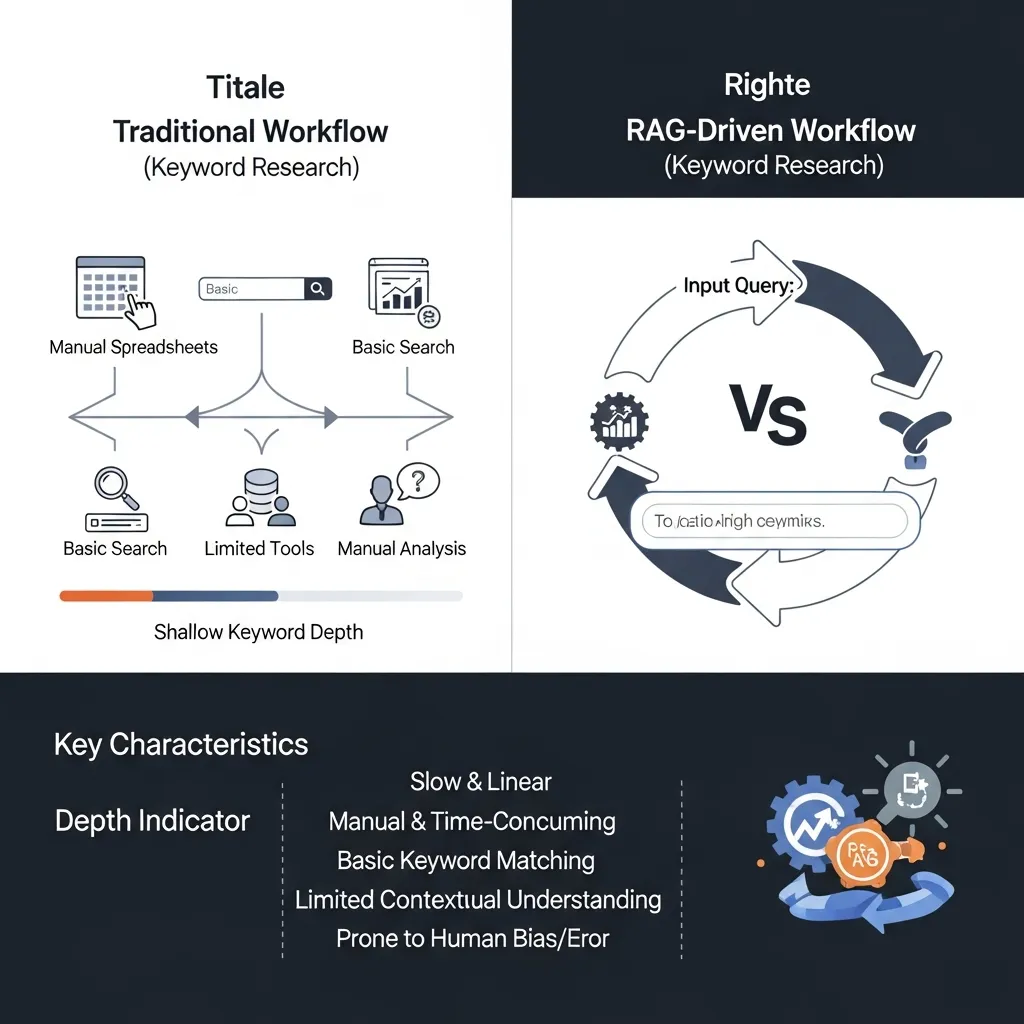
Furthermore, the depth of insight offered by RAG is unparalleled. Traditional tools primarily focus on exact match volume and keyword difficulty, providing a surface-level view. RAG, however, leverages semantic understanding to uncover user intent, related concepts, and latent long-tail queries that traditional methods frequently miss.
In my view, RAG's ability to unearth these semantic gaps within a niche is its most compelling advantage, leading to truly differentiated content strategies. When applying this method, I found that RAG consistently surfaced high-value long-tail opportunities that traditional tools overlooked, leading to significantly higher organic traffic for niche topics.
Currently, the cost-effectiveness of building internal RAG pipelines involves a substantial upfront investment. This includes data engineering, model training, and integration. While traditional tools carry ongoing subscription fees, RAG's initial costs can be higher. However, this investment yields a proprietary, highly customized system offering a competitive edge and insights tailored precisely to an organization's unique data and goals, often justifying the initial outlay over time.
Critical Errors to Avoid in AI-Assisted Research
Despite the power of keyword research RAG in uncovering deep semantic relationships, critical errors can undermine AI-assisted research. A primary concern is the danger of hallucinated search volumes. AI models, if not properly validated, can present plausible yet entirely fabricated data, leading to misallocated resources on non-existent opportunities.
Ignoring the seasonal nuances of search data is another significant pitfall. In my view, overlooking these cyclical trends severely misrepresents true user interest, resulting in poorly timed content launches.
Finally, an over-reliance on automation without manual SERP checking is a common mistake. While AI identifies potential keywords, a quick manual review of the top search results often reveals the true user intent and competitive landscape that automated tools can miss, ensuring content aligns with actual user needs.
Maximizing the Accuracy of Your Search Data
Maximum RAG accuracy relies on selecting high-quality 'ground truth' datasets. These are curated from reliable sources, reflecting user search behavior and successful content. In my experience, the integrity of this data directly correlates with the RAG model’s ability to discern nuanced intent.
For keyword categorization, prompt engineering is paramount. Precise, context-rich prompts guide the LLM to interpret and group keywords accurately. Vague prompts are a common mistake; define clear parameters and examples within the prompt to resolve this.
Iterative testing of retrieval parameters is indispensable. Continuously refining similarity thresholds ensures the RAG system pulls relevant information. In my view, this ongoing calibration effectively maintains robust accuracy in evolving search landscapes.
The Long-Term Impact of RAG on Content Strategy
The RAG advantage fundamentally redefines content strategy, enabling a profound grasp of user intent and facilitating the creation of truly comprehensive answers. This shift provides an unparalleled competitive edge.
In my experience, the most impactful results emerge when this AI efficiency is balanced with human creativity. While RAG uncovers nuanced opportunities, it is the human strategist who weaves these insights into compelling narratives. I believe its true value lies in augmenting human decision-making, not replacing it. To stay competitive, content teams must currently embrace RAG to future-proof their approach. Start by applying RAG's intent-mapping framework to your existing content.
Frequently Asked Questions
What is keyword research RAG?
Keyword research RAG (Retrieval-Augmented Generation) is an AI-driven process that combines real-time data retrieval with large language models to identify deep user intent and semantic keyword relationships.
How does RAG differ from traditional keyword tools?
Unlike traditional tools that focus on static volume data, RAG analyzes live SERP data and uses vector embeddings to understand the context and semantic meaning behind search queries.
What are the benefits of using RAG for SEO?
RAG streamlines content ideation, uncovers long-tail opportunities missed by manual analysis, and helps build topical authority through automated content clustering.
Can RAG replace human SEO experts?
No, RAG is designed to augment human decision-making. Human-in-the-loop validation is essential to refine AI outputs and ensure strategic alignment with business goals.