The digital landscape is undergoing a profound transformation, challenging the foundations of how users discover information and how marketers achieve visibility. For years, Search Engine Optimization (SEO) has been the cornerstone of digital strategy, meticulously aligning content with search engine algorithms. However, the rise of Generative AI is fundamentally altering this paradigm, moving beyond mere keyword matching to understanding intent and synthesizing answers.
Currently, many digital marketers and SEO professionals face a critical dilemma: traditional SEO tactics, while still relevant, no longer guarantee the same impact as AI-powered search results increasingly dominate the user experience. Field observations indicate a growing disconnect where content highly ranked for keywords might be bypassed by AI-generated summaries. This shift presents both a challenge and an immense opportunity:
- Navigating AI-driven content consumption
- Optimizing for nuanced user queries
- Redefining content authority
This article will explore the critical divergence in the geo vs seo landscape. We will provide a comprehensive framework to integrate GEO into your existing strategy, ensuring your content thrives in this new era. For a comprehensive overview, see What is Generative Engine Optimization?.
Defining the New Search Paradigm: SEO and GEO Explained
The digital marketing landscape is undergoing a profound transformation. At its foundation, Search Engine Optimization (SEO) remains the practice of enhancing organic visibility and ranking on traditional search engines. Practical experience shows SEO historically focused on optimizing content for keywords, technical performance, and backlinks.
However, the rise of AI-driven platforms introduces Generative Engine Optimization (GEO). This latest evolution focuses on tailoring content for generative AI models and conversational interfaces, where AI synthesizes answers directly. Field observations indicate that content designed solely for traditional SEO may struggle with these new AI systems.
The distinction between geo vs seo is crucial for modern digital marketers. Relying solely on traditional SEO risks diminishing organic presence within the evolving search ecosystem. For instance, an AI assistant seeking a synthesized answer will prioritize content structured for generative understanding. This shift demands content creators to:
- Adapt content structure for AI comprehension.
- Prioritize clarity and factual accuracy.
The Fundamental Divergence Between Traditional and Generative Search
The shift from traditional search engines to generative AI marks a fundamental divergence in how content is discovered and consumed. This isn’t merely an update; it’s a re-architecture of the underlying principles that govern visibility.
The very ranking factors have evolved. Traditional SEO heavily relied on keywords (exact match, semantic variations) and backlinks (quantity, quality, anchor text) as primary signals of authority and relevance. Generative AI, however, prioritizes factual accuracy, contextual relevance, and the content’s overall semantic depth.
A common mistake encountered in the field is content creators trying to force keyword density into their generative content strategies. While traditional SEO rewarded this, AI prioritizes semantic accuracy and contextual depth, often overlooking keyword-stuffed passages that lack genuine insight.
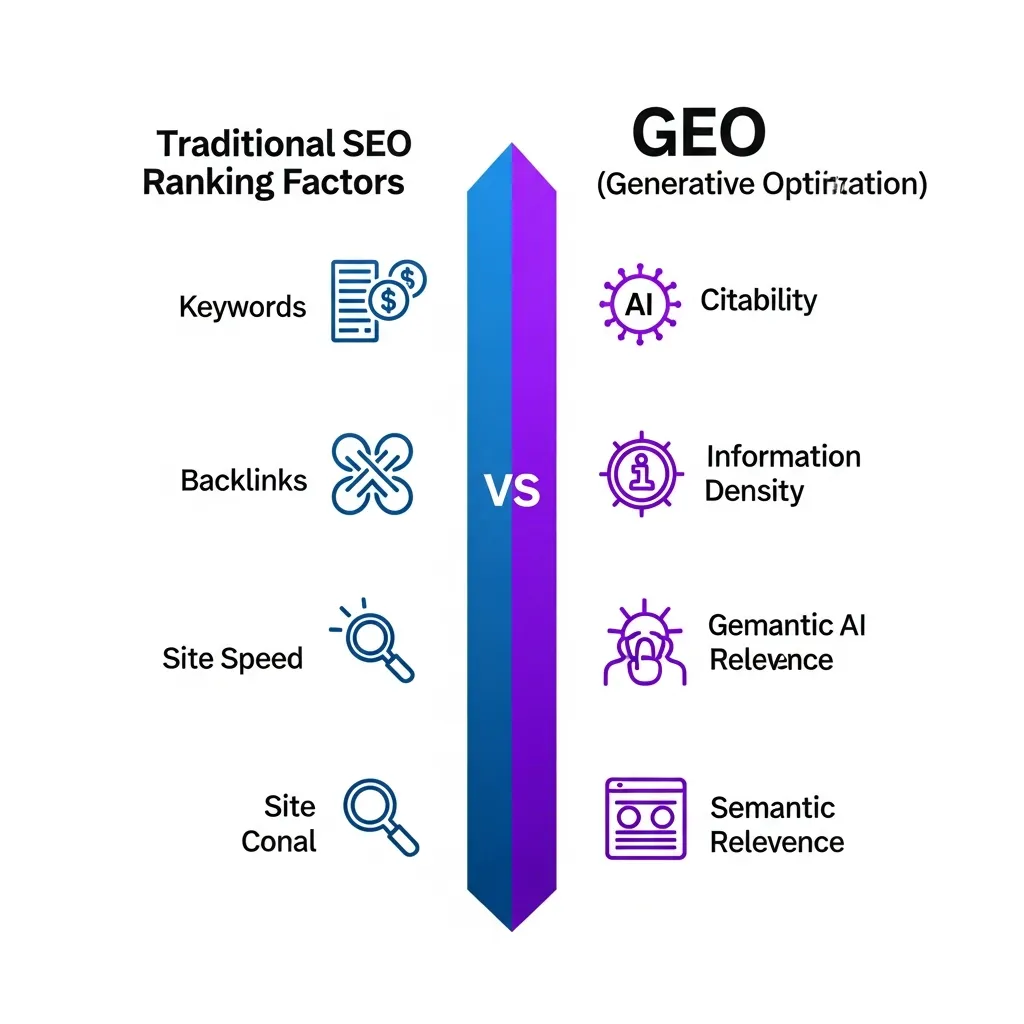
User intent has also undergone a profound transformation. Traditional search often served navigational (finding a specific site) or broad informational queries, leading users down a path of multiple clicks to piece together answers. The most significant shift lies in generative AI’s ability to handle conversational, problem-solving interactions, demanding content that directly answers complex questions and anticipates follow-ups, rather than just pointing to resources.
This fundamental difference also manifests in output formats. Where traditional search presented a list of blue links and occasional featured snippets, generative engines synthesize comprehensive AI overviews. Practical experience shows that while traditional SEO aimed for the top blue link, GEO aims for inclusion within the AI’s synthesized overview. Studies currently indicate a measurable decrease in organic click-through rates for informational queries where an AI provides a direct answer, making visibility through citation paramount.
The Role of E-E-A-T in Bridging the Gap
In the evolving landscape of generative AI, E-E-A-T (Experience, Expertise, Authoritativeness, and Trustworthiness) remains an evergreen cornerstone for content quality and visibility. Practical experience shows that while search interfaces transform, the fundamental need for credible, reliable information endures. These principles are no longer just ranking factors for traditional search; they are critical signals for AI engines seeking to verify the factual accuracy and contextual relevance of the information they synthesize.
AI models rely heavily on E-E-A-T to distinguish high-quality, truthful sources from unreliable ones, especially when generating comprehensive answers to complex queries. For AI to confidently present synthesized information, it must trust the underlying data’s provenance. Therefore, content exhibiting strong E-E-A-T signals is more likely to be selected as a foundational source for AI-generated overviews.
Crucially, the age of AI amplifies the importance of discernible author entities and verified credentials. Content attributed to individuals or organizations with demonstrable experience and expertise, supported by clear biographical information or industry recognition, gains significant weight. Field observations indicate that clearly establishing who created the content and their qualifications directly contributes to an AI engine’s ability to assess its trustworthiness and authority, making it a vital component for securing organic visibility in a generative search paradigm.
A Step-by-Step Framework for Integrating GEO into Your SEO Strategy
Navigating the geo vs seo shift necessitates a strategic evolution from traditional SEO tactics. While E-E-A-T forms the bedrock of trust, the practical implementation of GEO requires a refined content strategy. Currently, the goal isn’t just to rank for keywords, but to be recognized as the definitive source for a topic, providing content that AI models can confidently synthesize and cite. This involves a departure from focusing solely on keyword density to embracing a holistic, intent-driven approach.
To successfully navigate this landscape, digital marketers and content strategists can adopt a structured framework. Practical experience shows that integrating these elements systematically yields better results in an AI-powered search environment.
The GEO-SEO Unification Protocol
This five-step framework outlines how to adapt your existing SEO strategy to capture opportunities in generative AI search:
- Cultivate Comprehensive Topical Authority
Transitioning from a narrow focus on individual keywords to establishing topical authority and semantic depth is paramount. AI models seek comprehensive, authoritative answers. This means covering an entire topic thoroughly, addressing all related sub-topics, questions, and facets within a content cluster. Instead of creating multiple shallow articles targeting slight keyword variations, aim for fewer, deeper pieces that exhaustively explore a subject. Tools like Semrush’s Topic Research, Ahrefs’ Content Gap, or Surfer SEO can help identify comprehensive topical clusters and content gaps. Field observations indicate that content demonstrating deep expertise across a topic is significantly more likely to be featured in AI-generated summaries. - Engineer for AI Citeability
Generative AI thrives on verifiable information. To optimize for ‘Citeability’, your content must present unique, factual data that AI models can confidently attribute and reference. This involves integrating statistics, quotes from recognized experts, proprietary research findings, and unique data sets. Original studies, surveys, or case studies specific to your niche are invaluable. When citing external sources, ensure they are reputable and clearly linked. AI systems are designed to identify and prioritize content that offers distinct value and credible backing.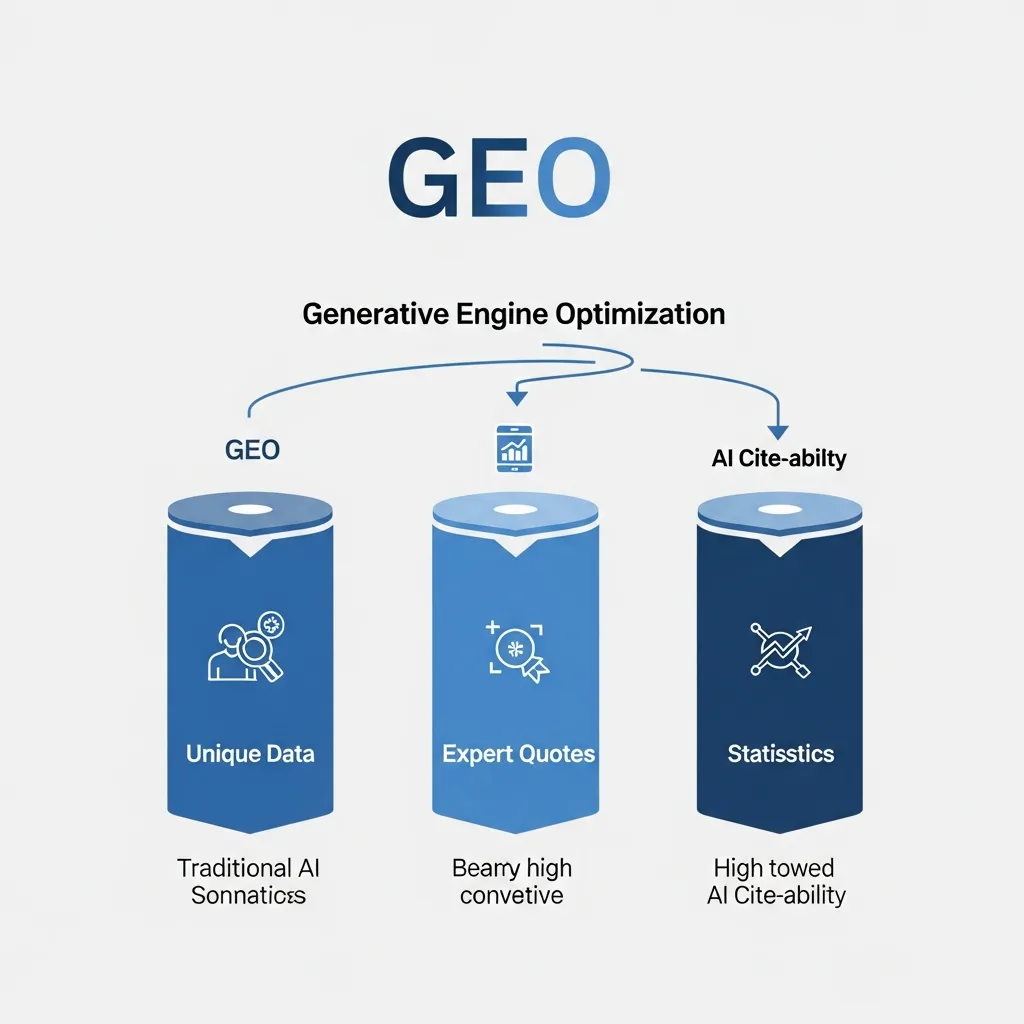
Infographic showing how unique data, expert quotes, and statistics drive AI cite-ability in GEO versus SEO.
- Implement Advanced Structured Data
Schema Markup and structured data are the machine-readable language that helps AI models understand the context and purpose of your content with greater precision. Beyond basic Article or BlogPosting schema, leverage advanced types such asFAQPage,HowTo,QAPage,Product, orReviewwhere appropriate. For example, usingQAPageschema on a forum explicitly tells AI that this content contains questions and expert answers, making it highly valuable for direct inclusion in generative summaries. Technical data suggests that content with well-implemented structured data is more easily parsed and utilized by AI for factual extraction. - Architect for Generative Answers
Develop a question-and-answer content architecture that directly addresses common user queries. This means structuring your content with clear headings that pose questions, followed immediately by concise, direct answers. Think about the types of questions users ask in natural language. For instance, instead of a heading “Benefits of Compost,” use “What are the benefits of composting?” followed by a bulleted list or short paragraph. This format directly aligns with how AI models process information to generate AI Overviews. - Leverage Intent-Based Content Clusters
Understanding and satisfying user intent at a cluster-level is crucial. Instead of optimizing for single keywords, group related keywords and topics by the underlying user intent (informational, navigational, transactional, commercial investigation). Create comprehensive content clusters where a main “pillar page” covers a broad topic, linking out to more detailed “cluster content” pages that address specific sub-intents. This strategy ensures that your site provides a complete answer ecosystem, making it a highly reliable and authoritative source for AI, which values interconnected, deep knowledge bases.
Pro Tip: When evaluating content for AI readiness, ask: “Could an AI confidently extract a definitive answer or a unique data point from this section without ambiguity?” If the answer is no, refine your content for clarity, conciseness, and verifiable facts.
Measuring Success: New Metrics for a Generative Era
The shift to generative AI necessitates a re-evaluation of how success is measured. Traditional metrics like organic traffic and keyword rankings, while still relevant, no longer paint a complete picture. Digital marketers must now track AI mention rates and brand citations, understanding how frequently generative models reference their content or directly attribute information to their brand. This signifies a profound shift from mere visibility to becoming a trusted, citable source that AI models synthesize and recommend.
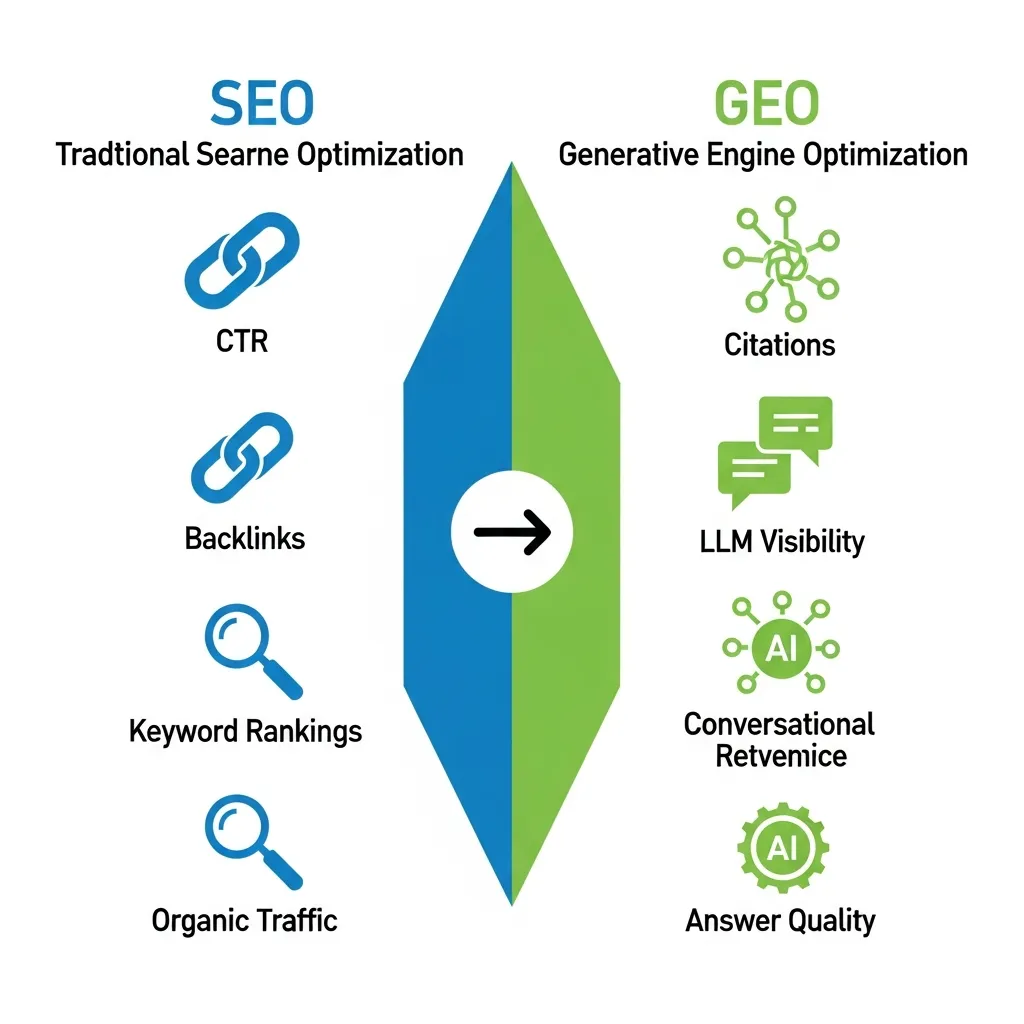
Beyond mere mentions, monitoring citation accuracy and brand sentiment within AI-generated responses is paramount. Field observations indicate that misinterpretations or negative portrayals by AI can significantly impact brand perception and trust. Proactive auditing is crucial. Specialized AI monitoring platforms, often leveraging advanced natural language processing (NLP), are emerging to scan generative outputs for brand mentions, assessing both their factual correctness and emotional tone. These tools enable professionals to gauge their share of voice in generative environments, analyzing not just if their content is used, but how often and how effectively it contributes to the AI’s synthesized answers.
Ethical Implications and the Authenticity Challenge
The rise of generative AI introduces significant ethical implications for content strategy. A primary concern is AI bias, which can stem from skewed training data, necessitating rigorous standards for transparent and fair content creation. Maintaining a distinct brand voice and authenticity also becomes challenging when AI synthesizes information, risking a homogenized digital landscape. Neglecting robust brand guidelines often results in generic outputs that dilute a brand’s unique identity and impact. Furthermore, content creators bear an undeniable ethical responsibility to provide accurate, reliable information. This extends beyond immediate search rankings; it’s about shaping the foundational knowledge AI models use, directly influencing the quality and trustworthiness of future generative search results.
Common Mistakes When Pivoting to GEO
Pivoting to GEO requires caution to avoid common missteps. A prevalent mistake is over-optimizing for AI at the expense of human readability; content becomes dense or unnatural. Chasing AI’s precise semantic needs often diminishes human engagement. Many also neglect fundamental technical SEO foundations, like site speed and structured data, mistakenly believing AI compensates for a poorly built site. A common error is prioritizing AI snippets over basic crawlability. Furthermore, relying entirely on AI-generated content without expert oversight risks inaccuracies and a lack of authentic voice. Human expertise remains critical for true topical authority.
Future-Proofing Your Strategy: The Unified SEO-GEO Approach
The future of visibility demands a unified geo vs seo approach. Relying solely on traditional SEO or generative optimization is insufficient. The most effective strategy involves seamlessly integrating both for sustained relevance. Search behavior is constantly evolving, with users seeking both direct answers and comprehensive summaries.
Brands embracing this dual-track approach achieve greater long-term authority and reach. A common pitfall is neglecting foundational SEO while chasing AI trends; a unified strategy prevents fragmentation, ensuring discoverable, valuable content across all platforms. Stay adaptable as generative technology matures.
Start now by auditing your current content strategy against both SEO and GEO principles.
Frequently Asked Questions
What is the main difference between GEO and SEO?
SEO focuses on ranking in traditional search engines using keywords and backlinks, while GEO (Generative Engine Optimization) optimizes content for generative AI models to synthesize and cite as direct answers.
Why is E-E-A-T important for GEO?
AI models use E-E-A-T (Experience, Expertise, Authoritativeness, and Trustworthiness) signals to verify factual accuracy and source credibility, ensuring the information they synthesize for users is reliable.
How can I optimize my content for AI citeability?
To improve citeability, include unique data, expert quotes, proprietary research findings, and statistics that AI engines can easily attribute and reference as a primary source of information.
Will traditional SEO become obsolete because of GEO?
No, traditional SEO remains foundational. A unified strategy combining both SEO and GEO is necessary for long-term visibility as users continue to use both traditional search and AI-powered overviews.