The digital landscape for local businesses is undergoing a profound transformation. Are your current marketing efforts effectively reaching potential customers in an era increasingly shaped by artificial intelligence? While foundational Search Engine Optimization (SEO) remains crucial, experience shows it alone may no longer secure prime visibility. Consider a local hardware store: beloved by the community yet absent from AI-generated summaries for “best hardware near me” because its online presence hasn’t adapted to new search paradigms.
This evolving environment presents both a challenge and a powerful opportunity. Businesses embracing this shift now will achieve a distinct competitive advantage. This guide introduces Generative Engine Optimization (GEO)—a strategic framework crafted to ensure your geo for local business efforts flourish. We will detail how to optimize your digital footprint to engage directly with customers utilizing AI-powered search. For a comprehensive overview, see Generative Engine Optimization locally.
This article aims to equip you to:
- Navigate AI’s influence on local search outcomes.
- Strengthen your local online presence.
- Capture more qualified local leads.
Understanding the Shift to Generative Engine Optimization
The search landscape is transforming. Users are no longer solely clicking “ten blue links”; instead, AI-powered engines are reshaping how information is delivered. This shift introduces Generative Engine Optimization (GEO), a specialized approach to optimizing your local business so it appears prominently within the concise, conversational answers generated by AI search platforms.
Unlike traditional engines that list links, modern AI platforms like Perplexity, Gemini, and Google’s Search Generative Experience (SGE) synthesize information to provide direct, personalized answers. For local businesses, visibility now hinges on being the authoritative source chosen for these AI-generated responses. Experience shows that businesses failing to adapt risk invisibility as users increasingly rely on synthesized answers.
- New visibility challenges are emerging.
- Proactive adaptation ensures a presence in AI-generated answers.
Imagine a user asking, “What is the best local coffee shop with outdoor seating?” An AI engine might directly name and describe a business based on optimized content, bypassing traditional search results entirely.
SEO, AEO, and GEO: Navigating the New Search Hierarchy
The landscape of online visibility has evolved dramatically. Initially, SEO (Search Engine Optimization) centered on keywords and technical factors to rank websites in search result lists. The goal was simply to appear high on the page. Next came AEO (Answer Engine Optimization), driven by direct answers and featured snippets. Here, the aim shifted to being the single, concise response displayed prominently, often above traditional organic results.
Currently, we are navigating the era of GEO (Generative Engine Optimization). This involves optimizing for AI search engines that synthesize information into conversational answers, often without providing direct links. Traditional ranking factors remain foundational; AI models still rely on signals like E-E-A-T (Experience, Expertise, Authoritativeness, Trustworthiness), website quality, and mobile-friendliness to identify credible sources. Neglecting these basics is a critical error.
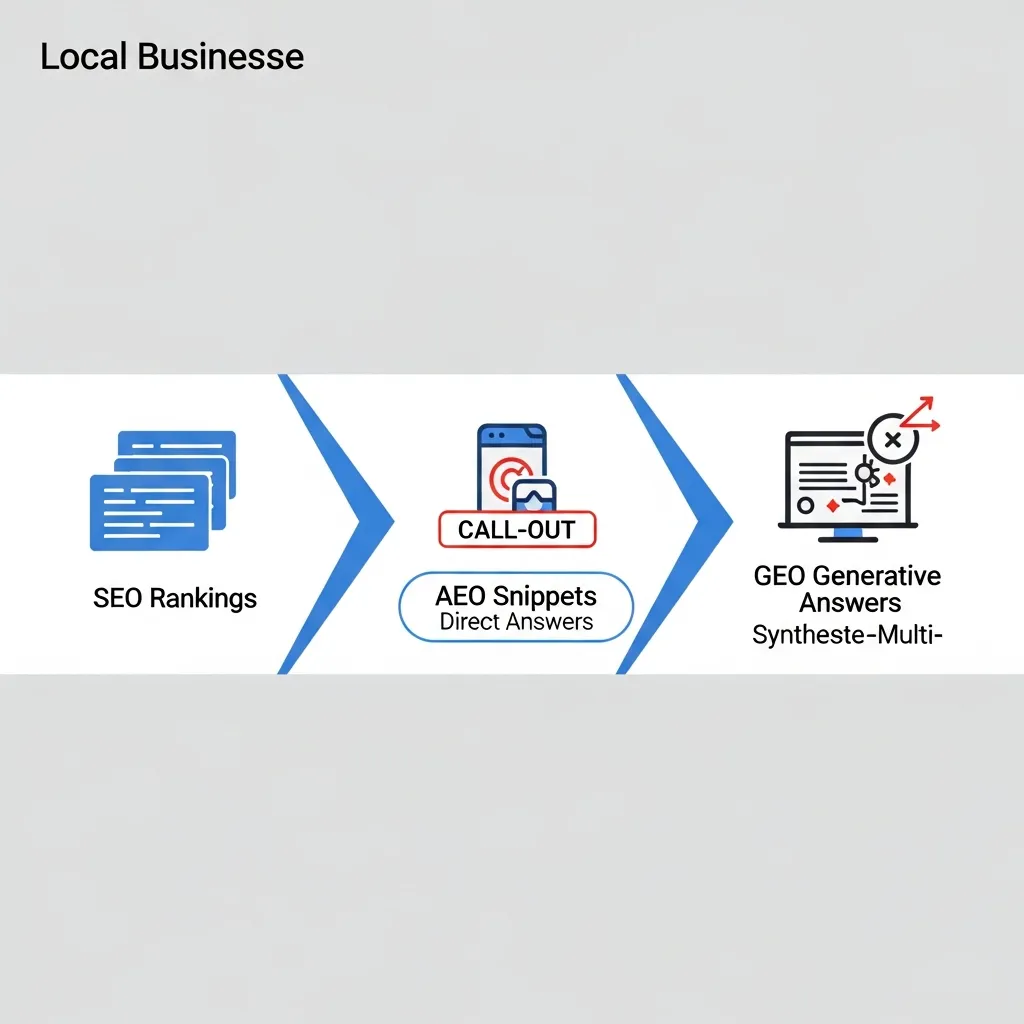
In my experience working with local businesses, a common mistake is neglecting the fundamentals of local SEO while chasing the latest AI trends. This often leads to AI engines overlooking content because the basic signals of trust and relevance aren’t strong enough. For local businesses, local relevance plays a unique and critical role. AI engines prioritize geographical context for “near me” or location-specific queries, synthesizing information from accurate Google Business Profiles, geo-tagged content, and local citations to recommend the most relevant options.
In my view, the most effective approach for local businesses is a layered strategy: build a robust SEO foundation, optimize for direct answers, and then elevate that with GEO principles.
The Core Pillars of Effective GEO for Local Business
Effective Generative Engine Optimization (GEO) for local businesses rests on three fundamental pillars designed to cater to the discerning nature of AI search.
First, Information Density is paramount. AI models excel at parsing comprehensive, structured data. Local businesses must provide exhaustive details about their services, products, operating hours, and unique attributes, ensuring this information is easily discoverable and consistently presented across your website and local listings. Research indicates that AI prioritizes sources offering clear, unambiguous answers to user queries.
Second, Citation and Source Reliability profoundly influence how AI attributes information to local brands. For AI to confidently synthesize and present your business’s details, your information must be consistent and verifiable across a broad spectrum of reputable online directories, review platforms, and mentions. A robust and consistent digital footprint builds critical trust signals for generative AI.
Finally, Natural Language Alignment is essential for the conversational AI search era. Content should be optimized for how users naturally ask questions, moving beyond traditional keywords to embrace long-tail and voice search queries. This means crafting content that directly answers common questions about your business, reflecting the conversational patterns of human interaction that AI is trained to understand.
Strategic Implementation: How to Optimize Your Local Business for Generative AI
The shift towards generative AI in search fundamentally redefines how local businesses must approach their online presence. It is no longer just about ranking; it is about providing answers and information in a format AI can readily consume, synthesize, and present to users. A proactive, structured approach to your digital assets is paramount for navigating this new landscape. Businesses failing to adapt risk being overlooked by AI models that prioritize comprehensive, verifiable data.
To effectively optimize for generative AI, adopting a comprehensive geo for local business strategy is paramount. This involves creating a rich, interconnected digital footprint that AI engines can easily understand and trust.
The AI-Ready Local Blueprint: 5 Strategic Steps
Implementing a robust GEO strategy requires a focused, multi-faceted approach. The following blueprint outlines key areas where local businesses can significantly enhance their visibility and “answerability” in the AI search era.
- Advanced Google Business Profile (GBP) Optimization for AI Data Extraction
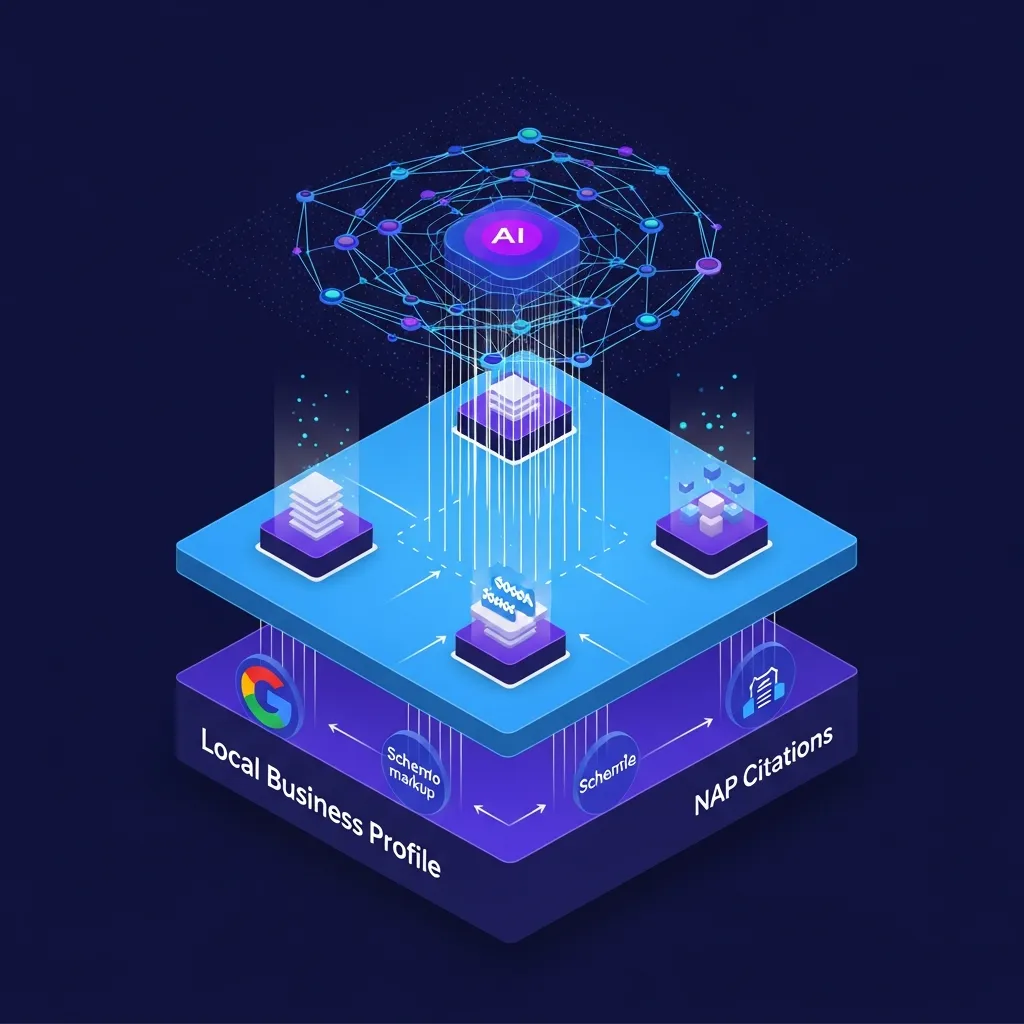
Your Google Business Profile is often the primary data source for AI models seeking local information. Beyond basic NAP (Name, Address, Phone) details, advanced optimization means populating every available section with rich, accurate, and frequently updated content. This includes comprehensive service lists, detailed product catalogs with descriptions, regular Google Posts announcing news or offers, and a robust Q&A section where you proactively answer common customer queries. High-quality, geo-tagged photos and videos of your premises, products, and team are critical, as AI increasingly relies on visual context. Furthermore, actively managing and responding to reviews not only builds customer trust but also provides AI with valuable sentiment data and additional keywords. Well-maintained GBP profiles are significantly more likely to be featured in AI-generated answers. - Implementing Comprehensive Schema.org Markup
Schema.org markup, or structured data, is the language AI models use to understand the content on your website. For local businesses, implementing specific schemas is non-negotiable. TheLocalBusinessschema should be meticulously filled out, including your exact address, phone number, opening hours, accepted payment methods, and areas served. Beyond this, integrateReviewschema to highlight customer testimonials,FAQPageschema for common questions and answers, and relevantServiceorProductschemas to detail your offerings. While the technical implementation of schema can be complex, numerous plugins and tools are available to assist. This structured data directly feeds AI knowledge graphs, making your information instantly digestible.
- Developing ‘Answer-Ready’ Location Pages
Your website’s location pages must evolve from simple contact pages into comprehensive resources designed to answer specific user intent. Create content that directly addresses long-tail, conversational queries customers might ask. For instance, instead of just “Our Services,” consider sections like “What are your gluten-free pizza options?” or “Do you offer emergency plumbing services after hours?” Incorporate detailed FAQs, specific service descriptions that include benefits and processes, and hyper-local content that references nearby landmarks or neighborhoods. The goal is to anticipate every potential question a local customer might have and provide a clear, concise answer directly on the page. - Building a Local Knowledge Graph Through Consistent NAP Across the Web
The foundation of AI trust for local businesses is consistency. Your Name, Address, and Phone number (NAP) must be identical across every online platform—your website, Google Business Profile, social media profiles, local directories (Yelp, TripAdvisor, etc.), and industry-specific listings. Any discrepancies, even minor variations, can confuse AI models and erode their confidence in your business’s legitimacy. This consistent data forms the bedrock of your local Knowledge Graph, a web of interconnected information that AI uses to verify your identity. Leveraging data aggregators can help automate and maintain this crucial consistency. - Optimizing for ‘Near Me’ Conversational Queries and Long-Tail Local Questions
The rise of voice search and generative AI means users are asking more natural, conversational questions. While “near me” queries remain vital, the sophistication has increased (e.g., “Where can I find a vegan bakery open late near me?”). Your content strategy must anticipate these types of questions:- Keyword research should now include a focus on question-based queries (who, what, where, when, why, how).
- Create dedicated content sections or blog posts that directly answer these questions using natural language.
- Ensure your location pages clearly state your service area and proximity to local points of interest.
- Consider the intent behind such queries—often, it is an immediate need or specific criteria. Your content should reflect an understanding of this urgency.
Pro Tip: Regularly audit your online presence for NAP consistency using dedicated tools. Even a single inconsistent citation can create a ripple effect, undermining AI’s ability to confidently recommend your business. Prioritize fixing these discrepancies immediately.
Establishing E-E-A-T and Trust Signals for AI Engines
Establishing E-E-A-T (Experience, Expertise, Authoritativeness, Trustworthiness) is paramount for AI engines seeking reliable local information. For AI to confidently cite your business, it needs robust evidence of your Experience and Expertise. This involves showcasing detailed service histories, team qualifications, and industry recognition. A common oversight is neglecting to fully populate employee bios or specific project details; these are goldmines for AI to understand your depth of knowledge.

Leveraging local customer reviews is equally critical. AI doesn’t just count stars; it performs sentiment analysis to understand the nuances of customer feedback. Encouraging detailed, specific reviews strengthens your authority. While many believe a high star rating is enough, the content of the reviews—reflecting genuine positive experiences—is what truly convinces AI of your value.
Finally, community involvement and consistent local citations act as robust trust anchors. Sponsoring local events, participating in community initiatives, or maintaining accurate, uniform business listings signal legitimacy and local embedment. These verifiable connections are vital for AI to confidently recommend your services in generative search results.
GEO in Action: Industry-Specific Applications for Local Brands
Applying GEO principles across industries yields tangible benefits. A local restaurant, by meticulously optimizing its Google Business Profile with rich descriptions and user-generated content, can dominate an AI summary for “best outdoor dining near me.” This ensures AI confidently synthesizes verifiable information.
For service providers like HVAC or plumbing, GEO translates into winning conversational troubleshooting. By detailing specific services and emergency availability while integrating customer reviews digitally, businesses are positioned for AI to recommend them directly when users describe a problem. Research indicates this structured data is key for AI’s recommendations.
Retailers benefit immensely from real-time inventory visibility. Integrating product feeds and precise stock information into their digital ecosystem allows AI to inform users: “Which local store has the latest gadget in stock right now?” Experience shows this direct, AI-driven insight converts searchers into immediate, informed customers.
Critical Mistakes to Avoid in Your Local GEO Strategy
Avoiding common pitfalls is crucial for effective GEO. Over-optimizing keywords while sacrificing natural language and semantic clarity actively hinders AI’s ability to understand your business context. In my view, prioritizing user intent over keyword density is paramount for AI-driven search.
Neglecting technical SEO health—such as broken links or slow loading speeds—directly prevents AI crawlers from efficiently accessing your valuable local data. A common mistake is businesses overlooking their XML sitemap, effectively putting up a “no entry” sign for AI. Furthermore, failing to consistently update real-time information like holiday hours or service changes leads to inaccurate AI-generated answers, eroding customer trust. Even minor discrepancies in operating hours can significantly impact local visibility.
Future-Proofing Your Local Presence with GEO
Generative Engine Optimization (GEO) is vital for local business longevity. I’ve witnessed how the proactive implementation of structured data and strong E-E-A-T signals secures lasting visibility. Delaying this transition is a common strategic error. Mastering geo for local business ensures your brand remains visible as search technology evolves. Start now by enriching your Google Business Profile and refining your E-E-A-T details to stay ahead of the curve.
Frequently Asked Questions
What is GEO for local business?
Generative Engine Optimization (GEO) for local business is a strategic framework designed to optimize a company’s online presence so it appears prominently in AI-generated search results and conversational answers.
How does GEO differ from traditional local SEO?
Traditional SEO focuses on ranking in the “ten blue links” or map packs. GEO focuses on being the authoritative source that AI models (like Gemini or Perplexity) synthesize into direct, conversational responses for users.
Why is schema markup important for GEO?
Schema markup provides structured data that AI engines use to understand your business’s details, such as services, hours, and location, making it easier for them to include you in generative answers.
What are the three pillars of effective GEO?
The three pillars are Information Density (providing comprehensive data), Citation and Source Reliability (consistent NAP across the web), and Natural Language Alignment (optimizing for conversational queries).