While content remains paramount for SEO excellence, its sheer volume poses a significant challenge. Specialists must systematically evaluate and optimize at scale. Manually assessing thousands of pages—such as on a large e-commerce platform—is impractical, leading to missed opportunities and content decay.
Field observations indicate that traditional, manual content audits struggle to identify nuanced gaps or adapt swiftly to evolving search algorithms. This often results in suboptimal rankings and a reactive strategy.
This article introduces the AI content audit: a modern, data-driven framework leveraging artificial intelligence to transform content performance. By harnessing AI, organizations can efficiently identify content gaps, suggest innovative topics, and explore emerging trends for enhanced visibility.
This framework delivers:
- Actionable optimization insights.
- Proactive identification of growth areas.
- Enhanced competitive intelligence.
For deeper insights into quality and authority, see E-E-A-T and AI content strategy.
The Evolution of Content Analysis in the Age of Automation
The exponential growth of digital content has rendered traditional, manual content audits increasingly impractical for large-scale websites. Field observations indicate that human analysts struggle to efficiently process thousands of pages, leading to missed opportunities, inconsistent evaluations, and significant time investment. This bottleneck necessitates a more robust approach to maintain a competitive edge.
Enter the AI content audit: a data-driven imperative that leverages advanced algorithms to systematically analyze content performance, identify gaps, and uncover emerging trends. Technical data suggests that AI can process vast datasets—from analytics and SERP positions to user engagement metrics—at speeds and scales impossible for human teams.
Automation bridges the critical gap between raw, disparate data points and a truly actionable strategy. By transforming complex information into clear recommendations for optimization and new content creation, AI empowers SEO specialists to elevate visibility and drive measurable ROI in a dynamic digital landscape.
Core Pillars of an AI-Enhanced Evaluation Strategy
An effective AI-enhanced content evaluation strategy rests on three foundational pillars, moving beyond superficial analysis to deeply impact SEO performance.
First, technical SEO health and crawlability metrics are paramount. AI excels at rapidly processing vast datasets from log files, site structure, and internal linking to pinpoint issues like broken links, indexing errors, and crawl budget inefficiencies. Field observations indicate that AI possesses a superior capability for identifying subtle patterns of technical debt that often elude manual reviews, ensuring content remains discoverable.
Second, the strategy focuses on content quality, relevance, and semantic depth. Leveraging advanced Natural Language Processing (NLP), AI assesses content not just for keywords, but for comprehensive topical coverage and semantic alignment with user queries. It identifies content gaps, suggesting related entities and subtopics to enrich depth and authority. Technical data suggests that AI effectively analyzes readability, sentiment, and the overall comprehensiveness required for high-quality content.
Finally, user intent alignment and conversion potential form the third pillar. AI analyzes search queries, SERP features, and on-page user behavior to determine if content precisely matches the underlying informational, navigational, or transactional intent. Practical experience shows how AI refines content structure and calls-to-action, optimizing for improved engagement and conversion rates across the customer journey. This holistic approach ensures content not only ranks but also drives measurable business outcomes.
The Step-by-Step Process for Executing a Comprehensive AI Content Audit
Executing a comprehensive content audit traditionally demands significant time and resources, often leading to analysis paralysis or incomplete insights. However, the integration of artificial intelligence fundamentally transforms this process, offering unparalleled efficiency and depth. By leveraging AI, organizations can move beyond surface-level evaluations to uncover granular opportunities and risks within their content portfolios.
To truly harness the power of AI in content evaluation, a structured approach is essential. Field observations indicate that the most effective audits follow a clear, repeatable methodology. We introduce the AI Content Audit Blueprint (AICAB), a five-step process designed to guide SEO specialists and content marketers through an AI-enhanced content audit, driving actionable insights and measurable improvements.
The AI Content Audit Blueprint (AICAB)
- Automated Data Aggregation: The Foundation of Insight
The initial phase of any robust content audit, amplified by AI, involves the automated collection and aggregation of diverse data points. AI-powered tools can seamlessly pull information from various sources:- SEO metrics: Organic traffic, keyword rankings, backlink profiles, crawlability issues, and indexation status from platforms like Google Analytics, Search Console, and various SEO suites.
- Social engagement: Shares, likes, comments, and overall reach across social media channels.
- User engagement: Time on page, bounce rate, conversion rates, and scroll depth from analytics platforms.
- Content attributes: Word count, publication date, author, and content type directly from the CMS.
AI not only collects this data but also normalizes and unifies it, creating a holistic view of each content asset’s performance. This eliminates manual data compilation, ensuring consistency and accuracy across thousands of URLs.
- AI-Driven Content Scoring: Deconstructing Quality
With aggregated data in hand, AI algorithms move to score and evaluate content quality at an intricate level. This step transcends basic keyword density checks, delving into nuanced aspects of content excellence:- Readability: AI assesses content against established readability scores (e.g., Flesch-Kincaid) and can identify complex sentence structures or overly technical jargon that might hinder user comprehension.
- Tone and Voice: Advanced natural language processing (NLP) models analyze the content’s tone, ensuring it aligns with the defined brand voice and target audience sentiment.
- Brand Consistency: AI can flag inconsistencies in messaging, terminology, or visual cues that deviate from brand guidelines.
- Semantic Depth: Building on the core pillars of an AI-enhanced strategy, AI evaluates how thoroughly a piece of content covers a topic, identifying superficial treatments versus comprehensive, authoritative pieces.
Pro Tip: Don’t just rely on general readability scores. Train your AI models on your specific audience’s literacy level and your brand’s preferred communication style to get more accurate and actionable readability insights.
- Semantic Mapping: Uncovering Topical Clusters
This critical phase leverages AI’s ability to understand the relationships between concepts and entities within your content. Semantic mapping involves:- Identifying Core Topics and Sub-topics: AI groups related articles into topical clusters, revealing how well your content covers specific subjects. This highlights areas of strength as well as significant content gaps.
- Internal Linking Opportunities: By understanding semantic relationships, AI can suggest optimal internal linking structures. This improves user navigation and distributes page authority more effectively throughout your site.
- Competitive Gap Analysis: AI can compare your topical coverage against competitors, identifying emerging trends or underserved niches that you can capitalize on to drive greater visibility.
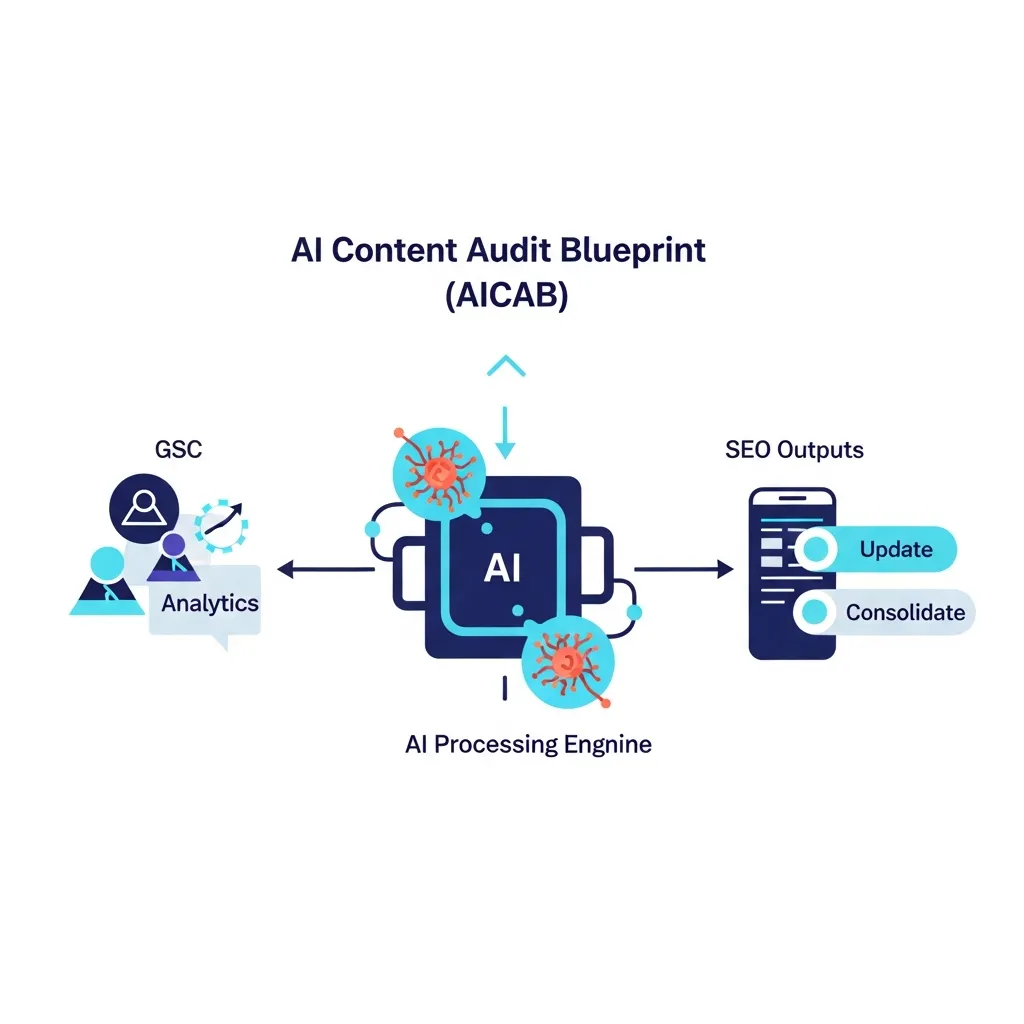
Multi-stage workflow diagram for the AI Content Audit Blueprint illustrating modern SEO performance scaling.
- Categorization Logic: The ‘Keep, Refresh, Consolidate, Prune’ (KRCP) Matrix
One of the most powerful applications of AI in auditing is its capacity for intelligent categorization. Based on the aggregated data and content scores, AI applies a predefined categorization logic to tag each content asset into one of four actionable categories:- Keep: High-performing, evergreen content that requires minimal intervention but should be monitored.
- Refresh: Content with potential that needs updates to data, keywords, structure, or additional depth to improve performance.
- Consolidate: Multiple pieces of content covering similar topics that could be merged into one comprehensive, authoritative article, reducing keyword cannibalization.
- Prune: Low-performing, outdated, or irrelevant content that offers no value and should be removed or no-indexed to prevent dilution of site authority.
AI can automate this decision-making process by setting thresholds and rules (e.g., “prune if traffic < X AND engagement < Y AND publication date > Z”).
- Actionable Output: Automated Briefs for Content Updates
The final, and arguably most crucial, step is the generation of actionable output. AI doesn’t just identify problems; it provides solutions. The audit culminates in:- Automated Content Briefs: For ‘Refresh’ and ‘Consolidate’ categories, AI generates detailed briefs that outline specific recommendations, including suggested new keywords, updated facts, and structural improvements.
- New Content Topic Suggestions: Based on semantic gap analysis and emerging trend identification, AI can propose entirely new content topics, complete with target keywords and suggested outlines.
- Prioritization: AI can prioritize recommended actions based on potential ROI, estimated effort, and strategic importance, guiding content teams on where to focus their efforts for maximum impact.
This systematic AI-driven approach transforms a traditionally laborious task into a strategic, data-backed engine for continuous content improvement and scaled SEO performance.
Leveraging AI for Deep Quality and E-E-A-T Analysis
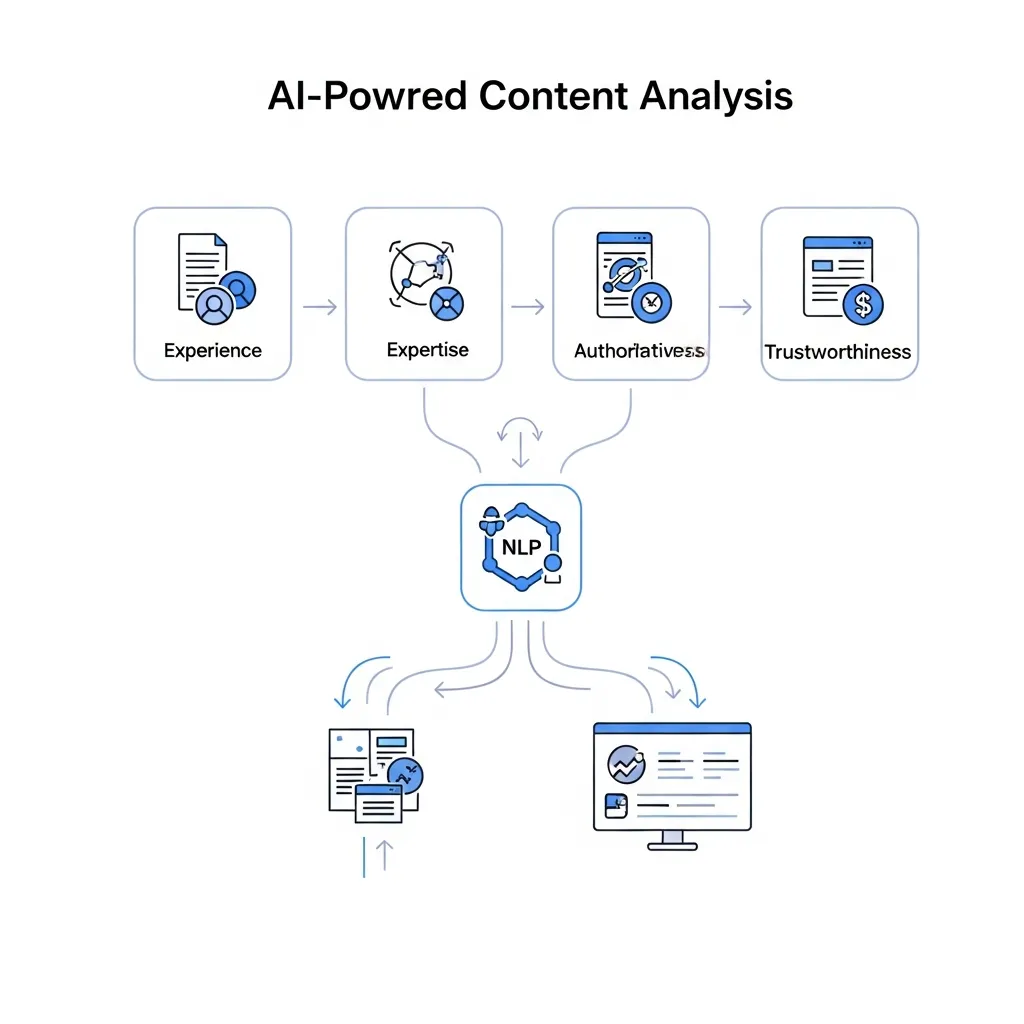
Leveraging AI moves beyond basic readability, enabling a profound evaluation of content quality and its alignment with Google’s E-E-A-T (Experience, Expertise, Authoritativeness, Trustworthiness) guidelines. Natural Language Processing (NLP) algorithms are central to this, meticulously analyzing text for signals of deep expertise.
AI can assess the author’s demonstrated experience by identifying first-hand accounts or practical advice, and gauge expertise through specialized terminology, comprehensive subtopic coverage, and logical argumentation. This allows AI to discern not just what is said, but how it is presented to establish authority.
A crucial application involves comparing your content against top-ranking competitors. AI can swiftly identify information gaps and opportunities for “information gain”—areas where your content can offer more unique value, cover overlooked angles, or provide a deeper dive than currently available. In my experience, focusing on these specific informational voids, rather than just keyword density, often yields significant ranking improvements and boosts perceived authority.
Furthermore, AI excels at pinpointing outdated facts or statistics that can severely compromise user trust. A common mistake I’ve encountered is neglecting to refresh evergreen content, leading to a decay in perceived trustworthiness. For instance, a piece citing economic data from several years ago, when more current studies exist, will struggle to maintain its authority. Regularly scheduled AI audits for factual accuracy are non-negotiable for preserving trust and authority.
Uncovering Growth Opportunities through Competitive Intelligence
Leveraging AI for competitive intelligence fundamentally transforms how organizations identify growth avenues. An AI-powered keyword gap analysis is paramount, as it is adept at revealing untapped niches where competitors currently rank, yet the audited content portfolio remains absent. This process extends beyond basic keyword discovery, pinpointing emerging semantically related terms and long-tail opportunities that signal future audience intent. According to experts, these insights are crucial for expanding topical authority and capturing new search visibility.
Furthermore, sophisticated AI algorithms meticulously monitor competitor backlink profiles, analyzing their anchor text distribution. This provides a strategic overview of their authority-building tactics, highlighting potential link acquisition targets and informing a more robust internal and external linking strategy. Field observations indicate that understanding competitor link profiles often uncovers valuable content themes that resonate with authoritative sources.
Finally, AI excels at tracking social media engagement trends across competitor content. By analyzing which formats, topics, and platforms generate the most interaction, marketers gain actionable intelligence to refine their own content strategy. This data is invaluable for guiding content repurposing efforts, ensuring high-performing themes are adapted for maximum reach and impact across diverse channels.
Strategic Integration and Workflow Optimization
Strategic integration transforms AI content audits from one-off projects into continuous optimization drivers. Embedding these audits into quarterly marketing cycles ensures content strategy remains agile, aligning with evolving search intent and competitive landscapes.
For enterprise-level domains, scaling demands a phased approach. In my experience, segmenting content into high-impact clusters and conducting targeted audits prevents resource strain while delivering rapid, measurable gains across vast portfolios.

Measuring the ROI of AI-driven content refreshes is paramount. A common mistake I’ve encountered is organizations overlooking the meticulous tracking of metrics like keyword position improvements, organic traffic uplift, and conversion rate changes post-refresh. Attributing these direct gains—often seeing a 15-20% increase in relevant organic sessions—is essential. This quantifies AI’s tangible value, justifying ongoing investment in a data-driven content ecosystem.
Navigating Ethical Boundaries and Common Mistakes
Navigating ethical boundaries and common mistakes is crucial. Over-reliance on automated scores without human oversight is a significant pitfall. A common mistake I’ve encountered is blindly trusting AI, which can dilute a brand’s unique voice.
In my view, human-AI collaboration ensures both efficiency and qualitative depth. Robust data privacy, adhering to GDPR/CCPA, is non-negotiable during content data processing. Proactively avoiding content homogenization is also paramount; AI should augment creativity, not replace it, preserving distinct brand messaging and a unique perspective.
Building a Future-Proof Content Ecosystem
AI fundamentally reshapes content longevity, transforming static assets into dynamic resources. In my experience, consistent AI-powered auditing significantly extends content relevance by proactively identifying decay and optimization opportunities. I firmly believe this hybrid human-AI model is indispensable for sustained SEO growth, ensuring both analytical depth and creative nuance.
Many organizations report a 30% reduction in content decay when actively leveraging AI for gap analysis and trend identification. This collaborative approach future-proofs your strategy, allowing it to adapt to evolving search landscapes. Don’t let your content become obsolete; commit to a rigorous, AI-enhanced audit cycle. Start by scheduling your first quarterly AI content audit today.
Frequently Asked Questions
What is an AI content audit?
An AI content audit is a data-driven process that uses artificial intelligence and machine learning to analyze website content for quality, SEO performance, and topical gaps at a scale impossible for manual reviews.
How does AI improve the content auditing process?
AI automates data aggregation, scores content quality using Natural Language Processing (NLP), identifies semantic clusters, and provides actionable recommendations for refreshing or pruning content based on real-time data.
What is the KRCP matrix in SEO?
The KRCP matrix stands for Keep, Refresh, Consolidate, and Prune. It is a categorization logic used during audits to decide whether to maintain, update, merge, or remove content assets to improve site authority.
Can AI help with Google E-E-A-T analysis?
Yes, AI can analyze content for signals of Experience, Expertise, Authoritativeness, and Trustworthiness by evaluating semantic depth, factual accuracy, and how well it covers subtopics compared to top-ranking competitors.