The Evolution of Search and the Rise of AI-Driven Content Structures
The digital search landscape has fundamentally evolved. Modern search engines, powered by advanced AI, now prioritize topical authority over mere keyword matching. This shift gave rise to AI topic clusters: a strategic content framework where a central pillar page broadly covers a core subject, supported by interconnected cluster content exploring specific sub-topics.
This represents a pivotal move from a keyword-centric approach to an entity-centric understanding. Search algorithms currently interpret user intent by discerning relationships between concepts and entities. For instance, a user searching for "sustainable energy" expects content covering solar, wind, and geothermal power, rather than just pages repeating the exact phrase.
This intelligent architecture offers significant advantages:
- Enhanced organic rankings.
- Superior user experience.
- Robust topical authority.
For a comprehensive overview, see AI and SEO.
How AI Systems Evaluate Topical Authority and Content Relationships
AI systems currently employ sophisticated Natural Language Processing (NLP) to decipher a piece of content's true meaning, moving far beyond simple keyword matching. This semantic understanding allows search engines to grasp the nuances of language, identify synonyms, and infer user intent by analyzing the relationships between words and concepts.
To understand user intent comprehensively, search engines utilize query fan-out. This involves taking an initial search query and exploring a network of related queries and sub-topics that a user might also be interested in. This process helps AI build a holistic picture of the user's information needs, identifying the breadth of entities and concepts associated with their core intent.
Furthermore, AI rigorously assesses entity relationships. By identifying distinct entities—such as specific people, places, or abstract concepts—within your content and mapping their interconnections, AI constructs a detailed knowledge graph of your domain. Field observations indicate that robust, interconnected entity relationships signal profound expertise, leading AI to perceive your site as more authoritative on a given topic.
The Core Components of a Robust Topic Cluster Ecosystem
The foundation of any successful AI-driven content strategy lies in a well-structured topic cluster ecosystem. At its core is the Pillar Page, a comprehensive, high-level resource that serves as the central hub for a broad subject. This page offers a holistic overview of a significant topic, addressing a wide informational intent without diving into exhaustive detail. It acts as the primary answer for a broad head term, providing foundational knowledge and establishing initial authority within that domain.
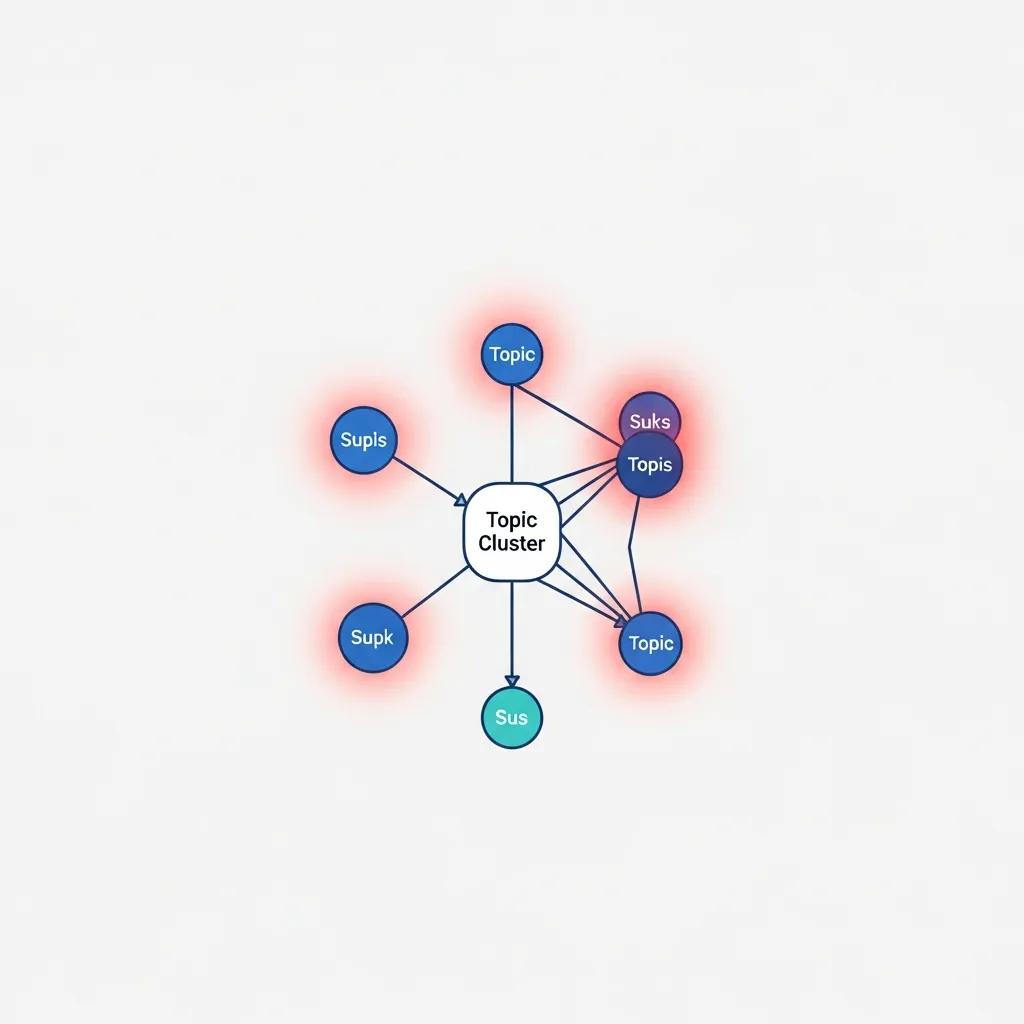
Supporting this pillar are numerous Cluster Content pieces. These articles are specialized, in-depth explorations of specific subtopics derived from the pillar. Each cluster article targets more niche, long-tail keywords, demonstrating granular expertise and catering to specific user queries that branch off the main topic. For instance, a pillar on "AI in SEO" might have cluster content on "AI-Powered Keyword Research Strategies" or "Using Generative AI for Content Outlines."

The critical element binding this ecosystem together is robust Internal Linking. This isn't just about navigation; it's about creating a semantic web that explicitly signals content relationships to AI search systems. By linking from the pillar to relevant cluster pages, and strategically linking between related cluster pages, you guide crawlers through your topical expertise. Field observations indicate that descriptive anchor text, aligned with the target content's subject, significantly enhances the ability of AI to map your site's knowledge graph and assign topical authority.
Pro Tip: Ensure every cluster page links back to its pillar page. This reinforces the hierarchical structure and funnels authority back to your central hub, strengthening its perceived relevance and importance for AI ranking systems.
A Practical Framework for Developing AI Topic Clusters
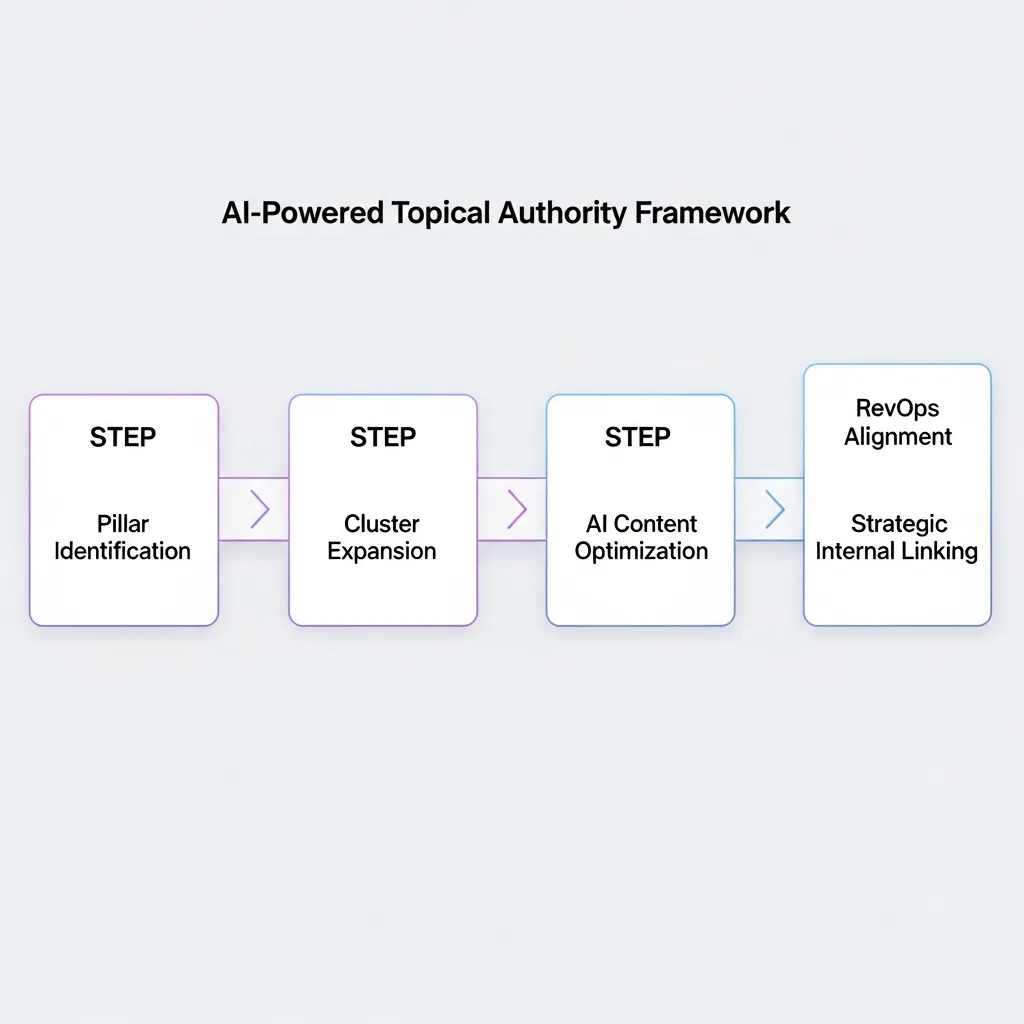
Developing a robust content strategy that truly resonates with AI search systems requires more than just identifying keywords; it demands a structured, interconnected approach. This section outlines The AI-Powered Topical Authority Framework, a practical methodology for building AI topic clusters that drive organic visibility and establish genuine expertise.
Step 1: Identifying High-Intent Pillar Topics Using AI-Assisted Competitive Analysis
The foundation of any successful topic cluster is a well-chosen pillar topic. These broad, foundational subjects serve as the central hub for your cluster, addressing a comprehensive user query. Currently, AI-assisted competitive analysis provides an unparalleled advantage in identifying these high-intent pillars. Rather than merely listing keywords, AI algorithms can analyze vast datasets of competitor content, including their top-performing pages, semantic structures, and the underlying user intent their content serves.
Field observations indicate that AI excels at detecting content gaps and emerging trends within a niche, revealing underserved areas where your brand can establish authority. By scrutinizing SERP features, user questions (e.g., "People Also Ask"), and engagement metrics across competitor sites, AI can pinpoint topics with strong commercial intent and significant search volume, ensuring your pillar addresses a genuine market need.
Step 2: Mapping Subtopics and Semantic Keywords to Fill Content Gaps
Once a pillar topic is established, the next crucial step involves meticulously mapping out its supporting subtopics and the associated semantic keywords. This is where the depth of AI's natural language processing (NLP) capabilities becomes indispensable. AI tools can analyze your chosen pillar topic and generate an exhaustive list of related concepts, questions, entities, and long-tail keywords that human researchers might overlook.
This process moves beyond simple keyword variations, focusing instead on the relationships between concepts. AI helps identify the specific angles, problems, and solutions that users are actively searching for within the broader pillar theme. By understanding the semantic landscape, you can strategically fill content gaps, ensuring your cluster provides comprehensive answers and truly covers the topic in its entirety, signaling deep expertise to AI search systems.
Step 3: Leveraging AI Tools for Content Ideation and Structured Outlining
With pillar and subtopics defined, the challenge shifts to content creation. AI tools are transforming content ideation and structured outlining, acting as powerful co-pilots for content teams. For each cluster article, AI can generate unique content ideas, suggest compelling angles, and even propose initial drafts of headlines and introductions based on the identified subtopics and semantic keywords.
Furthermore, AI's ability to analyze top-ranking content for a given query allows it to construct highly effective structured outlines. These outlines go beyond basic headings, suggesting logical content flows, key points to cover, data points to include, and even potential calls to action. This ensures that each piece of cluster content is not only comprehensive but also optimized for readability and information retrieval by both users and AI search crawlers.
Pro Tip: While AI can generate outlines, always integrate human expertise to refine the narrative, inject unique insights, and ensure brand voice. AI provides the structure; human writers provide the soul and nuanced understanding.
Step 4: Executing a Strategic Internal Linking Plan to Distribute PageRank and Relevance
The efficacy of a topic cluster hinges on its internal linking strategy. This step is critical for distributing PageRank and establishing semantic relevance across your content ecosystem. AI can analyze your entire site's content graph, identifying optimal linking opportunities between your pillar page and supporting cluster articles. It can suggest contextually relevant anchor text that clearly signals the relationship between pages to search engines.
Practical experience shows that a well-executed internal linking plan not only enhances user navigation but also explicitly defines the semantic relationships within your site for AI search systems. This interconnectedness helps search engines understand your site's comprehensive authority on a subject, boosting the ranking potential of both individual cluster pages and the overarching pillar. AI can even flag orphaned content or weak links, ensuring maximum distribution of authority.
Step 5: Aligning Clusters with Business Goals and the Revenue Operations (RevOps) Funnel
The ultimate success of any content strategy is its contribution to business objectives. This final step involves meticulously aligning your AI topic clusters with your overarching business goals and the Revenue Operations (RevOps) funnel. Technical data suggests that content optimized for specific stages of the RevOps funnel—awareness, consideration, decision, and even retention—yields higher conversion rates.
AI can analyze user behavior data, conversion paths, and sales cycles to identify which types of content resonate best at each funnel stage. This allows you to tailor your cluster content to address specific pain points and information needs of your target audience as they progress towards a purchase or engagement. For instance, an awareness-stage pillar might link to consideration-stage cluster content featuring case studies, which then links to decision-stage content like product comparisons or demo requests. This strategic alignment ensures your topical authority translates directly into measurable business outcomes.
Optimizing Content for Answer Engines and AI Visibility
Optimizing for Answer Engines (AEO) means crafting content explicitly for AI models that prioritize direct, concise answers. This goes beyond traditional keyword targeting, requiring a focus on factual accuracy and structural clarity for AI extraction. In my view, prioritizing direct answers and structured data is no longer optional; it is fundamental for future visibility.
To achieve this, content must be structured meticulously. Utilize clear, descriptive headings (H2s, H3s), bullet points, and numbered lists to break down complex information. Employ definitive statements and provide immediate answers to common questions. While not a technical tutorial, strategically incorporating schema markup can significantly aid AI in understanding key entities and relationships.
The challenge lies in balancing the needs of Large Language Models (LLMs) with those of human readers. LLMs thrive on structured, unambiguous data, while humans seek context, engagement, and narrative. Through many projects, I've found that content teams often overlook the subtle but critical differences between writing for human readability and AI extractability. The solution is to provide the direct, AI-friendly answer upfront, then elaborate with human-centric explanations, examples, and deeper insights. Content optimized for Answer Engines consistently demonstrates a higher likelihood of securing featured snippets and direct answers, often boosting organic visibility for specific queries by 20-30% compared to less structured counterparts.
Measuring the Performance and ROI of Your Cluster Strategy
Measuring the ROI of an AI-driven cluster strategy starts with tracking evolving topical authority. Monitor improvements in share of voice for core topics, signaling market prominence, and observe the expansion of keyword breadth by the diversity of long-tail keywords ranked. Field observations confirm that a rise in long-tail rankings directly enhances topical authority.
Analyze engagement metrics across the entire content cluster. Evaluate time on page, bounce rate, and click-through rates (CTR) across all interconnected articles. Practical experience shows that improved engagement signifies robust internal linking and a user-centric content flow.
Link this progress to tangible business outcomes. Track organic traffic growth from clusters, directly attributing it to lead generation and conversion rates. Experts emphasize that direct conversion attribution to clusters proves the strategic value and ROI of AI-driven topical authority.
Strategic Insights: Avoiding Common Mistakes in AI Content Clustering
When leveraging AI topic clusters, several pitfalls can undermine your efforts. A common mistake I've encountered is keyword cannibalization within clusters. AI can generate similar subtopics, leading to multiple pages competing for the same search intent. To fix this, always conduct a manual review to ensure a distinct intent for each piece.
Over-reliance on purely AI-generated text also poses a significant risk. Content lacking human refinement often feels generic, hurting your brand's topical authority and trustworthiness. In my view, the most effective strategy uses AI as an assistant, not a sole creator. To truly differentiate from generic AI output, focus on integrating unique data, proprietary research, and authentic personal experiences. These elements provide depth and originality AI cannot replicate, establishing genuine expertise.
Future-Proofing Your SEO with Intelligent Content Architecture
Embracing AI topic clusters crafts an intelligent content architecture, ensuring enduring topical authority. In my experience, this semantic-first approach consistently future-proofs SEO against evolving search algorithms, making it non-negotiable for sustained organic growth. I firmly believe this is the path forward. Start now by applying our practical framework to your content strategy.
Frequently Asked Questions About AI Topic Clusters
What are AI topic clusters?
AI topic clusters are a strategic content framework consisting of a central pillar page covering a broad subject and multiple interconnected cluster pages exploring specific sub-topics to build topical authority.
How do AI topic clusters improve SEO?
They improve SEO by establishing topical authority, enhancing user experience through logical navigation, and helping search engines understand the semantic relationships between your content pieces.
What is the difference between a pillar page and cluster content?
A pillar page provides a comprehensive, high-level overview of a broad topic, while cluster content pieces are specialized, in-depth explorations of specific subtopics that link back to the pillar.
How does AI evaluate topical authority?
AI systems use Natural Language Processing (NLP) and entity relationship mapping to understand the semantic meaning and depth of content, moving beyond simple keyword matching to grasp true expertise.