The Convergence of Artificial Intelligence and Jurisprudence
The legal profession currently faces a pivotal juncture with the profound integration of artificial intelligence and jurisprudence. This shift marks a significant evolution from labor-intensive manual research toward sophisticated, data-driven analysis. Practical experience demonstrates AI's capacity to process vast legal datasets, identifying precedents and patterns far beyond human scale and augmenting core aspects of legal reasoning. For legal and legal tech professionals, understanding these capabilities is paramount.
Consider a complex litigation scenario where AI tools analyze millions of discovery documents in minutes, pinpointing crucial evidence. This article explores the practical applications of AI and legal reasoning, ethical considerations, and integration strategies, covering:
- Navigating algorithmic bias.
- Optimizing workflow efficiencies.
- Ensuring ethical deployment.
Fundamental Principles of Machine Learning in Legal Analysis
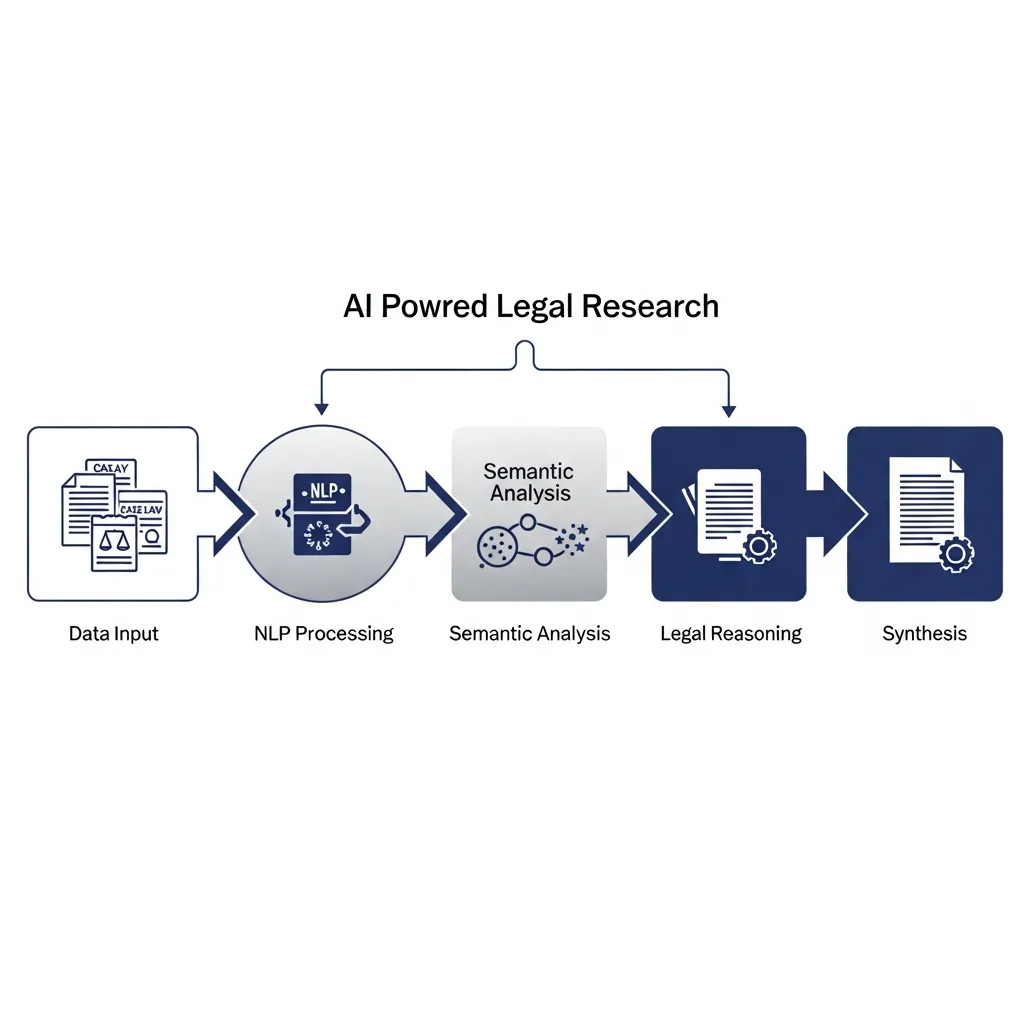
Machine learning serves as the bedrock of AI’s analytical capabilities in law. Natural Language Processing (NLP) is fundamental, allowing systems to parse, understand, and extract critical information from vast unstructured legal documents—including contracts, statutes, and case law. This involves techniques like tokenization and named entity recognition, specifically adapted for complex legal terminology and context.

Legal AI systems primarily utilize either rule-based systems or neural networks. Rule-based approaches rely on predefined logical rules and expert knowledge, making them suitable for structured tasks like compliance. Neural networks, a subset of deep learning, learn intricate patterns directly from data, excelling at identifying subtle relationships and nuanced contexts within legal texts for predictive analytics. Field observations indicate that hybrid models often combine the strengths of both.
Algorithms identify legal precedents and patterns by training on extensive datasets of historical cases and judicial opinions. They learn to correlate specific fact patterns, legal arguments, and outcomes. This enables them to flag highly relevant prior decisions, predict potential litigation outcomes, or highlight discrepancies across documents. Technical data suggests that this pattern recognition substantially enhances legal research efficiency by surfacing pertinent information.
Practical Applications of AI in the Legal Reasoning Process
The evolution of AI and legal reasoning has propelled the legal sector into an era of unprecedented augmentation, transforming how legal professionals approach complex tasks. Building upon the foundational principles of machine learning, AI tools are now actively deployed across various stages of legal practice, from initial research to strategic litigation planning. Field observations indicate that these applications are not merely automating mundane tasks but are fundamentally enhancing the depth, speed, and accuracy of legal analysis.
Automated Legal Research and Case Law Synthesis
One of the most immediate and impactful applications of AI lies in automated legal research and case law synthesis. Traditional legal research, often a labor-intensive and time-consuming process, has been revolutionized by AI-powered platforms. These systems go beyond simple keyword matching, employing advanced NLP to understand the semantic context of legal texts. They can identify highly relevant precedents, statutes, and regulatory documents, even if the exact phrasing differs. Furthermore, AI can synthesize complex case law, highlighting conflicting judicial opinions, identifying emerging legal trends, and summarizing key arguments from vast datasets.
- Pros: Significantly reduces research time, uncovers obscure but relevant cases, and enhances the comprehensiveness of legal arguments. Practical experience shows it allows legal professionals to focus on strategic analysis rather than exhaustive document review.
- Cons: Over-reliance can lead to a lack of critical human evaluation of sources, and the models' training data might perpetuate biases or overlook novel interpretations not present in historical records.
Predictive Analytics for Litigation Outcomes and Judicial Behavior
Predictive analytics represents another powerful AI application, offering data-driven insights into potential litigation outcomes and judicial behavior. By analyzing historical court decisions, judge profiles, case types, and settlement data, AI models can forecast the probability of success for different legal strategies. This capability allows legal teams to assess risks more accurately, inform settlement negotiations, and tailor arguments to specific judicial tendencies. For instance, technical data suggests that AI can identify patterns in a judge's past rulings on particular types of motions or evidence, providing invaluable strategic intelligence.
- Pros: Empowers more informed decision-making, optimizes resource allocation in litigation, and provides a statistical edge in negotiation.
- Cons: Predictions are based on historical data and may not account for unique case facts or novel legal arguments. There is also a risk of oversimplifying the complex, often unpredictable, human element in judicial decision-making.
Generative AI for Drafting Complex Legal Arguments and Briefs
The advent of generative AI has opened new frontiers in the drafting of legal documents. Large Language Models (LLMs) can assist in drafting initial versions of complex legal arguments, briefs, motions, and even contracts. By inputting specific case facts, legal principles, and desired outcomes, these tools can generate coherent, well-structured text, summarize lengthy documents, or create outlines for intricate legal positions. This capability significantly accelerates the initial drafting phase, freeing up legal professionals for refinement and strategic oversight.
- Pros: Drastically reduces drafting time, provides a strong starting point for complex documents, and can help in exploring different argumentative angles.
- Cons: A significant risk of "hallucinations" (generating plausible but incorrect information), a lack of nuanced legal judgment, and the potential for perpetuating biases present in training data. Requires rigorous human review to ensure accuracy and ethical soundness.
Contract Lifecycle Management and Automated Risk Assessment
Contract lifecycle management (CLM) has been profoundly enhanced by AI, streamlining processes from drafting and negotiation to execution and renewal. AI tools can automatically identify key clauses, extract critical data points, flag deviations from standard terms, and assess potential risks within contracts. This includes identifying non-compliant clauses, highlighting ambiguities, or pinpointing areas of high liability. For large organizations managing thousands of contracts, this automation significantly reduces manual review time and ensures greater consistency across the board.
- Pros: Improves efficiency in contract review, reduces operational risks, ensures compliance, and frees legal teams to focus on high-value strategic negotiations.
- Cons: Can struggle with highly customized or unusually worded clauses, requiring human intervention. Initial setup and training for complex contract types can be resource-intensive.
The Role of AI in Discovery and Evidentiary Analysis
In discovery and evidentiary analysis, AI tools are indispensable for managing the sheer volume of digital information prevalent in modern litigation. E-discovery platforms leverage AI to rapidly process, categorize, and review millions of documents, emails, and other data points. AI can identify privileged information, flag relevant evidence, detect patterns in communications, and organize potential exhibits. This capability drastically reduces the time and cost associated with manual document review, allowing legal teams to build stronger cases more efficiently.
- Pros: Accelerates document review, reduces discovery costs, enhances accuracy in identifying relevant evidence, and uncovers hidden connections within vast datasets.
- Cons: Potential for AI to misinterpret context, leading to false positives or negatives that require careful human verification. Data privacy and security concerns are paramount when processing sensitive client information.
Key Insight: While AI offers transformative benefits across these applications, its role is primarily that of an advanced assistant. The ultimate responsibility for legal judgment, ethical considerations, and nuanced interpretation remains firmly with the human legal professional.
The AI Legal Application Vetting Protocol
Integrating AI effectively into legal reasoning requires a structured approach. The following protocol provides a framework for evaluating and deploying AI tools within a legal practice:
- Define Core Legal Task: Clearly identify the specific legal reasoning task AI is intended to augment (e.g., contract review, e-discovery, case prediction).
- Assess Data Requirements: Evaluate if sufficient, high-quality, and relevant legal data is available for the AI model's training, considering data privacy and ethical sourcing.
- Evaluate Algorithmic Transparency: Understand the AI's methodology and the interpretability of its outputs, especially for critical decisions where explainability is crucial.
- Pilot Program & Validation: Implement a controlled pilot to test the AI's performance against human benchmarks, validating its accuracy and reliability in real-world scenarios.
- Integrate Human Oversight: Establish clear protocols for human review, intervention, and ultimate decision-making, acknowledging AI as an assistive tool.
- Monitor & Iterate: Continuously monitor the AI's performance post-deployment, gathering feedback for ongoing refinement and adaptation to evolving legal standards.
Navigating Ethical Pitfalls and Algorithmic Bias
A significant concern within AI and legal reasoning is the 'black box' problem, where complex algorithms yield outcomes without clear, human-understandable explanations for their rationale. This lack of transparency can undermine core legal principles like due process, making it difficult to audit or challenge AI-assisted conclusions. The imperative is to develop and utilize explainable AI (XAI), allowing professionals to understand and justify decisions rather than merely accepting them.
Furthermore, AI systems learn from historical datasets, which often embed and perpetuate societal or institutional biases. This algorithmic bias can manifest in unfair or discriminatory outcomes—for instance, in predictive policing or sentencing recommendations—if the training data reflects past inequities. Addressing this demands meticulous curation of diverse and representative datasets and robust bias detection and mitigation strategies. In my experience working with complex data models, a common mistake is assuming data neutrality; legal professionals must critically examine the provenance and composition of their training data.
Legal professionals bear a duty of technological competence, requiring a foundational understanding of AI's capabilities and its inherent limitations. This encompasses recognizing when AI-generated insights might be flawed due to bias or lack of interpretability. Professional responsibility mandates continuous learning and the application of astute ethical judgment. In my view, the most effective approach to mitigating these risks is a human-in-the-loop strategy, where AI serves as a powerful assistant, but ultimate judgment and ethical oversight remain firmly with the legal professional.
Strategies for Integrating AI into Legal Workflows
Integrating AI effectively into legal workflows demands a strategic approach centered on the human-in-the-loop model. Legal professionals must retain ultimate oversight and decision-making authority, ensuring nuanced interpretation and ethical considerations are always applied. While AI excels at data synthesis, human judgment remains indispensable for complex legal reasoning. In my experience, blindly trusting AI outputs without robust human verification often leads to critical oversights, particularly with context-specific legal precedents or emerging case law. This continuous human review mitigates risks like algorithmic bias and ensures adherence to professional responsibilities.

Next, selecting the right tools for specific legal tasks is paramount. Not all AI solutions suit every legal function; specialized tools for e-discovery, contract analysis, or predictive analytics offer greater efficiency and accuracy. In my view, prioritizing targeted AI applications that excel in narrow, well-defined legal domains, rather than generic solutions, maximizes utility and aligns precisely with firm needs. Finally, continuous training and staying updated on latest advancements are crucial. The legal tech landscape evolves rapidly. A common mistake is viewing AI implementation as a one-time project; firms often neglect ongoing training, leading to underutilization. Integrating regular learning modules into professional development ensures professionals can leverage AI's full potential responsibly.
Real-World Impact: Case Studies in AI-Driven Law
In high-stakes corporate litigation, AI platforms currently accelerate e-discovery and contract review, processing millions of documents with speed and accuracy far exceeding human capabilities. Field observations indicate this significantly reduces preparation time and uncovers critical evidence, offering a strategic advantage while demanding careful validation. AI also plays a pivotal role in improving access to justice, particularly for pro bono cases. Tools that automate legal research for common issues or assist with document generation empower legal aid organizations to serve more individuals, addressing a persistent gap in legal services.
Early adopters in large law firms have yielded crucial insights: successful AI integration necessitates robust human-AI collaboration, not just automation. Practical experience shows that while AI enhances tasks like due diligence and predictive analytics, continuous human oversight and ethical frameworks are indispensable to ensure accuracy, prevent algorithmic bias, and ultimately, augment AI and legal reasoning effectively.
The Future Landscape of the Legal Profession
The future legal landscape sees AI as an indispensable augmentative tool, shifting legal expertise toward strategic oversight and nuanced judgment. My experience shows proactive adaptation is crucial; neglecting it is a common mistake. Professionals must embrace AI literacy. Start by identifying your firm's most time-consuming research tasks to integrate AI effectively and ensure you remain competitive in an increasingly automated field.
Frequently Asked Questions about AI and Legal Reasoning
How does AI improve legal reasoning?
AI enhances legal reasoning by processing vast datasets to identify precedents, patterns, and insights that would be impossible for humans to find manually, allowing for more data-driven analysis.
What are the ethical risks of AI in law?
Key ethical risks include algorithmic bias, the "black box" problem where decision-making isn't transparent, and the potential for AI to generate incorrect information (hallucinations).
Can AI replace human lawyers?
No, AI is an augmentative tool. While it automates research and drafting, human judgment, ethical oversight, and nuanced interpretation remain essential to the legal process.
What is the "black box" problem in legal AI?
The "black box" problem refers to AI algorithms that produce outcomes without providing a clear, human-understandable explanation of the logic used to reach that conclusion.