Understanding the Fundamentals of Sentence-Level Optimization
Are you struggling with AI-driven search visibility despite your traditional SEO efforts? As content strategists work to prevent AI summaries from bypassing their content, a new priority has emerged. This section explores an essential shift: sentence-level optimization, which prioritizes information density and granular clarity to improve AI readability.
In the age of Large Language Models (LLMs), sentence-level optimization involves treating every sentence as a factual, unambiguous unit of information. The focus has shifted decisively from keyword density to information density; every phrase must contribute meaningful value. This is because AI models process semantic meaning and factual assertions at the individual sentence level.
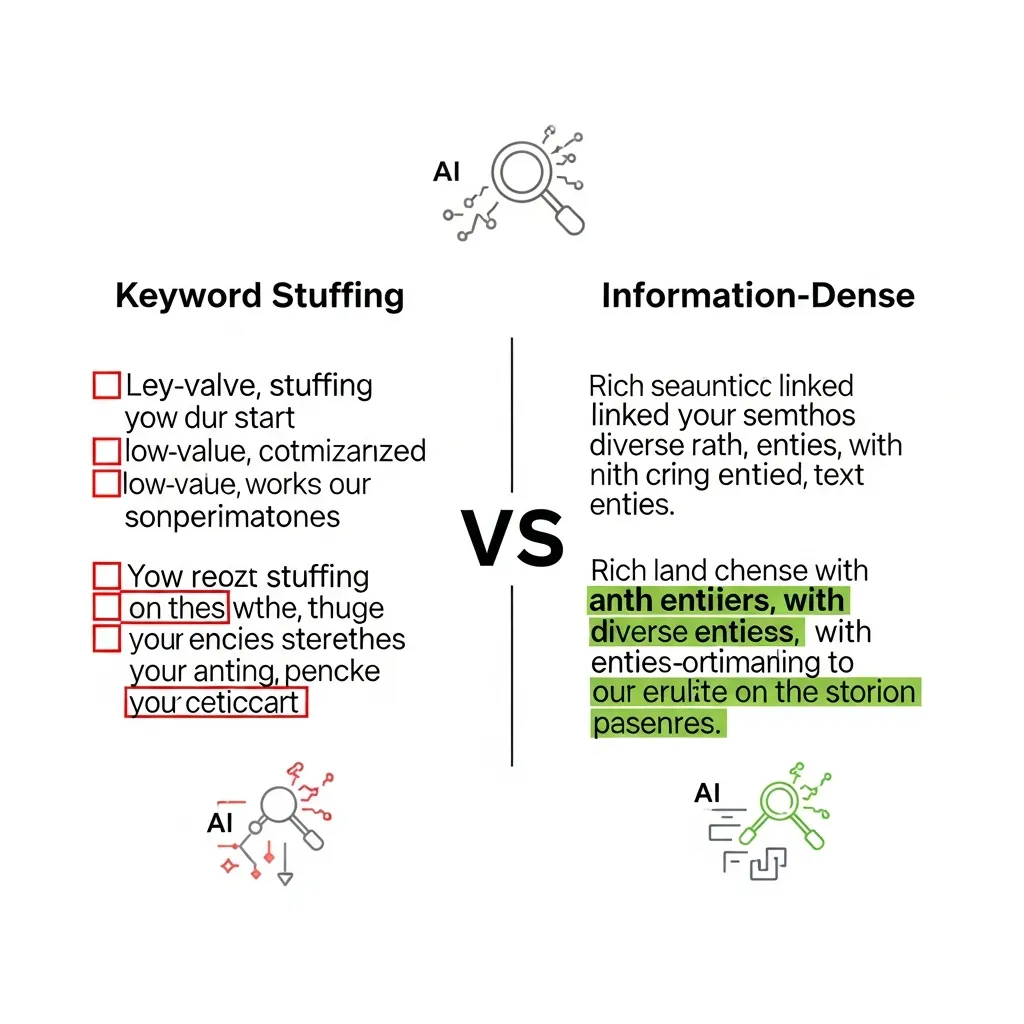
Granular clarity is now a critical factor for AI readability. Precisely worded sentences allow LLMs to accurately extract, synthesize, and cite information, which in turn ensures content reliability. For a comprehensive overview of these strategies, see Search AI optimization.
How AI Models Process and Summarize Digital Content
AI models, particularly large language models (LLMs), function as sophisticated information summarizers that meticulously parse digital content. Their process involves deconstructing text to identify and extract core entities—such as people, organizations, concepts, and temporal markers—while mapping the intricate relationships between them. This granular extraction allows AI to build a comprehensive understanding of a text's fundamental meaning and context, moving beyond mere keyword recognition toward sentence level optimization.
A critical aspect of AI processing involves establishing factual consensus. These models are engineered to cross-reference information against a vast repository of high-ranking, authoritative sources. By comparing multiple data points, AI identifies consistent facts and prevailing understandings, effectively filtering out unsubstantiated claims and prioritizing trustworthy content.
Consequently, excellent structural organization is paramount for efficient machine parsing. Clear headings, subheadings, and concise paragraphs act as vital semantic signposts for AI. This logical hierarchy enables models to quickly delineate distinct topics, understand nested relationships, and precisely extract specific answers or summaries. Content lacking robust structural clarity significantly hinders an AI's ability to accurately process information, directly impacting its search visibility.
Core Techniques for Factual Writing and High-Density Content
AI-driven search necessitates a re-evaluation of content creation at the sentence level optimization. AI models prioritize content that is not only accurate but also structured for efficient information extraction. This requires a dual focus: ensuring factual integrity and maximizing content density.
Prioritizing Verifiable Data and Objective Claims
For AI models, the credibility of information is paramount. Content must be grounded in verifiable data and present objective claims to be deemed authoritative. AI systems cross-reference information to identify a factual consensus; consequently, unsubstantiated assertions harm visibility. Content writers must consistently attribute sources, cite specific studies, and use quantifiable metrics.
Move beyond vague statements to provide concrete evidence. For example, instead of stating, "Many businesses find AI beneficial," an optimized sentence would be: "A recent report by [Research Firm X] indicates that 72% of surveyed businesses reported increased operational efficiency after integrating AI tools." This approach builds trust with human readers while providing AI with clear, verifiable data points for summarization and direct answers.
Crafting High-Density Content
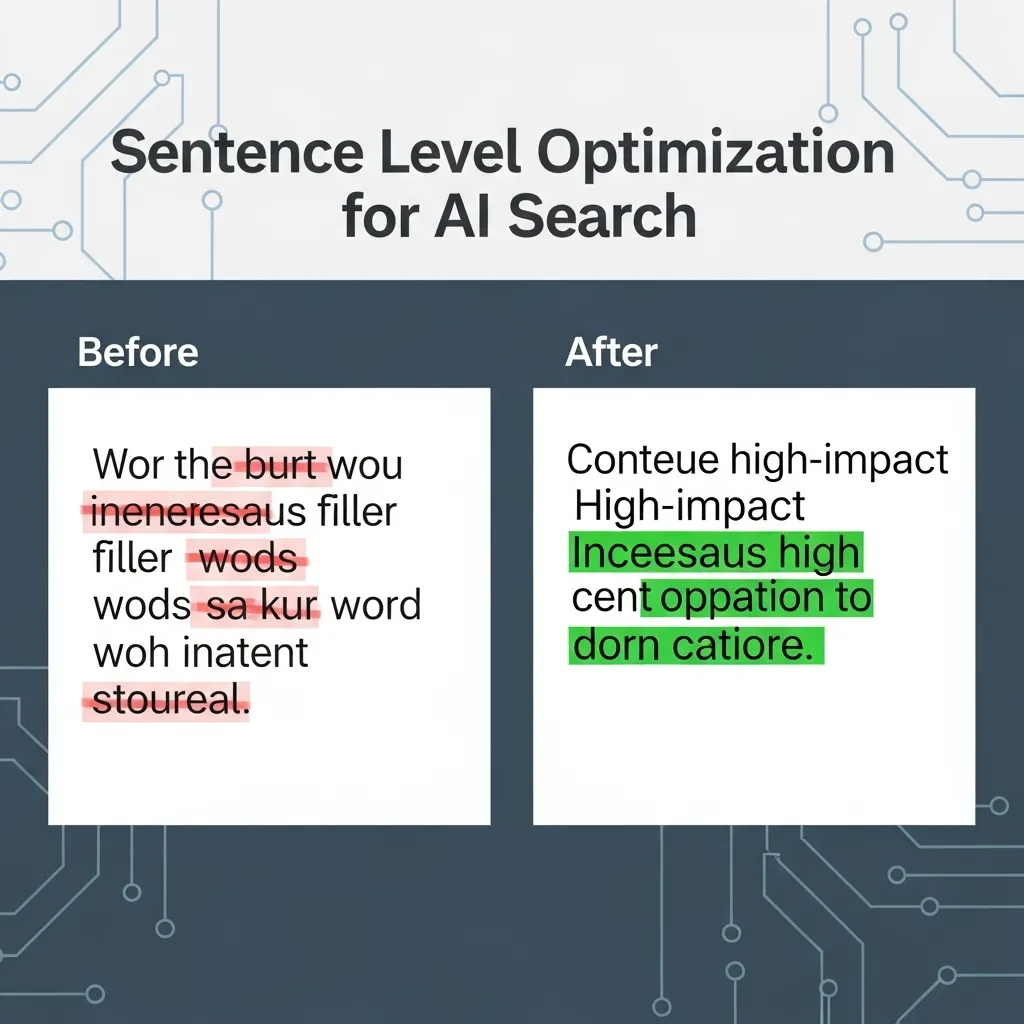
High-density content conveys information efficiently by stripping away superfluous language. Because AI models process vast amounts of text, eliminating filler words and redundant modifiers significantly improves their ability to extract core facts. Common culprits include phrases like "in order to," "due to the fact that," and "it is important to note," as well as redundant modifiers such as "basic fundamentals" or "completely unique." By trimming these unnecessary elements, content becomes more potent, allowing AI to identify key entities and relationships with greater precision.
The 'One Idea Per Sentence' Rule
A fundamental principle for AI content optimization is adhering to the 'one idea per sentence' rule. AI models extract information more reliably from atomic units of thought than from complex, multi-clause sentences. Each sentence should ideally convey a single, distinct fact or concept to reduce ambiguity and prevent the AI from misinterpreting the relationships between different pieces of information.
Consider this example: "The new software, which integrates machine learning and natural language processing, enhances data analysis capabilities and automates report generation for large enterprises."
This can be optimized by breaking it into smaller units: "The new software integrates machine learning and natural language processing. These features enhance data analysis capabilities. Furthermore, the software automates report generation for large enterprises." This segmentation makes each fact independently extractable and easier for AI to process.
Implementing Concise Writing for Improved Extraction Rates
Concise writing SEO focuses on maximizing the information-to-word ratio to improve AI overview and snippet generation. Beyond removing filler, this involves employing the active voice, strong verbs, and direct sentence structures. Passive constructions often elongate sentences and obscure the subject, which can hinder an AI's ability to identify key actors and their actions. For example, "Data was analyzed by the system" is less direct than "The system analyzed the data." By prioritizing clarity and directness, writers ensure that the most salient information is readily accessible for AI to synthesize into accurate, succinct overviews.
Balancing Natural Language Flow with Technical Precision
Achieving an effective balance between natural language flow and technical precision is crucial. While conciseness is key, content should not sound robotic or disjointed. Varying sentence lengths, strategically employing transition words, and maintaining a coherent narrative are essential for human readability.
However, when discussing technical topics, precision must trump colloquialism. Using correct terminology consistently ensures that AI accurately categorizes and relates information. The challenge lies in simplifying complex ideas without sacrificing accuracy, allowing AI to grasp the nuances while providing a smooth reading experience for the user.
The AI-Centric Content Precision Checklist
To ensure content meets these standards, apply the following checklist during the sentence level optimization process:
- Factual Verification: Are claims supported by verifiable data and objective evidence, with sources clearly indicated?
- Filler Elimination: Have all unnecessary words, phrases, and redundant modifiers been removed?
- Idea Isolation: Does each sentence convey one primary idea or fact?
- Conciseness Check: Is the content written in the active voice with strong verbs? Can any sentence be shortened without losing its core meaning?
- Precision & Flow Audit: Is technical terminology accurate and consistent? Does the content read naturally for a human audience?
Structuring Sentences for AI Citations and Direct Answers
To help AI models efficiently extract and cite information, content must be structured for immediate clarity. A fundamental strategy for sentence level optimization involves identifying core questions a user might ask and providing declarative, immediate answers. Pages that directly address queries in this manner become prime candidates for AI citations and direct answer boxes because they minimize the AI's interpretive workload.
Consider how AI systems currently function: they prioritize concise, verifiable statements. When a sentence leads with the answer to an implicit question—for instance, "AI-driven search prioritizes direct answers because…"—it presents the most crucial information upfront. This technique applies the Inverted Pyramid writing style granularly, ensuring that key data is accessible at the first point of contact.
This principle dictates placing the most important information (the main answer or conclusion) at the very beginning of a sentence or short paragraph. Subsequent clauses then provide supporting details, context, or elaboration. For example, instead of writing "Several factors contribute to AI citation eligibility, with directness being key," rephrase to: "Directness is a key factor in AI citation eligibility, alongside other contributing elements." This immediate delivery of the core answer significantly enhances the content's extractability and the likelihood of being cited by AI.
Content Transformation: Sentence-Level Before and After Comparisons
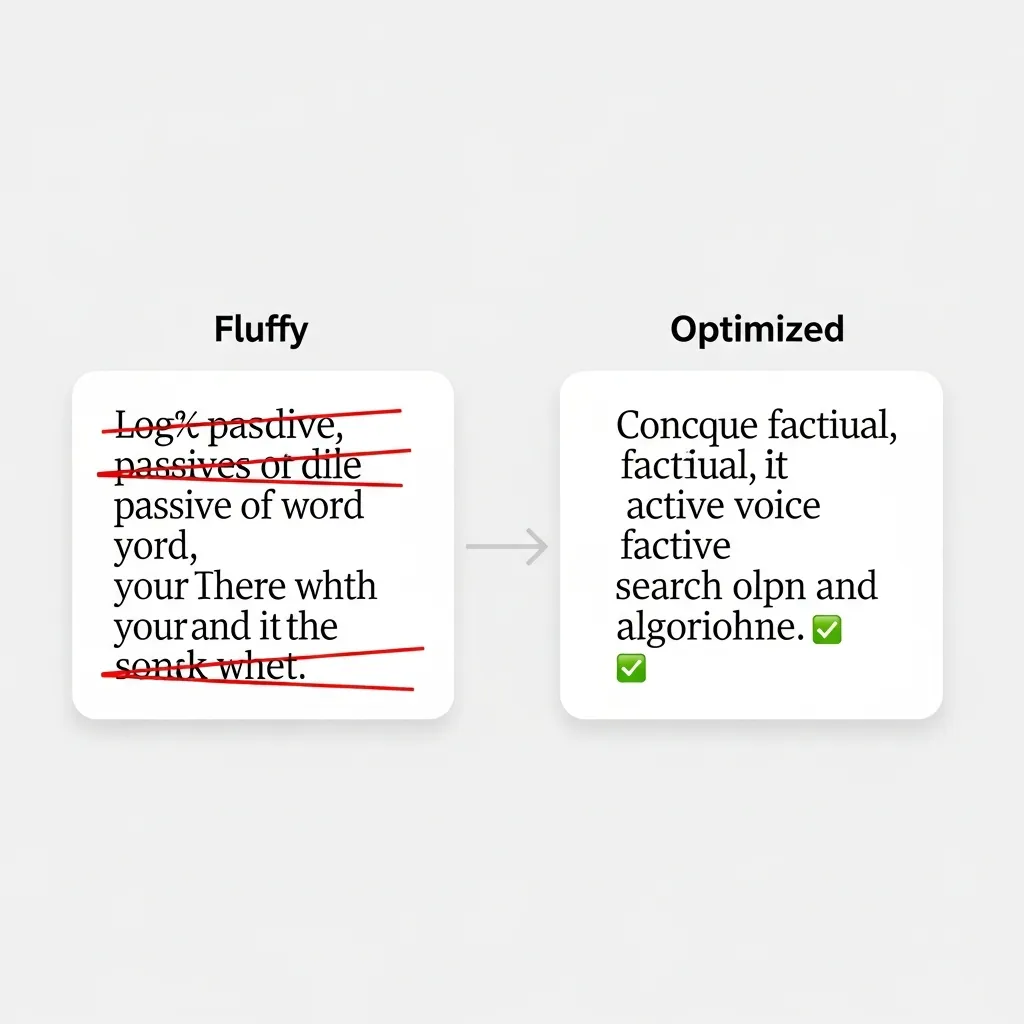
Achieving AI-optimized clarity requires a deliberate focus on sentence level optimization. Consider the difference between "fluffy" marketing speak and high-density, factual sentences:
- Before: "Our cutting-edge solutions empower organizations to unlock their full potential and drive transformative outcomes."
- After: "The new software module increased data processing efficiency by 25% and reduced manual error rates by 10%."
This shift moves the narrative from vague promises to verifiable metrics. Research consistently shows that employing the active voice significantly improves AI parsing speed and comprehension. Sentences with a clear subject-verb-object structure enable AI models to identify core actions rapidly, minimizing ambiguity and streamlining information extraction for direct answers.
Eliminating jargon is equally critical for clarity.
- Before: "We operationalize integrated solutions for optimal stakeholder engagement and augmented ROI."
- After: "We implement strategies to improve client communication and increase financial returns."
These transformations demonstrate how precise, active, and jargon-free language is paramount for content to be effectively processed and utilized by AI-driven search algorithms, ultimately boosting visibility and citation potential.
Common Mistakes in AI Content Optimization
One prevalent error in sentence level optimization is over-optimization, which often sacrifices human readability. When phrasing becomes unnatural or relies on keyword stuffing, it deters readers and signals poor quality to both users and search engines.
Another mistake involves using ambiguous pronouns, such as "it" or "this," without clear antecedents. This lack of precision confuses an AI’s contextual understanding, leading to potential misinterpretations of the text's core message.
Finally, neglecting the semantic relevance between adjacent sentences impedes an AI's ability to build a coherent narrative. Logical connections are essential for effective sentence level optimization, as they allow algorithms to accurately grasp the relationships and depth of the information presented.
The Future of Precision in Content Strategy
Mastering sentence level optimization ensures your content remains discoverable and accurately cited by AI. This precision builds lasting authority, driving evergreen success as search landscapes evolve. Prioritizing factual density today guarantees your content’s long-term relevance and credibility. Start applying these principles to your next draft to stay ahead of the curve.
Frequently Asked Questions
What is sentence level optimization?
Sentence level optimization is the practice of treating every sentence as a factual, unambiguous unit of information to improve readability and extraction for AI models and LLMs.
Why is information density important for AI-driven SEO?
Information density ensures every phrase adds value, allowing AI models to accurately synthesize and cite your content, which improves visibility in AI-generated summaries.
How does the 'one idea per sentence' rule improve content?
By limiting each sentence to a single idea, you increase the clarity of your writing, making it easier for AI algorithms to process and attribute factual assertions correctly.