Defining the New Era of Search Results
The search landscape has shifted profoundly, moving beyond traditional blue links toward direct, synthesized answers. SEO professionals and digital marketers are currently navigating this evolution, striving to understand its impact on visibility and traffic. This section defines this core shift, clarifying what AI Overviews are and how they fundamentally reshape search engine results pages (SERPs).
At its core, an AI Overview is an AI-generated summary that appears prominently at the top of search results to answer a user's query directly. This integration marks a new era in which search engines prioritize immediate, accurate, and contextually rich information—often providing comprehensive responses without requiring a click-through to an external website. This shift has recalibrated user expectations; searchers now demand instant, authoritative answers directly within the search interface. Adapting to this paradigm requires a deep understanding of content relevance and authority, as outlined in our Google AI Overviews strategy.
The Mechanics Behind AI-Generated Search Results
AI Overviews are powered by advanced large language models (LLMs), such as Gemini, which represent a significant evolution in natural language processing. Rather than simply extracting text from a single source, these models perform a sophisticated synthesis of information across numerous high-quality web pages. This process involves analyzing the nuances of a user's query and consolidating relevant facts, data points, and diverse perspectives into a coherent, summarized response designed for comprehensive accuracy.
The selection of these underlying web sources is far from random. Google’s foundational ranking systems, including PageRank and the Helpful Content system, remain vital in guiding the AI. These systems evaluate the authority, trustworthiness, and overall quality of content, ensuring that AI Overviews prioritize sources that demonstrate expertise and provide reliable information. This rigorous vetting process is essential for maintaining the integrity and utility of the generated summaries.
The prominent placement of AI Overviews at the top of the SERP is a strategic design choice intended to deliver immediate, concise answers. This positioning reflects a broader shift toward more efficient information consumption, where the AI's ability to process complex data directly addresses user intent. The seamless integration of Gemini allows the AI to not only comprehend queries but also generate human-like text, making these summaries highly readable, contextually relevant, and instantly informative.
AI Overviews vs. Featured Snippets: Key Differences
While both AI Overviews and Featured Snippets aim to provide immediate answers, their underlying mechanics and impact on search behavior differ significantly. The primary distinction lies in information synthesis. Featured Snippets typically extract a concise, verbatim answer from a single, authoritative source. In contrast, AI Overviews leverage generative models to synthesize insights from multiple high-quality sources, creating a richer, more comprehensive summary that integrates diverse perspectives.
This multi-source approach allows AI Overviews to provide a conversational context that goes beyond simple direct answers. While Featured Snippets offer factual, often transactional responses to specific queries, AI Overviews provide broader context, anticipate follow-up questions, and structure information in a narrative, human-like manner. By cross-referencing and combining insights from various authoritative sources, AI summaries offer a more nuanced and holistic understanding than a single-source snippet can provide.
The impact on click-through rates (CTR) also presents a complex picture. Historically, Featured Snippets provided a significant CTR boost to the source page, though they also contributed to zero-click searches when the answer fully satisfied the user's intent. AI Overviews fundamentally alter this dynamic by delivering extensive answers directly on the SERP alongside links to all contributing sources. While this comprehensive presentation may reduce the immediate need to click a single organic listing, it can also encourage users to explore multiple vetted sources for deeper insights. This shift potentially redistributes clicks across several high-ranking pages, necessitating a re-evaluation of traditional content visibility strategies.
Strategic Optimization for AI Overviews and Visibility
Optimizing for AI Overviews requires a holistic, sophisticated approach that moves beyond traditional keyword density to focus on content quality, user intent, and technical precision. The goal is to be more than just a high-ranking result; you must be the definitive, trustworthy source that AI models select to synthesize comprehensive answers.
Structuring Content for Complex, Multi-Part Queries
AI Overviews excel at answering nuanced, multi-faceted questions by synthesizing information from various sources. To capitalize on this, structure your content to address complex queries comprehensively within a single resource. This involves anticipating follow-up questions and embedding those answers directly into your text.
Use clear, descriptive headings (H2, H3, H4) that function as mini-summaries, allowing AI to quickly identify and extract relevant sections. Additionally, employ strategic internal linking to connect related concepts across your site, demonstrating a deep and interconnected knowledge base. The aim is to create a resource so thorough that it satisfies multiple user intents related to a broader topic.
The Critical Importance of E-E-A-T
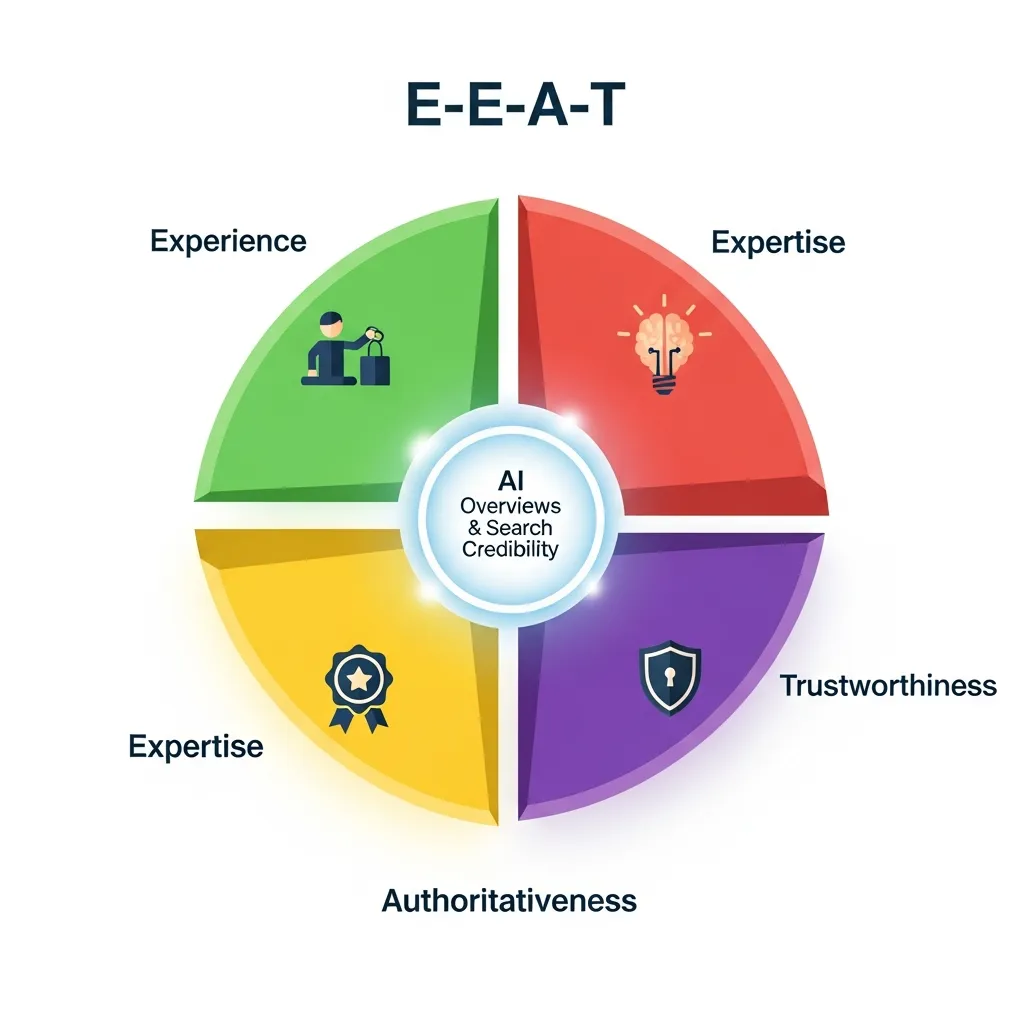
Experience, Expertise, Authoritativeness, and Trustworthiness (E-E-A-T) have long been cornerstones of quality content, but their significance is amplified by AI Overviews. Because AI models are designed to prioritize credible sources, demonstrating strong E-E-A-T signals tells the AI that your content is a reliable foundation for its synthesized answers.
To build these signals, showcase author credentials, cite reputable sources, provide evidence-based information, and present clear methodologies for any claims. For businesses, this also requires transparent "About Us" pages, comprehensive contact information, and a documented history of positive user interactions.
Technical SEO: Structured Data and Clear Information Architecture
Effective technical SEO is paramount for AI visibility. Structured data, particularly Schema.org markup, acts as a translator that helps AI models understand the context, relationships, and meaning of your content.
Implementing relevant schema types—such as Article, FAQPage, HowTo, Product, or Review—highlights key data points that AI can easily ingest. For example, using Question and Answer properties within FAQPage schema directly supports the AI’s ability to answer specific queries. Beyond schema, a clear information architecture featuring logical navigation, breadcrumbs, and a well-organized URL structure ensures that AI can efficiently crawl, index, and understand your content hierarchy.
Creating 'Linkable' Facts and Data Points
AI Overviews function by synthesizing information and frequently citing their sources. To be featured, your content needs to contain easily extractable, 'linkable' facts and data points.
Present key information in concise, definitive statements, ideally at the beginning of sections or paragraphs. Examples include clear definitions, statistics, step-by-step instructions, and bulleted lists summarizing features or benefits. These digestible "content chunks" are ideal for AI to pull and attribute. Furthermore, original research and unique data enhance the likelihood of being cited, as they offer exclusive value to the AI's synthesis process.
Optimizing for Conversational Keywords and Natural Language Patterns
The rise of AI Overviews reflects an evolution in search behavior toward conversational keywords and natural language. Users are increasingly asking full questions rather than typing fragmented keywords.
Content optimization must reflect this shift by incorporating long-tail, question-based phrases that mirror how a person naturally speaks. Analyze user intent by looking past the keywords to the underlying questions users want answered. Use natural language throughout your content to ensure it reads smoothly while providing direct, authoritative answers to anticipated queries.
The Role of High-Quality Reviews and User-Generated Content
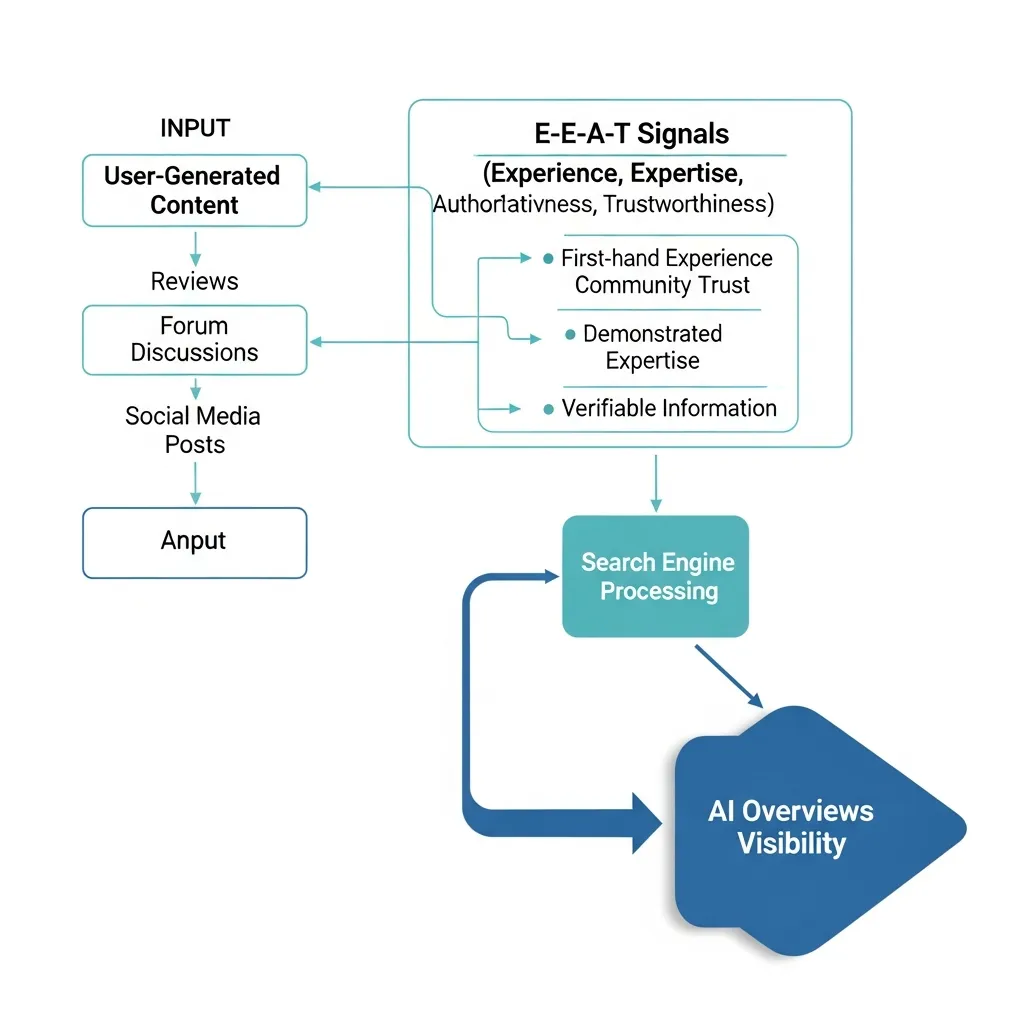
High-quality reviews and user-generated content (UGC) are vital for establishing the real-world experience signals that AI models value. AI Overviews often incorporate sentiment and practical insights derived from authentic user experiences.
Encouraging and managing genuine customer reviews, testimonials, case studies, and active community forums provides a rich source of experience-based content. This UGC demonstrates practical application, addresses common concerns, and validates your claims through the voice of real users, significantly enhancing your appeal to AI models seeking trusted information.
The Content Architect's AI Visibility Framework
To systematically optimize for AI Overviews, utilize the following strategic framework:
- Intent-Centric Content Mapping:
- Goal: Map content to complex, multi-part user queries.
- Action: Research common user questions and anticipate follow-ups. Structure content with logical headings that directly answer these queries.
- E-E-A-T Amplification:
- Goal: Establish and showcase expertise and trustworthiness.
- Action: Feature detailed author bios, cite reputable sources, provide evidence-based arguments, and maintain transparent business information.
- Schema-First Technical Foundation:
- Goal: Enable AI to easily categorize and understand your content.
- Action: Implement relevant Schema.org markup (e.g., FAQPage, HowTo) and maintain a logical site architecture.
- Extractable Data Presentation:
- Goal: Provide AI with easily quotable facts.
- Action: Present key information as concise definitions, statistics, and bullet points early in relevant sections.
- Conversational Language Integration:
- Goal: Align content with natural search patterns.
- Action: Optimize for long-tail, question-based keywords and ensure the prose flows naturally.
- UGC & Review Cultivation:
- Goal: Leverage authentic experiences to build authority.
- Action: Actively manage customer reviews, testimonials, and community engagement to provide "real-world" proof.
Pro Tip: Focus on creating "answer clusters." Instead of publishing isolated articles, develop interconnected content pieces that explore a broad topic from multiple angles. This demonstrates comprehensive authority to AI models.
How SEO Strategies Must Evolve for AI Overviews
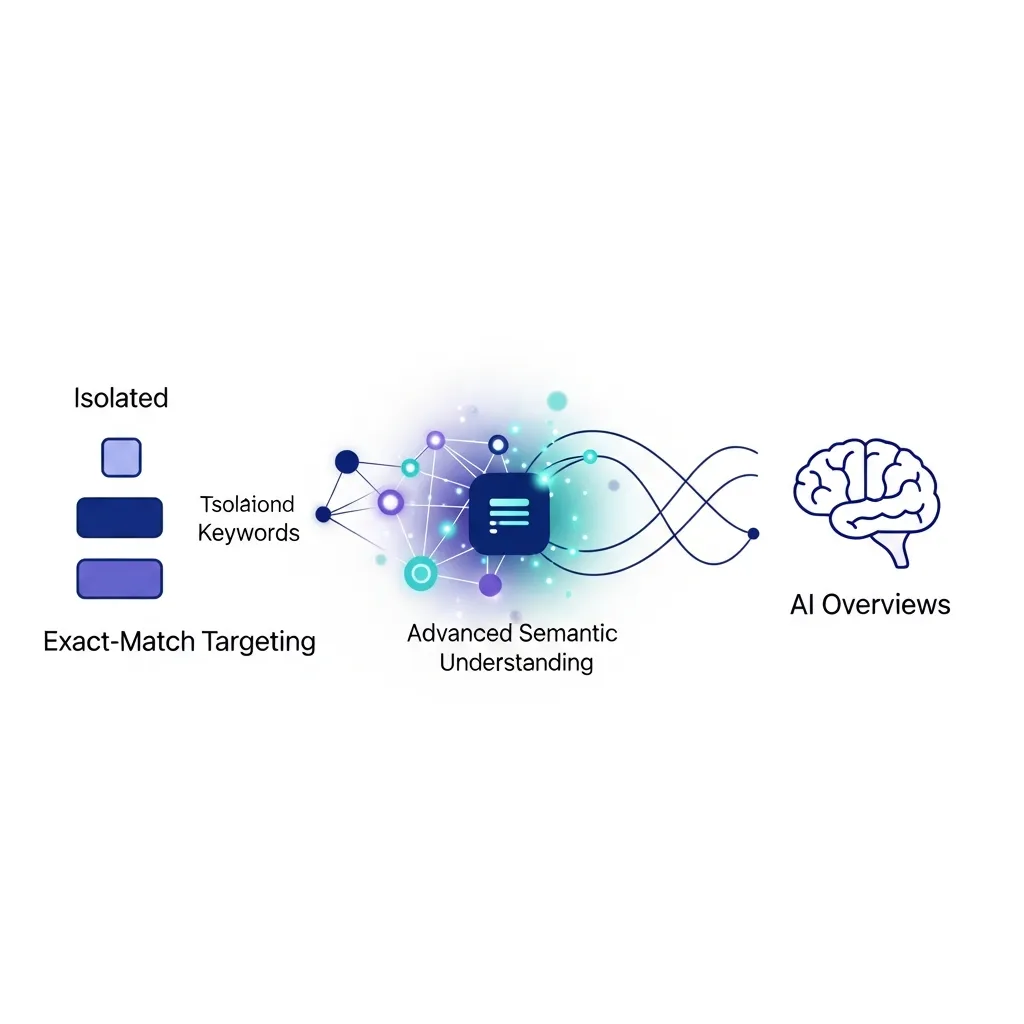
The rise of AI Overviews necessitates a fundamental shift in how SEO professionals approach their strategy. A primary evolution involves moving beyond keyword density toward a deeper understanding of semantic relevance and user intent. Content must now demonstrate comprehensive topical authority by addressing the broader context of a query, anticipating follow-up questions, and offering in-depth insights. This requires a focus on entities and their relationships to provide a truly holistic answer.
This shift also brings a potential increase in 'zero-click' searches for simple informational queries. As AI Overviews synthesize answers directly within search results, users may no longer need to click through to a website for basic facts or definitions. This compels content creators to re-evaluate their strategies for high-volume, low-complexity content, focusing instead on how to provide unique value that an AI cannot easily summarize.
Expert Tip: To counter the impact of AI on simple queries, focus on creating bottom-of-funnel content that AI Overviews struggle to replicate. This includes highly personalized experiences, unique data-driven case studies, detailed product comparisons with proprietary insights, interactive tools, and content requiring human judgment or empathy. These formats foster deeper engagement, support conversion paths, and offer value that synthesized answers cannot fully deliver.
Monitoring performance remains critical, but it must be viewed through an updated lens. SEO professionals should leverage the latest Search Console metrics to understand how their content interacts with AI Overviews. This involves closely tracking changes in impressions, clicks, and click-through rates (CTR) specifically for queries where AI Overviews are prominent. Analyzing these metrics provides crucial insights into shifting user behaviors and the true impact on organic visibility, guiding more effective optimization efforts.
Practical AI Overview Examples Across Different Niches
AI Overviews synthesize information across a wide range of search intents to provide immediate value. For informational queries, they summarize complex topics—such as "What is blockchain technology?"—or provide step-by-step instructions for "How to tie a Windsor knot," pulling from multiple authoritative sources. In commercial intent scenarios, AI generates product comparisons for queries like "best laptops for students" or "iPhone vs. Android," highlighting key features, pricing, and user reviews to streamline purchasing decisions. Finally, for local search, a query like "restaurants open late downtown" triggers a consolidated view of business hours, locations, ratings, and menu highlights, offering a comprehensive snapshot directly within the SERP.
Adapting to the Future of AI-Powered Search
The shift toward AI-powered search underscores the critical importance of high-quality, helpful content. Creating truly valuable resources that address user intent with depth and precision remains the core strategy for maintaining visibility. Success requires a balance between leveraging AI for efficiency and preserving human creativity in content development. While AI can synthesize information and optimize delivery, human expertise provides irreplaceable insights, original thought, and empathy. As search algorithms and AI capabilities evolve, SEO professionals and content creators must remain agile and committed to continuous learning. Ultimately, the future of search demands adaptability and a focus on foundational content excellence.
Start now with step 1: Auditing your existing content for AI Overview alignment.
Frequently Asked Questions
What are AI Overviews in search results?
AI Overviews are AI-generated summaries that appear at the top of search engine results pages. Powered by large language models like Gemini, they synthesize information from multiple sources to provide direct, comprehensive answers to user queries.
How do AI Overviews differ from Featured Snippets?
Unlike Featured Snippets, which typically pull a specific block of text from a single source, AI Overviews use generative AI to combine information from various websites into a new, cohesive summary tailored to the user's intent.
How can I optimize my content for AI Overviews?
To increase visibility in AI Overviews, focus on high-quality content that demonstrates E-E-A-T (Experience, Expertise, Authoritativeness, and Trustworthiness), use structured data, and provide clear, fact-based answers to complex or conversational questions.
What role does E-E-A-T play in AI-powered search?
E-E-A-T is critical because AI models prioritize authoritative and trustworthy sources when synthesizing information. Providing original insights, human expertise, and verifiable data makes your content more likely to be cited in an AI Overview.