The Evolution of Search Engine Optimization through Artificial Intelligence
SEO once relied heavily on manual analysis. Currently, Artificial Intelligence (AI) is fundamentally reshaping this landscape, transitioning workflows to AI-assisted optimization. Search engines increasingly leverage machine learning (ML) to interpret user intent, evaluate content quality, and rank information with unprecedented depth.
For instance, practical experience shows how AI identifies emerging trends and content gaps far more efficiently than traditional methods. This constant evolution necessitates that SEO professionals remain agile and adaptable, mastering AI's integration into strategy for sustained visibility. This shift brings about:
- Enhanced content creation efficiency.
- Deeper user behavior insights.
- A mandate for continuous learning.
For a comprehensive overview, consider these factors for choosing AI SEO tools, which are vital for this transition.
Core Pillars of AI Integration in Search Marketing
Integrating AI into search marketing workflows fundamentally reshapes how professionals approach core tasks, moving from manual analysis to data-driven automation. One primary pillar is automating keyword research and intent discovery. AI tools can swiftly analyze immense datasets, identifying not just high-volume terms but also emerging trends and intricate user intent signals. Experience shows that this capability dramatically accelerates the process of understanding user motivation, allowing for the creation of content precisely aligned with searcher needs rather than just surface-level queries.
Another critical integration point is enhancing technical SEO audits with predictive analysis. AI-powered platforms can process vast amounts of site data, identifying complex technical issues like crawl budget inefficiencies, duplicate content problems, or subtle site speed bottlenecks that might elude traditional manual checks. These tools offer predictive analysis, forecasting the potential impact of identified issues on search visibility and prioritizing fixes based on their projected ROI. Field observations indicate that this transforms reactive problem-solving into proactive, strategic maintenance.
Finally, AI is instrumental in streamlining content briefs and semantic optimization. AI-driven platforms can generate comprehensive content briefs by analyzing top-ranking articles for a target keyword, identifying crucial subtopics, entities, and questions that need coverage. This ensures topical authority and comprehensive content. Furthermore, AI assists in semantic optimization, helping writers understand the linguistic nuances and related concepts search engines associate with a topic, thereby enhancing content relevance and depth. This integration significantly improves both content quality and production efficiency.
Evaluating the Best AI SEO Tools for Professional Workflows
The landscape of AI SEO tools is rapidly evolving, offering sophisticated solutions for agencies and in-house teams seeking to elevate their search strategies. Moving beyond basic automation, today's industry-leading platforms leverage advanced machine learning to provide actionable insights and streamline complex tasks. For SEO professionals with 2-5 years of experience, selecting the right tools involves a detailed analysis of their core capabilities, pricing models, and seamless integration into existing workflows.
Generative Content Tools vs. Analytical Optimization Tools
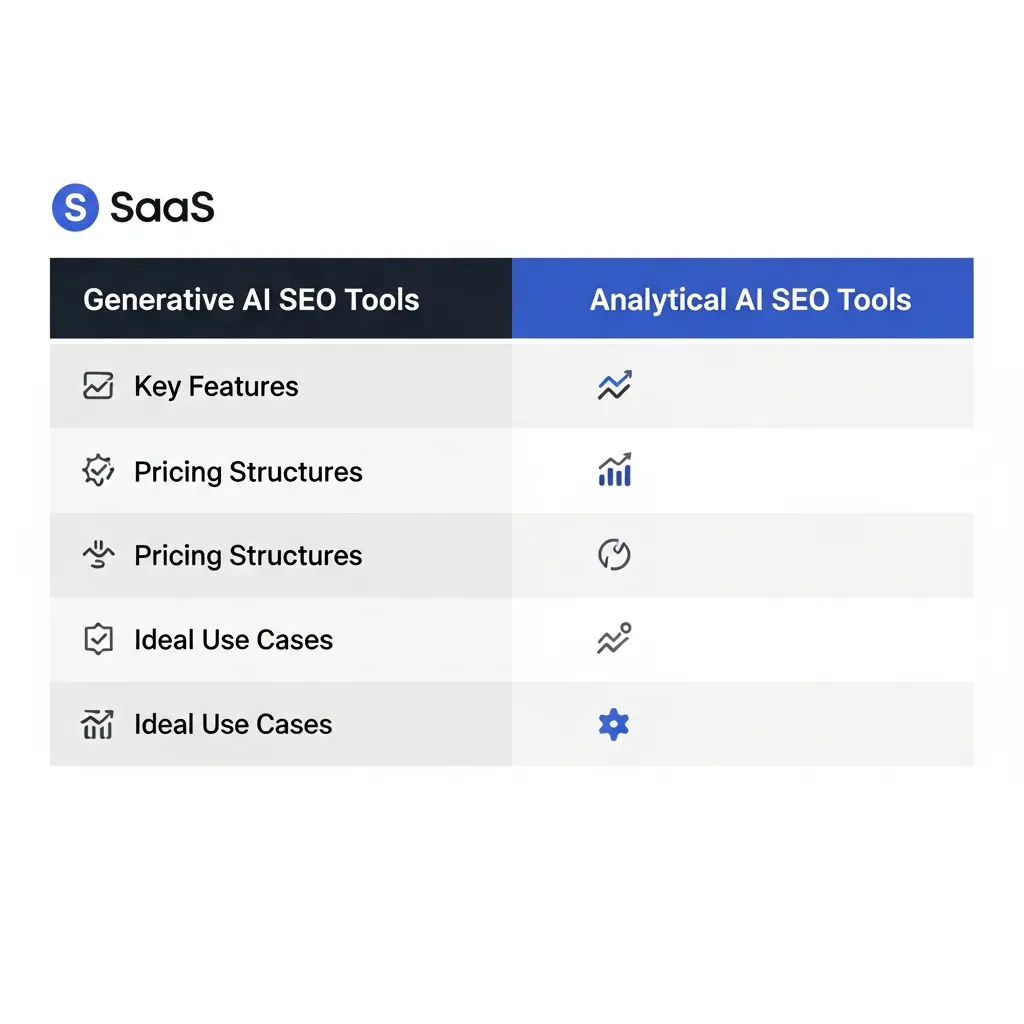
Before diving into specific platforms, it's crucial to understand the fundamental distinction between two primary categories of AI SEO tools: generative content tools and analytical optimization tools.
Generative Content Tools focus on assisting with content creation, ideation, and semantic optimization. These tools leverage large language models (LLMs) to generate content briefs, outlines, meta descriptions, and even full article drafts based on target keywords and competitive analysis. Examples include platforms like Surfer SEO, MarketMuse, Clearscope, and specialized AI writing assistants that integrate SEO features. Their strength lies in accelerating the content production cycle and ensuring topical authority from the outset.
Analytical Optimization Tools, conversely, are designed for data analysis, performance monitoring, technical SEO diagnostics, and strategic planning. While traditional SEO suites (e.g., Semrush, Ahrefs) have long offered these features, their AI-enhanced counterparts now integrate predictive analytics, anomaly detection, and more nuanced insights into keyword research, competitor analysis, and site health. These tools excel at identifying hidden opportunities, flagging potential issues before they impact rankings, and providing data-driven recommendations for both on-page and technical improvements.
In my view, the most effective approach for professional workflows is to utilize a complementary blend of both. Generative tools help create high-quality, semantically rich content, while analytical tools help optimize, monitor, and refine that content and the underlying technical infrastructure for maximum search visibility.
Industry-Leading Tools: Features and Use Cases
Let’s examine some prominent tools across these categories and their practical applications.
For Content Strategy and Generation:
- Surfer SEO / Clearscope / MarketMuse: These platforms are stalwarts for content optimization. They analyze top-ranking content for a given keyword, identifying key entities, common questions, and content gaps. AI then guides users to create comprehensive, semantically rich content that aligns with search intent.
- Features: Content brief generation, real-time content scoring, keyword clustering, topic cluster identification, and internal linking suggestions.
- Use Cases: An agency can use Surfer SEO to rapidly generate detailed content briefs for clients, ensuring every piece of content is optimized for topical authority. An in-house content team might leverage MarketMuse to identify topic clusters where they lack authority and prioritize creation based on competitive gaps.
- Pricing: Typically subscription-based, with tiers scaled by the number of content analyses or user seats. Entry-level plans might start around $99-$150/month, scaling up to several hundred for enterprise-level usage.
For Technical SEO and Performance Analysis:
- Semrush / Ahrefs (AI-enhanced features): While not exclusively AI tools, these suites have integrated AI to enhance their capabilities. AI-driven features include predictive keyword trend analysis, anomaly detection in traffic drops, and sophisticated competitor insights.
- Specialized AI Technical SEO Tools: Newer tools are emerging that specifically focus on AI-driven technical audits, identifying issues like crawl budget inefficiencies and indexation problems with greater precision.
- Features: Predictive issue detection, advanced log file analysis, smart internal linking recommendations, and anomaly detection in performance metrics.
- Use Cases: A large e-commerce site can use AI-powered anomaly detection in Semrush to instantly flag a sudden drop in category page traffic, pinpointing the root cause faster than manual analysis. For complex websites, AI-driven tools can sift through massive log files to identify subtle crawl pattern shifts that indicate potential issues.
- Pricing: Broad SEO suites range from $120-$200/month for standard plans to custom enterprise solutions.
Integrating AI Tools into Professional Workflows: The AI SEO Integration Framework
Successfully integrating AI SEO tools isn't just about purchasing software; it's about strategically embedding them into your agency or in-house processes. Here’s a framework to guide this integration:
- Audit Current Workflows: Identify existing bottlenecks and manual tasks where human effort is disproportionately high for the output.
- Define AI Integration Points: Determine where AI adds the most value, such as content brief generation, technical issue detection, or keyword clustering.
- Tool Selection & Piloting: Select tools that align with your budget and requirements. Conduct small-scale pilot projects to test efficacy.
- Team Training & SOP Development: Invest in training your team. AI tools are most effective when users understand how to interpret outputs. Develop Standard Operating Procedures (SOPs) for using the tools.
- Common Mistake + Fix: A frequent error is implementing powerful tools without adequate training. Investing in dedicated training sessions and clear SOPs can improve tool adoption and lead to a measurable 25-30% increase in workflow efficiency within the first two months.
- Monitor & Iterate: Continuously track performance. Are the tools saving time? Improving content quality? Use this data to refine your strategy.
Developing a Hybrid Strategy: Balancing AI Efficiency with Human Expertise
The integration of AI into SEO workflows presents an opportunity for unprecedented efficiency, yet true mastery lies in fostering a hybrid strategy that synergizes AI's speed with human insight. This approach ensures productivity gains while preserving content quality and brand authenticity.
At the core of this hybrid model is the 'Human-in-the-Loop' (HITL) framework. This is about intelligent collaboration where AI handles repetitive, data-intensive tasks, and human experts provide strategic direction and final refinement. For instance, while AI excels at generating initial content drafts, a human editor must critically review them for factual accuracy and adherence to specific guidelines.
A common mistake is treating AI output as a final product, which often leads to generic information. Instead, allocating at least 30% of the content creation time for human review significantly elevates overall impact.
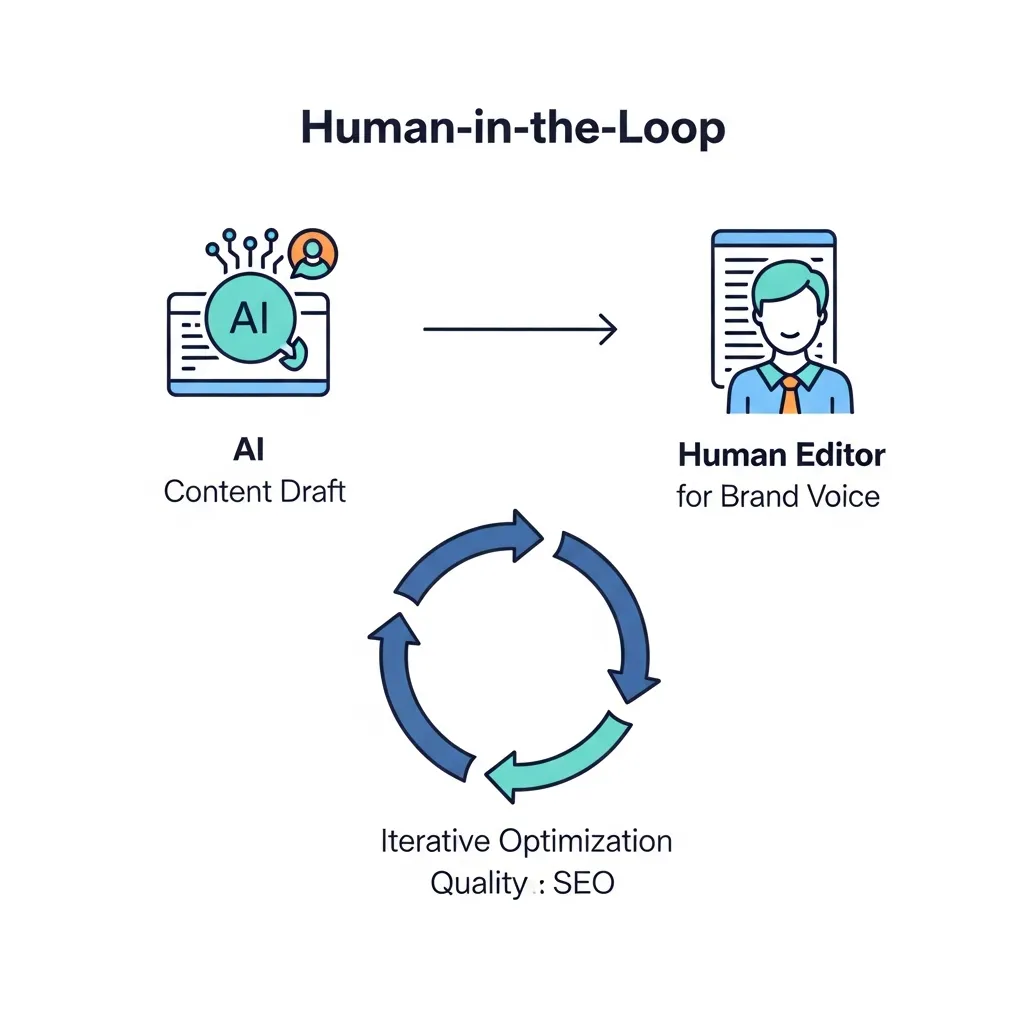
Maintaining a distinct brand voice and editorial integrity is paramount. AI models tend to produce statistically probable text, which can dilute a unique brand personality. The most effective approach is to initially train AI tools on existing, high-performing brand content to help them mimic tone and style. However, the final polish—the subtle humor or specific jargon that resonates with your audience—remains a uniquely human contribution.
Furthermore, ethical considerations and avoiding over-reliance on automation are critical. Blindly trusting AI can lead to the propagation of biases or content that lacks genuine empathy. It is essential to use AI as an augmentation, not a replacement, for human judgment. Regularly audit AI-generated content for originality and compliance with search engine guidelines to maintain your site's authority and trustworthiness.
Optimizing for the Future: Generative Engine Optimization (GEO) and Voice Search
The landscape of search is rapidly evolving beyond traditional results, ushering in an era of Generative Engine Optimization (GEO). This paradigm shift focuses on optimizing content for AI-powered search summaries and direct answers. To capture visibility, content must be exceptionally clear, authoritative, and directly address user intent. Field observations indicate that content designed to answer specific questions thoroughly is more likely to be selected as source material for these generative summaries.
Successfully navigating this shift also means mastering conversational and voice-based queries. Voice search often involves natural language questions rather than keyword strings. Optimizing for these queries requires a deep understanding of natural language processing (NLP). Practical experience shows that creating content that directly answers common questions, using a conversational tone, significantly improves its chances of ranking for voice search.
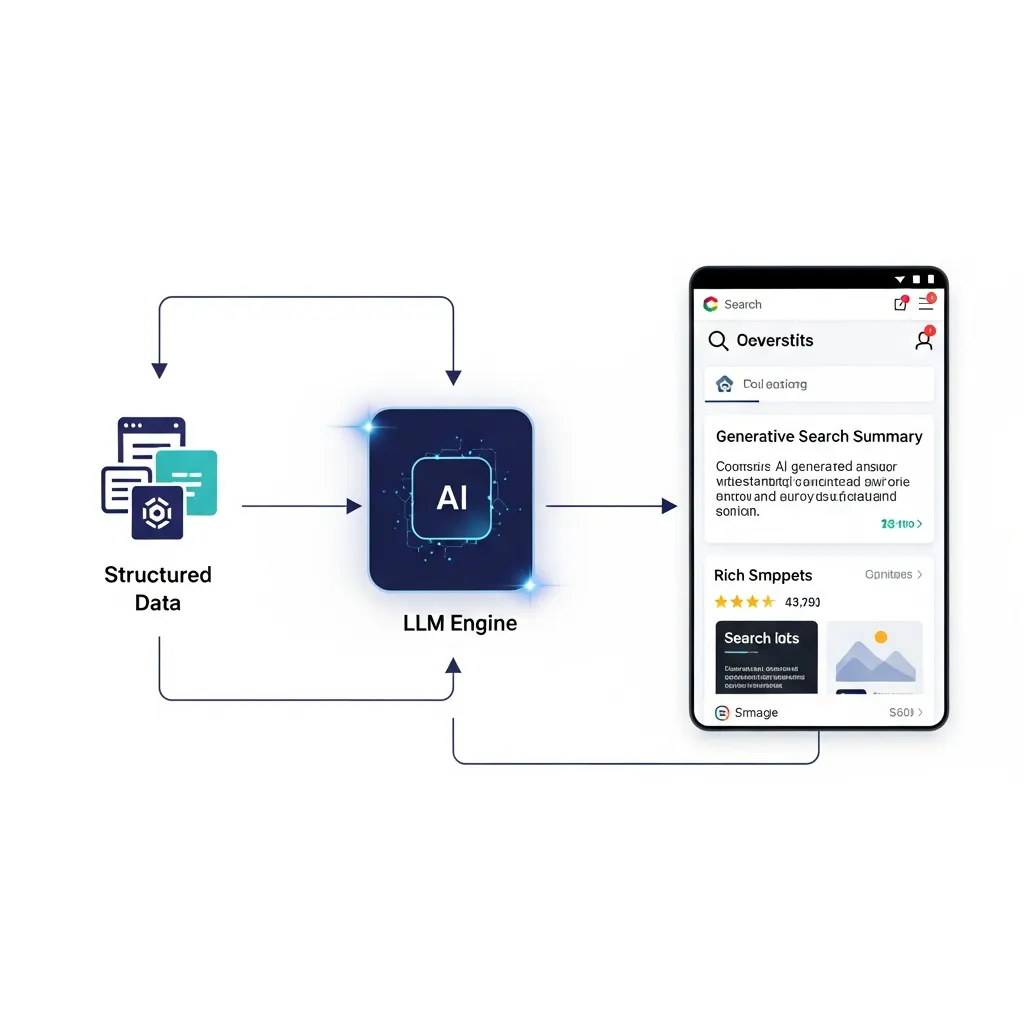
Crucially, structured data plays an indispensable role in feeding these advanced AI search engines. Implementing Schema.org markup explicitly tells AI models what your content is about and its key entities. Whether it's FAQPage, HowTo, or Product schema, well-implemented structured data enhances a page's eligibility for featured snippets and direct integration into AI summaries. Technical data suggests that websites with robust structured data are better positioned to be understood and utilized by generative AI.
Navigating Risks and Measuring the ROI of AI-Driven SEO
Integrating AI into SEO workflows offers immense potential, yet it's crucial to mitigate associated risks. One significant pitfall is the potential for algorithmic penalties if AI-generated content is unverified or lacks true informational value. Over-reliance on raw AI output without human oversight can lead to the spread of misinformation or content that fails to meet E-E-A-T guidelines. Neglecting to fact-check AI-generated data can quickly erode trust and search visibility.
To evaluate effectiveness, clearly defined Key Performance Indicators (KPIs) are essential. Beyond traditional metrics like organic traffic, focus on improvements in content quality scores, reduced time-to-publish, and enhanced user engagement metrics such as dwell time. For instance, tracking the average time saved on initial content drafts—often upwards of 30-40%—against the quality of the final output provides a clear picture of success.
Measuring the Return on Investment (ROI) for AI-driven SEO involves a pragmatic calculation of time-savings versus subscription costs. The most effective approach involves quantifying the human hours saved in tasks like keyword research and technical audits. Compare these savings against the monthly or annual cost of your AI SEO tools. If a tool reduces a task from 8 hours to 2 hours, that 6-hour saving, multiplied by your team's hourly rate, reveals its financial benefit and enables better resource allocation.
Final Thoughts on the Future of Search and Artificial Intelligence
AI isn't replacing SEO professionals; it's evolving our roles into strategic oversight and innovation. The long-term impact means embracing AI as a powerful co-pilot. Selecting tools should always align with your specific professional needs and goals, not just market hype.
In my experience, a common mistake is adopting AI without a clear strategy, leading to negligible ROI. I firmly believe that continuous learning and strategic experimentation are paramount for staying ahead. As the search landscape shifts, our expertise in guiding AI for optimal outcomes becomes invaluable. Start by auditing your current workflow to identify where AI can strategically enhance, not just automate, your efforts.
Frequently Asked Questions
What are the different types of AI SEO tools?
AI SEO tools are generally categorized into generative content tools for content creation and analytical optimization tools for data analysis and technical audits.
How does AI improve keyword research?
AI tools analyze massive datasets to identify high-volume terms, emerging trends, and complex user intent signals more efficiently than manual methods.
What is Generative Engine Optimization (GEO)?
GEO is the process of optimizing content for AI-powered search summaries and direct answers, focusing on clarity, authority, and structured data.
Can AI replace SEO professionals?
No, AI acts as a co-pilot. Success requires a hybrid strategy where AI handles data-intensive tasks while humans provide strategic oversight and brand voice.