The Evolution of Website Analysis
The era of static, manual SEO audits is firmly in the past. What was once a laborious, spreadsheet-driven exercise has evolved into dynamic, real-time monitoring of website performance. Modern automated auditing now defines its scope by comprehensively assessing everything from technical health and content quality to backlink profiles across vast digital ecosystems.
Practical experience shows that for sustained SEO success, speed and scale are currently non-negotiable. Consider a large enterprise managing hundreds of web properties; manual checks simply cannot keep pace. This evolution focuses on:
- Overcoming manual limitations to reduce human error.
- Ensuring continuous optimization through persistent monitoring.
To truly automate SEO audits and thrive in a competitive landscape, embracing this digital transformation is paramount.
Strategic Benefits of Scaling Your Review Process
Scaling the SEO review process with automation offers profound strategic advantages. Automated systems eliminate human error in technical data collection, ensuring unparalleled accuracy—a factor that is crucial when managing large datasets. Field observations confirm this precision, allowing teams to rely on data rather than assumptions.
These systems also enable real-time detection of critical crawl errors and site downtime, flagging issues before they significantly impact organic visibility. This operational efficiency directly frees up valuable human resources. SEO specialists can pivot from routine data gathering to high-level strategy, competitive analysis, and creative content development, driving more impactful results. Technical data suggests this reallocation significantly boosts team productivity.
Furthermore, automated audits ensure consistency in reporting across complex, large-scale enterprise domains. This provides a unified, reliable performance view for all stakeholders, enabling faster and more informed decision-making.
Core Pillars of a Comprehensive Automated Scan
A truly comprehensive automated SEO scan dissects a website across several critical dimensions, extending far beyond superficial checks. These core pillars ensure a holistic view of performance.
Technical Foundation
Automated audits prioritize the technical infrastructure. This involves scrutinizing crawlability (robots.txt, sitemaps), indexing status, and crucial site speed metrics like Core Web Vitals. Field observations indicate that unresolved technical issues frequently bottleneck even the highest-quality content.
On-Page Optimization
Next, the scan evaluates on-page elements. This involves analyzing meta data (titles, descriptions) for completeness and relevance, validating header structures (H1-H6) for semantic hierarchy, and assessing internal linking for optimal link equity distribution.

Content Quality
A robust automated audit delves into content health. It identifies instances of thin content lacking substance and flags potential keyword cannibalization, where multiple pages target the same keywords and dilute their collective strength. Practical experience shows this significantly impacts overall ranking potential.
External Signals
Finally, comprehensive scans monitor off-page signals. This includes automated backlink monitoring to track new and lost links, alongside sophisticated toxic link detection to identify and flag potentially harmful backlinks. Technical data suggests proactive monitoring is key to maintaining domain authority.
A Step-by-Step Framework for Interpreting and Prioritizing Audit Data
Once automated SEO audits deliver their comprehensive findings, the real strategic work begins: interpreting the data and translating it into a clear, actionable roadmap. Without a structured approach, the sheer volume of information can overwhelm even experienced professionals, leading to analysis paralysis or misdirected efforts.
The challenge lies in sifting through hundreds, sometimes thousands, of data points to identify what truly impacts search performance and aligns with overarching business goals. The most effective SEO specialists differentiate themselves not just by running audits, but by their ability to derive meaningful insights and prioritize fixes efficiently.
The Automated Audit Action Framework
To transform raw audit data into tangible improvements, SEO professionals can leverage The Automated Audit Action Framework. This five-step process guides the interpretation, prioritization, and implementation of findings, ensuring efforts deliver maximum ROI.
-
Categorizing Issues by Impact: Critical, Warning, and Notice
Automated tools are adept at flagging a wide array of issues, but not all carry the same weight.- Critical Issues: Immediate, high-priority problems that severely hinder crawling, indexing, or ranking. Examples include widespread 4xx/5xx errors, blocked resources, or significant Core Web Vitals failures. Addressing these is the absolute first priority.
- Warning Issues: Potential problems that negatively affect performance or user experience over time. This includes broken internal links, missing H1 tags, or duplicate content. These lead to incremental gains and prevent larger problems.
- Notice Issues: Minor suggestions or informational findings, such as slight image compression opportunities or sub-optimal metadata length. These are addressed after critical and warning issues.
-
Distinguishing 'Noisy' Data from Actionable Insights
Automated audits can sometimes generate "noise"—data points that appear problematic but are irrelevant to current goals or are false positives. Effective interpretation requires context. For instance, a "missing H1" on a paginated archive page might be intentional. Focus on actionable insights directly linked to a measurable SEO or business objective.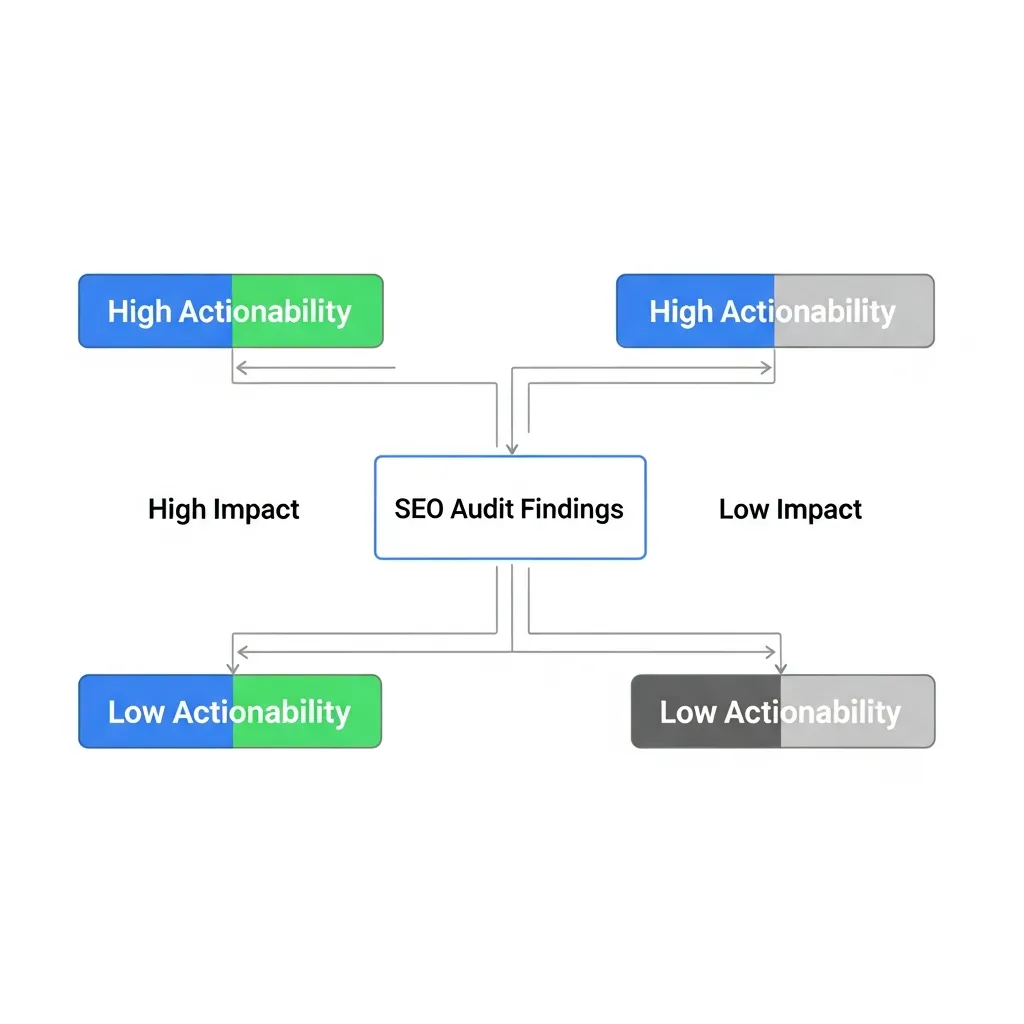
A flowchart diagram showing how to prioritize SEO audit findings based on impact and actionability.
-
Bridging the Gap Between Technical Findings and Content Quality
Many technical issues have direct implications for content visibility. A slow page load directly impacts user experience and can lead to higher bounce rates, diminishing the perceived quality of the content. It is crucial to connect these dots:- Technical bottlenecks can suppress the visibility of high-quality content.
- User experience issues (e.g., Core Web Vitals) affect engagement metrics that search engines consider.
- Content gaps can be identified through technical audits that analyze page relationships and keyword usage patterns.
-
Creating a Prioritized Roadmap Based on Business Goals and ROI
Prioritization must align with broader business objectives. Ask:- Which fixes most directly impact KPIs like organic traffic or conversions?
- What is the estimated effort versus the potential impact?
- Are there "quick wins" to build momentum?
- Which issues affect the most valuable pages (e.g., high-converting product pages)?
-
Translating Automated Reports into Clear Tasks for Development Teams
The final step is converting complex findings into actionable tasks for developers. For each prioritized fix, provide:- The specific issue: e.g., "Missing canonical tag."
- Affected URLs: A list or pattern of pages.
- Recommended solution: e.g., "Implement self-referencing canonical tags."
- Rationale/Impact: Briefly explain why the fix is important.
Pro Tip: When translating tasks for development, include a "verification step" for each fix. This empowers the development team to confirm successful implementation and provides a clear checkpoint for the SEO team to validate the changes.
How Artificial Intelligence Enhances Pattern Recognition
Artificial intelligence significantly elevates pattern recognition in SEO audits, surpassing human capabilities in both scale and subtlety. Practical experience shows AI's ability to predict the impact of specific SEO fixes by analyzing vast historical datasets, offering data-driven foresight into how optimizations might influence rankings.
Moreover, AI powers sophisticated automated sentiment and intent analysis for content audits, accurately discerning underlying user needs and aligning content strategy with evolving search queries at scale. Currently, machine learning algorithms excel at identifying complex patterns in algorithm fluctuations, detecting subtle correlations across numerous ranking factors that human analysis often misses. Furthermore, machine learning dramatically improves the accuracy of 'toxic' link identification, distinguishing harmful backlinks from legitimate ones to safeguard site authority more effectively.
Maintaining the Balance Between Automation and Human Strategy
Automated SEO audits enhance efficiency but can struggle with brand voice and nuanced content. While tools identify technical issues, they often lack the contextual understanding required for client-specific messaging or audience sentiment.
For high-stakes technical migrations, such as platform changes, human oversight remains critical. Missed redirects or misconfigured canonicals, sometimes undetected by generic checks, can cause substantial traffic loss. Relying solely on tool reports without human validation during major migrations often creates unforeseen complications.
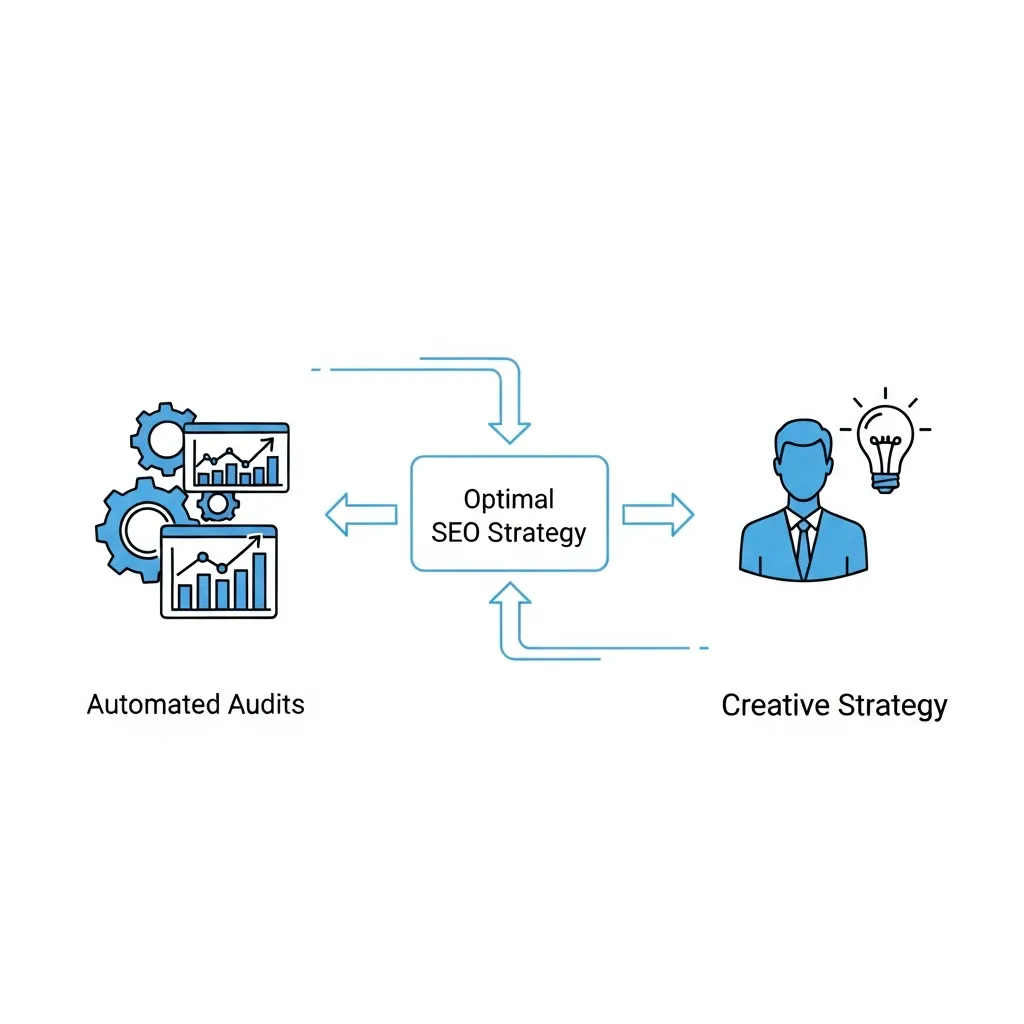
View automation as a consultant, not a replacement for expertise. It provides the data and highlights the problems, but strategic interpretation and the tailoring of recommendations to specific niche requirements demand human insight. The most effective approach integrates automated insights with a deep understanding of business goals and market dynamics.
Critical Pitfalls to Avoid in Automated Reporting
Automated reporting, while powerful, demands careful interpretation. A key pitfall is over-reliance on a simple SEO score without examining the raw data; industry context is always crucial. Ignoring a website's specific industry can yield irrelevant recommendations.
A common mistake is neglecting to update crawl settings as site architecture evolves, which can skew audit results. Furthermore, treating all automated warnings as equally urgent is inefficient. Prioritizing fixes based on potential impact and business alignment ensures optimal resource allocation for measurable gains.
Evaluating Success and Future-Proofing Your Strategy
Evaluating success involves more than just identifying issues; it is about quantifying impact. Measure the ROI of automation by tracking time saved on repetitive tasks, which often translates to a 30-50% efficiency gain compared to manual audits. Coupled with improvements in keyword rankings and organic traffic, the value of these systems becomes undeniable.
To maintain evergreen site health, establish a recurring audit schedule. This proactive approach ensures continuous optimization and addresses emerging technical debt before it impacts performance. I firmly believe that automated SEO audits are no longer a luxury but a necessity in today's data-driven, competitive digital landscape. They empower strategic decisions and facilitate scalable growth.
Apply the automated audit framework to your next project to achieve measurable efficiency gains and sustained search performance.
Frequently Asked Questions
What are automated SEO audits?
Automated SEO audits are software-driven processes that continuously scan a website for technical issues, content quality, and backlink health, providing real-time data without manual intervention.
What are the main benefits of scaling SEO reviews with automation?
Automation eliminates human error, enables real-time detection of crawl errors, and frees up SEO specialists to focus on high-level strategy rather than manual data collection.
Can automation replace a human SEO strategist?
No. While automation provides the data and identifies patterns, human expertise is required for brand voice, nuanced content strategy, and high-stakes technical migrations.
How do I prioritize findings from an automated SEO scan?
Use a framework to categorize issues by impact (Critical, Warning, Notice) and align fixes with business goals and potential ROI to ensure resources are used effectively.