The Evolution of Digital Visibility in the Age of Intelligence
The digital landscape for brand visibility has undergone a profound transformation. What was once a battle for position on traditional Search Engine Results Pages (SERPs) is now evolving into a new, critical frontier: generative AI responses. Currently, sophisticated AI models are acting as powerful information gatekeepers, synthesizing vast amounts of data to provide direct, often singular, comprehensive answers to user queries. This fundamental shift means brands are no longer solely vying for clicks on their websites but, more importantly, for explicit inclusion and authoritative citation within these AI-generated summaries.
Field observations indicate that a brand’s presence within AI-driven content is rapidly becoming the primary metric for digital marketing success. Consider a user asking an AI assistant for "the most reliable CRM solution"; the brands explicitly mentioned within that generated response gain immediate, highly authoritative visibility.
- This paradigm shift presents new challenges for ensuring accurate brand representation.
- It also offers unprecedented opportunities for direct brand authority.
Understanding this requires new analytical approaches, as detailed in AI share-of-voice tracking.
Defining the Core Components of Generative Presence
AI Share of Voice (SoV) fundamentally redefines brand visibility, quantifying the frequency and sentiment of a brand's presence within generative AI outputs. It extends beyond simple mentions to encompass explicit citations, direct links, and proactive recommendations embedded in AI-generated summaries and conversational responses. AI SoV prioritizes the quality and context of these references, unlike traditional metrics. Field observations indicate that achieving top-of-mind placement is key; this occurs when AI systems independently suggest a brand as a primary solution or authoritative source, rather than just including it in a list of many. Such proactive recommendations signify a brand's deep integration into the AI's knowledge base, elevating it beyond mere mention volume. Practical experience shows this distinction is vital for competitive advantage.
AI-Driven Metrics vs. Traditional Search Benchmarks
Traditional SEO fixates on keyword rankings and securing clicks from search result pages. In the AI-driven landscape, the game shifts dramatically. Marketers must now prioritize AI citation frequency, measuring how often and how accurately an AI system references their brand as a primary source, rather than just appearing in a list of links. This fundamental change transitions our focus from generating website clicks to cultivating powerful brand impressions directly within the AI interface.
High search volume, a traditional SEO gold standard, no longer guarantees visibility. An AI prioritizes authority and relevance; therefore, a brand with deep expertise in a niche topic might achieve significant AI visibility, even if its keyword volume is modest. In my experience, a common mistake is over-optimizing for broad, high-volume terms that AI systems summarize generically. Instead, focusing on becoming the definitive source for specific, high-value questions yields superior AI citations.
According to experts, AI Share of Voice offers a more holistic measure of brand authority currently. It encompasses not just presence, but trusted recommendation. In my view, this shift isn't just about adapting to new technology; it's about redefining what it means to be a recognized leader. Practical experience shows brands achieving high AI citation frequency gain a distinct competitive edge, proving AI SoV is paramount.
Step-by-Step Guide to Measuring Brand Citations in AI
Understanding your brand's presence in generative AI requires a structured approach. Here’s how to systematically measure brand citations and gain actionable insights:
-
Prompt Identification: Begin by meticulously crafting a representative set of prompts that directly reflect your target audience's genuine search queries and informational needs. Practical experience shows that focusing on diverse user intents—ranging from broad industry questions to specific product comparisons—is paramount. This ensures a comprehensive scan of how AI systems might encounter and reference your brand.
-
Tracking Brand Mentions: Systematically monitor your brand's appearance across leading generative AI platforms, including ChatGPT, Gemini, and Claude. This process can leverage manual querying for qualitative depth on specific prompts, or utilize automated methods via platform APIs for scalable data collection. Field observations indicate that a blended approach often yields the most robust data.
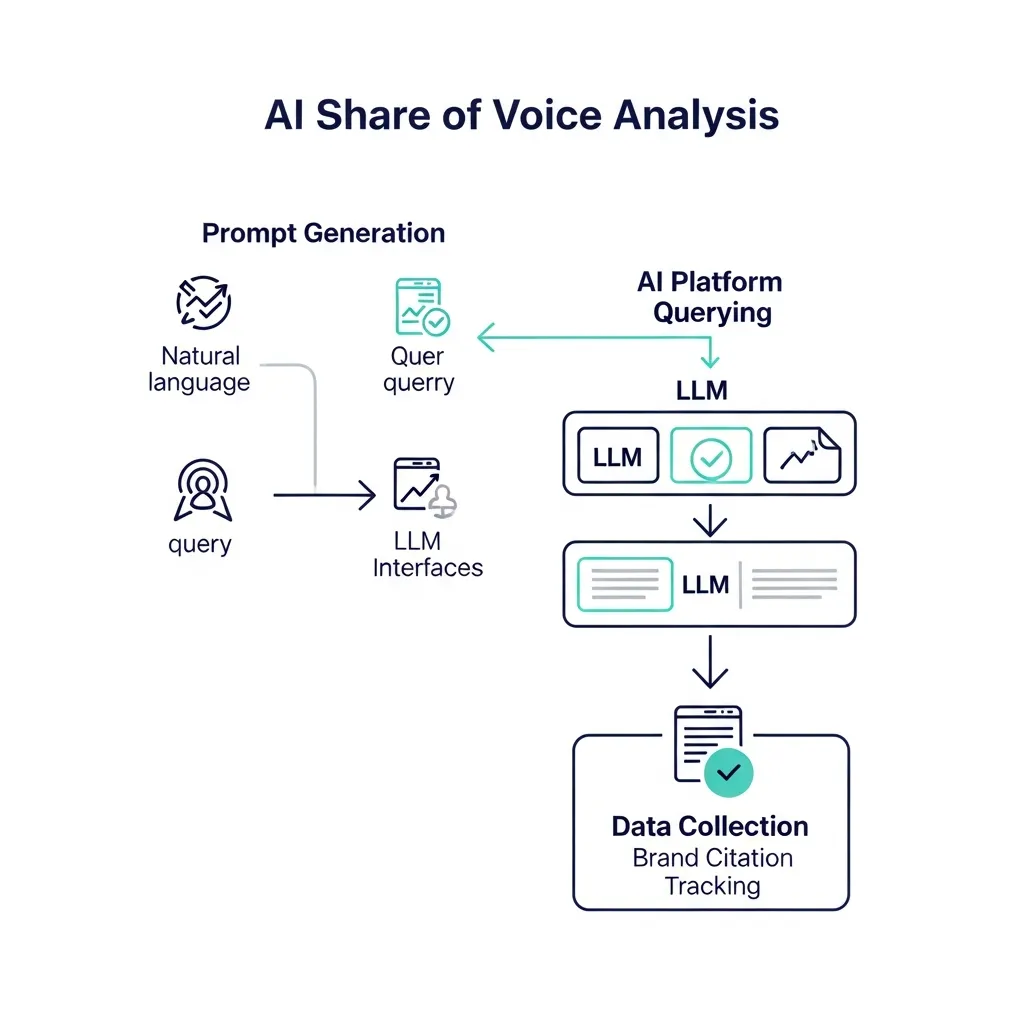
Flowchart illustrating the process of prompt generation and data collection for AI brand citation analysis. -
Calculating Brand Feature Rate: Quantify your brand's visibility by calculating the percentage of responses where your brand is explicitly featured or recommended. This metric becomes particularly insightful when directly compared against key competitors within the same set of prompts. Technical data suggests that a higher, consistent feature rate signals a stronger AI Share of Voice.
-
Sentiment and Contextual Analysis: Beyond mere presence, analyze the sentiment and context of AI-generated brand descriptions. Assess whether the tone is positive, neutral, or negative, and critically evaluate if the AI accurately conveys your brand's core value proposition and differentiators. Experts emphasize that the quality and depth of these mentions are as crucial as their frequency for establishing true AI authority.
A Comprehensive Framework for Optimizing Content for AI Extraction
The shift towards generative AI in search has fundamentally altered how brands achieve visibility, moving beyond keyword rankings to focus on AI Share of Voice. To effectively capture this, a strategic framework for optimizing content for AI extraction is paramount. Field observations indicate that content designed for human readability alone often falls short when processed by large language models (LLMs) and Retrieval-Augmented Generation (RAG) systems.
The Generative Content Optimization (GCO) Framework
This framework outlines six critical pillars for ensuring your brand's information is not only discoverable but also accurately parsed, synthesized, and cited by AI. Adopting these principles will position your content as a preferred source for AI-driven answers.
-
Implement Generative Engine Optimization (GEO) through Structured Data and Clear Hierarchies
Optimizing for AI extraction begins with technical foundations. Structured data, particularly Schema.org markup, acts as a Rosetta Stone for AI, explicitly defining the relationships between entities, facts, and concepts on your page. This isn't just about basic article or product schema; it extends to specific properties likehasPart,mainEntityOfPage, andaboutto provide granular context. Alongside this, a clear content hierarchy—using H1s for main topics, H2s for sub-topics, and H3s for supporting details—guides AI through the logical flow of information. Technical data suggests that content with well-defined structural elements is significantly easier for LLMs to deconstruct, identify key arguments, and extract specific data points for coherent summaries or direct answers. -
Develop 'AI-Friendly' Content Formats
While long-form prose has its place, AI models thrive on structured, digestible formats. Lists (bulleted or numbered), tables, and concise executive summaries are invaluable. Lists make it easy for AI to identify and extract distinct items or steps. Tables present comparative data or factual information in an unambiguous, machine-readable way. Executive summaries, placed prominently at the beginning of a piece, provide immediate, high-level answers, allowing AI to quickly grasp the main takeaways without parsing extensive text. Incorporating dedicated FAQ sections with direct answers further enhances extractability for common queries.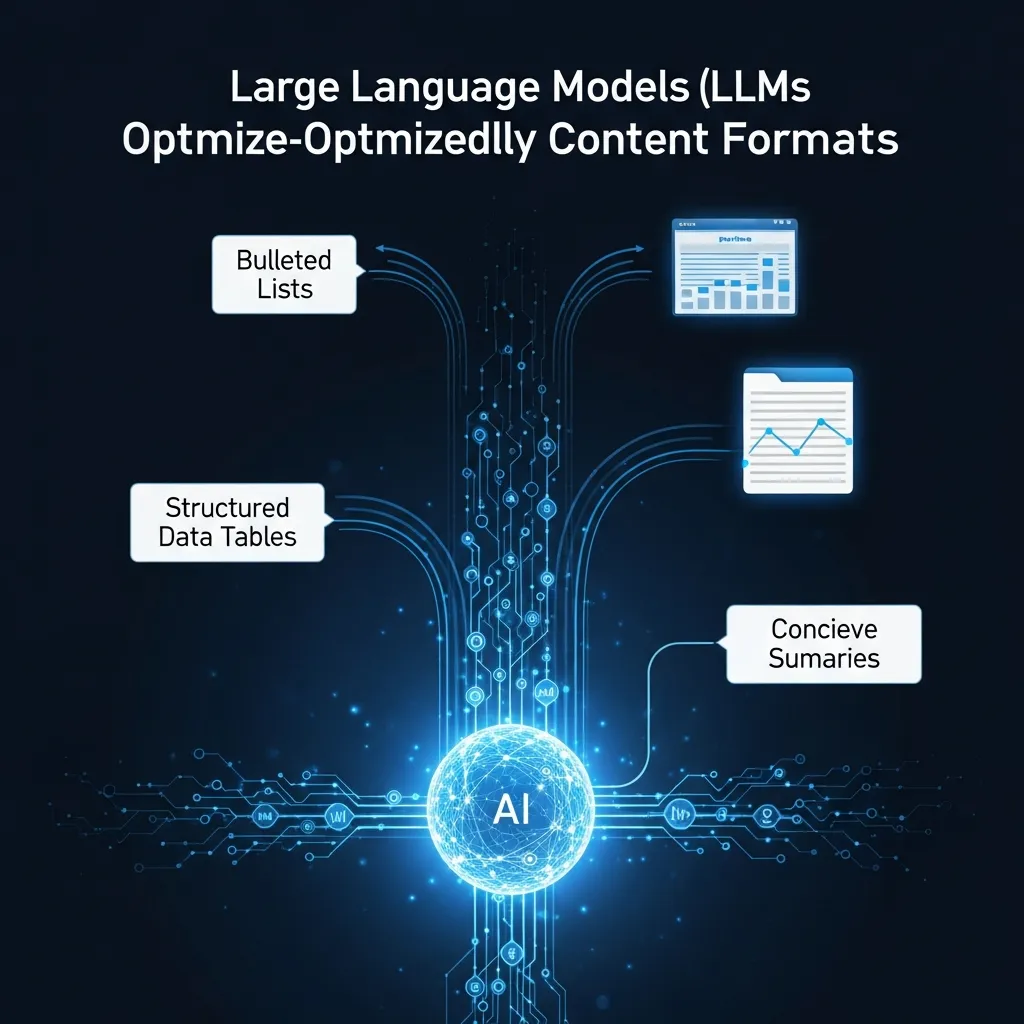
Diagram showing how AI processes structured lists, tables, and summaries for generative search visibility.
-
Build Topical Authority through High-Quality, Data-Backed Original Research
AI models are trained on vast datasets, and their responses often prioritize sources demonstrating topical authority and expertise, experience, authoritativeness, and trustworthiness (E-E-A-T). This is achieved by consistently publishing high-quality, data-backed original research, unique insights, and proprietary studies. When your content introduces novel data, provides unique perspectives, or offers in-depth analysis supported by verifiable evidence, it establishes your brand as a leading voice in its domain. According to experts, AI systems are increasingly adept at identifying and valuing sources that contribute genuinely new, credible information rather than simply regurgitating existing content. -
Ensure Cross-Channel Consistency for Brand Identity Recognition
AI models don't just consume web pages; they draw from a multitude of sources across the digital ecosystem. Therefore, cross-channel consistency in your brand messaging, data, and identity is crucial. Ensure your brand name, mission, product descriptions, and key value propositions are uniform across your website, social media profiles, press releases, industry directories, and third-party mentions. This consistency helps AI build a robust, coherent understanding of your brand's identity and offerings, reducing the likelihood of misinterpretation or inaccurate representation in generative outputs. Practical experience shows that a fragmented brand presence can lead to AI providing conflicting or incomplete information. -
Optimize for 'Extractability' – Making it Easy for LLMs to Parse and Cite
Beyond structural elements, the very language of your content must facilitate easy extraction. This means employing clear, unambiguous language, avoiding excessive jargon unless clearly defined, and structuring sentences to deliver key facts directly. Think about how an LLM would process your text to answer a specific question. Can it easily pinpoint the "who," "what," "when," "where," "why," and "how" without inferring? Use active voice, provide direct answers to potential questions within the text, and ensure that any statistics, dates, or names are presented clearly and are easily verifiable. This deliberate approach to writing makes your content a prime candidate for direct citation or synthesis by AI. -
Leverage PR and External Mentions to Feed Training Data and RAG Systems
The ecosystem of AI visibility extends beyond your owned properties. Public relations (PR) efforts and high-quality external mentions play a vital role in feeding both the foundational training data of LLMs and the real-time Retrieval-Augmented Generation (RAG) systems. When reputable industry publications, news outlets, or authoritative blogs cite your brand, data, or research, it signals credibility and relevance to AI. These external references act as powerful validators, contributing to your brand's overall knowledge graph within AI models and increasing the likelihood that your insights will be retrieved and presented in generative outputs. Actively seeking and fostering these high-quality backlinks and brand mentions is a critical, often underestimated, component of AI optimization.
Top-Rated Platforms for Monitoring AI Brand Mentions
Monitoring AI Share of Voice (AI SoV) requires tailored tools. Emerging AI-specific monitoring platforms track direct brand citations within generative AI outputs, providing granular insights into how LLMs utilize your content.
Concurrently, many existing SEO suites are integrating features to monitor generative search components like AI Overviews and conversational AI results. Practical experience shows these platforms offer initial visibility into prominent AI citations by leveraging their established crawling capabilities.
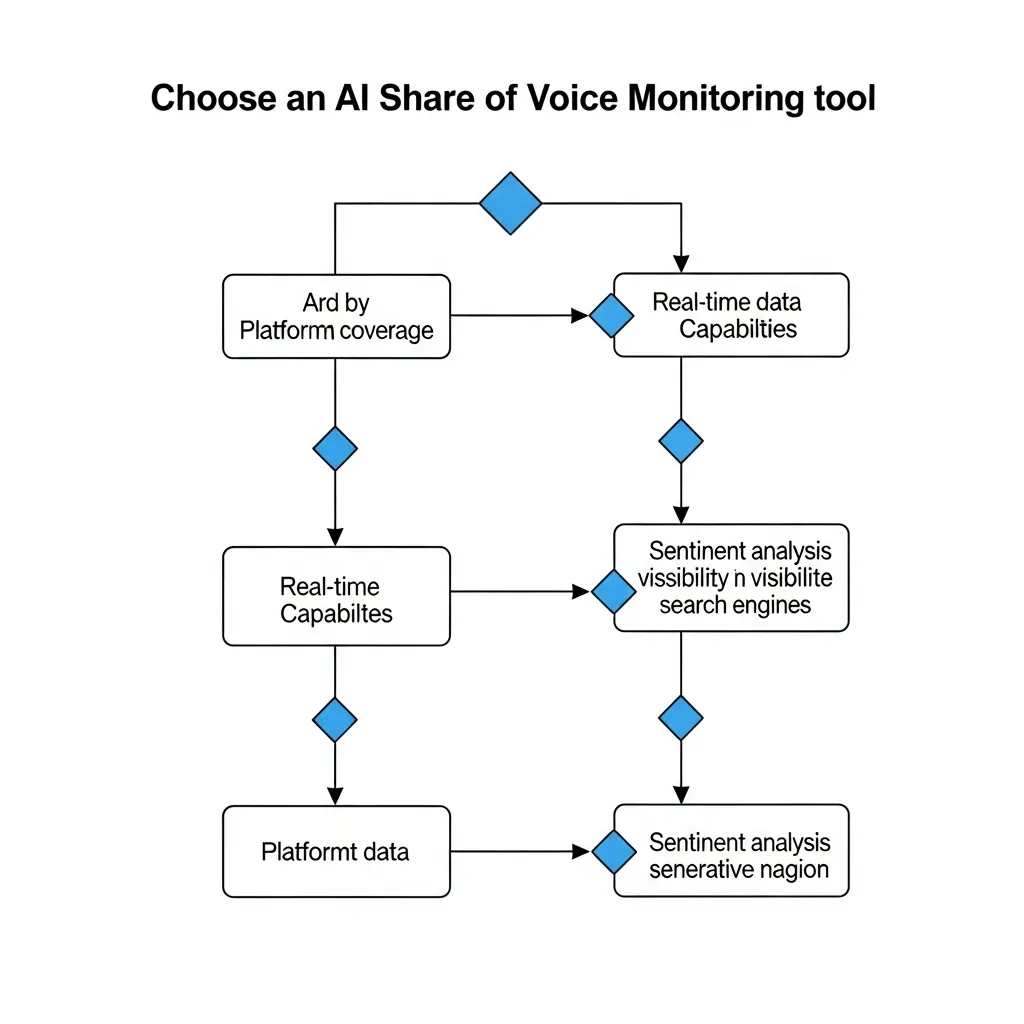
For large-scale auditing or unique requirements, open-source solutions and custom scripts offer flexibility, albeit demanding internal technical expertise. The optimal tool selection hinges on your budget constraints and technical capabilities. Evaluate whether a commercial platform, an enhanced existing suite, or a bespoke solution best aligns with your strategic objectives.
Strategic Pitfalls That Hinder AI Visibility
Brands often stumble by over-optimizing for AI extraction at the expense of human readability. A common mistake I've seen is prioritizing keyword density over natural language, degrading user experience and AI comprehension. Inconsistent brand messaging across digital touchpoints confuses AI models, hindering a unified identity. In my view, this oversight is critical. Neglecting fundamental technical SEO like site speed and crawlability severely impedes discovery. Practical experience shows AI responses are inherently volatile; continuous monitoring is indispensable for adapting strategies and maintaining AI visibility.
Building a Timeless Authority in the Generative Era
AI Share of Voice transcends fleeting metrics, establishing itself as a vital, long-term KPI for brand health. True authority in generative search balances technical optimization for AI extraction with unwavering brand trust. AI models prioritize verifiable, expert-driven content. A common mistake I've encountered is brands optimizing solely for technical signals, neglecting the foundational trust that builds enduring relevance. In my view, a proactive strategy focusing on consistent, high-quality content builds a timeless digital presence, far more valuable than reactive adjustments. This forward-thinking approach ensures your brand remains a recognized authority, irrespective of evolving AI capabilities. Start now by auditing your content for expertise, authoritativeness, and trustworthiness (E-A-T) across all platforms.
Frequently Asked Questions
What is AI share of voice?
AI share of voice (SoV) is a metric that quantifies the frequency, sentiment, and quality of a brand's presence within generative AI outputs like ChatGPT, Gemini, and Claude.
How do you measure AI share of voice?
You can measure it by identifying key user prompts, tracking brand mentions across AI platforms, and calculating the percentage of responses where your brand is featured or recommended.
What is Generative Engine Optimization (GEO)?
GEO is the process of optimizing content using structured data, clear hierarchies, and authoritative information to ensure it is easily parsed, synthesized, and cited by AI models.
Why is AI share of voice important for SEO?
As users shift from traditional search to AI assistants, brand visibility depends on being cited as an authoritative source within AI-generated summaries rather than just ranking in a list of links.