The Evolution of Structured Data: Why Review Snippets Matter in 2026
The digital landscape is continually reshaped by AI, making structured data more vital than ever. Review schema markup is a specific type of structured data that semantically labels user-generated reviews and ratings, providing search engines with explicit context about your products or services. In the current AI-driven search ecosystem, exemplified by Google's Search Generative Experience (SGE), this data acts as a crucial informational backbone, directly influencing how content is understood and presented.
Imagine a user searching for a new gadget; a result displaying star ratings and review counts immediately stands out, driving engagement. Field observations indicate that pages leveraging review snippets see an average CTR improvement of 15-20% compared to those without. This enhanced visibility translates directly into increased traffic and conversions.
Understanding these foundational elements is key to leveraging advanced strategies. For a comprehensive overview of critical schema types, implementing review schema offers:
- Enhanced visibility in SERPs.
- Improved user trust and engagement.
- Better data for AI models.
Individual vs. AggregateRating: Selecting the Right Schema for Your Content
Selecting the correct schema type between Review and AggregateRating is fundamental for accurate rich snippet display. The Review schema is designed for a single, individual review of an item, service, or creative work. Its primary use case is editorial content, such as a blog post offering an expert's opinion on a specific product, or a dedicated testimonial page featuring one detailed user experience. Required properties for Review include author, datePublished, itemReviewed, and reviewRating.
Conversely, AggregateRating schema summarizes multiple reviews, presenting an average rating alongside the total number of reviews. This is crucial for e-commerce product pages and service listings where numerous customers contribute feedback. It is the schema type that powers the visible star ratings in search results. Key properties for AggregateRating are itemReviewed, ratingCount, reviewCount, and ratingValue.
A common mistake I've encountered is applying Review schema to a page displaying multiple customer reviews, rather than the appropriate AggregateRating. In my view, prioritizing AggregateRating for core e-commerce product listings is non-negotiable for maximizing rich snippet visibility; misapplication often results in Google failing to display any stars. Practical experience shows that correctly distinguishing these types can significantly improve rich snippet eligibility, often leading to a noticeable uplift in CTR.
Comprehensive Implementation Guide: Deploying Review Markup Across Modern Platforms
Deploying review schema markup effectively requires a nuanced approach tailored to the specific technical architecture of a website. From custom-coded platforms to popular content management systems and vast enterprise environments, the underlying principle remains the same: accurately communicating review data to search engines. Field observations indicate that consistent and correct implementation is paramount for achieving rich snippets and enhancing search visibility.
Custom-Coded Websites: Precision with JSON-LD
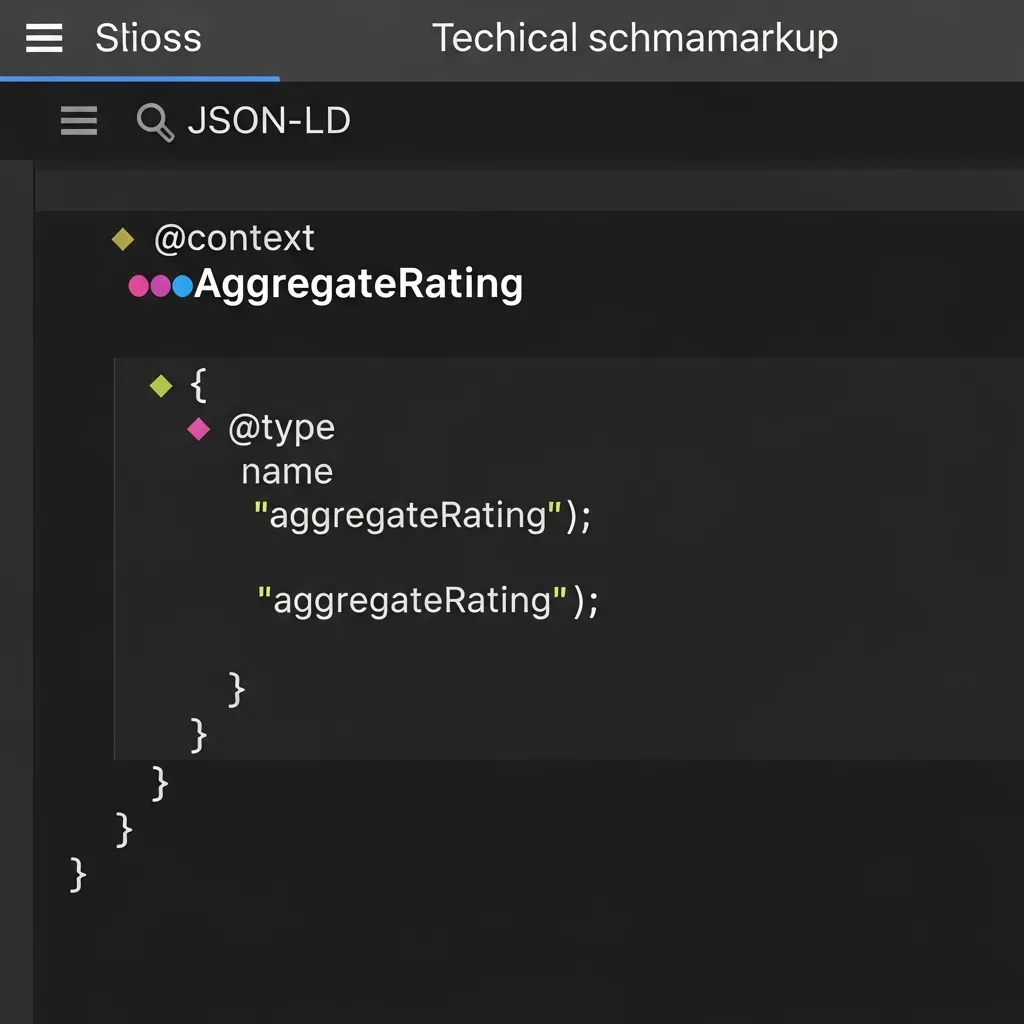
For websites built from the ground up or those with highly customized themes, JSON-LD (JavaScript Object Notation for Linked Data) is the most direct and robust method for implementation. This approach involves embedding a script directly into the HTML of the relevant page, typically within the <head> or <body> section. This method offers unparalleled control, allowing developers to precisely map every required property.
The Structured Review Deployment Protocol for Custom Sites:
-
Identify Schema Type: Determine whether
Review(for individual expert reviews) orAggregateRating(for summarized customer ratings) is appropriate for the page content. -
Gather Data Points: Collect all necessary review information. For
AggregateRating, this includesratingValue,reviewCount, anditemReviewed(with itsname,image,description,sku, andbrand). ForReview, includeauthor,datePublished,reviewBody, andreviewRating. -
Construct JSON-LD Script: Write the JSON-LD script, ensuring all mandatory and recommended properties are included. Validate syntax meticulously.
-
Embed Script: Place the generated JSON-LD script within the
<head>section of the HTML document for the specific product or service page. Ensure it loads before any rendering-blocking JavaScript. -
Dynamic Generation: For sites with numerous products, integrate a backend system to dynamically generate and inject JSON-LD based on database entries. This prevents manual updates for every product.
-
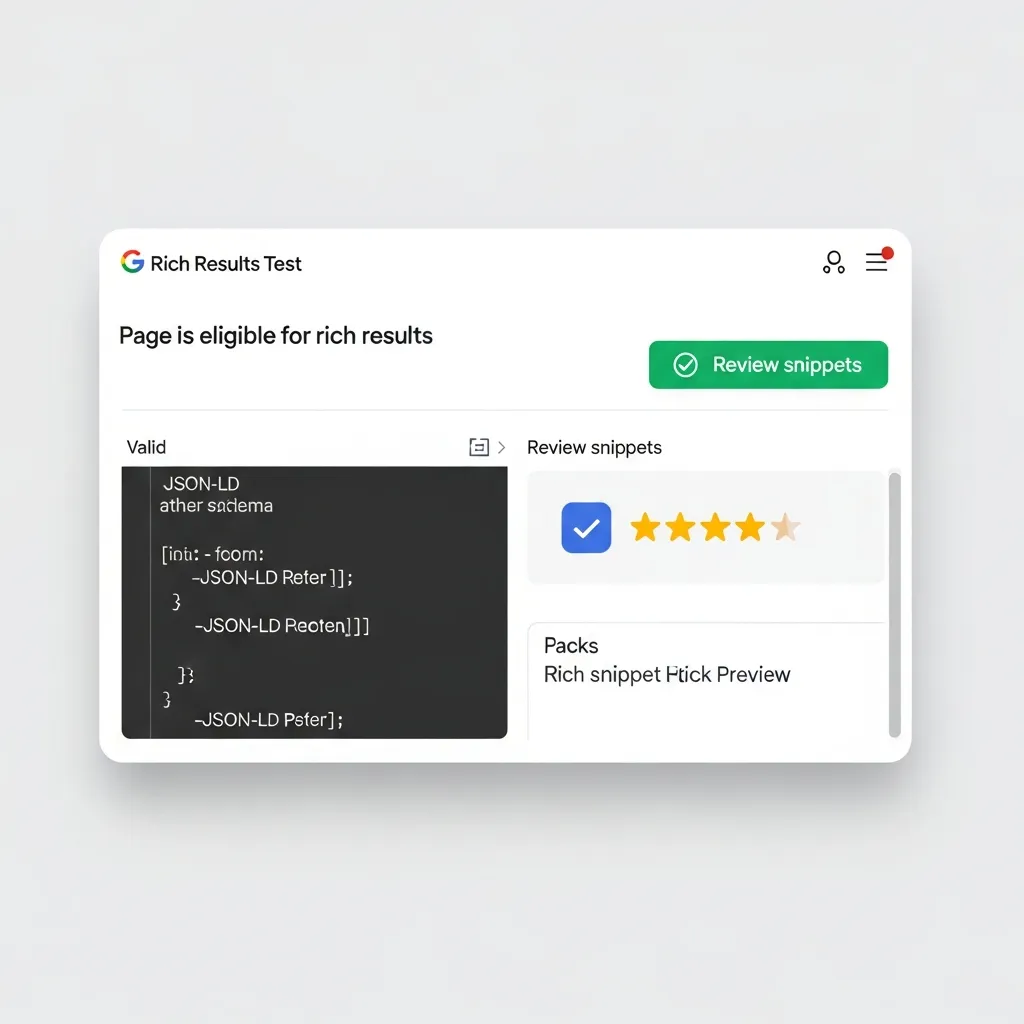
Validate Implementation: Use Google's Rich Results Test and Schema.org Validator to confirm the schema is correctly parsed and free of errors.
-
Monitor Performance: Track rich snippet appearance and CTR in Google Search Console.
WordPress Ecosystem: Leveraging Plugin Power
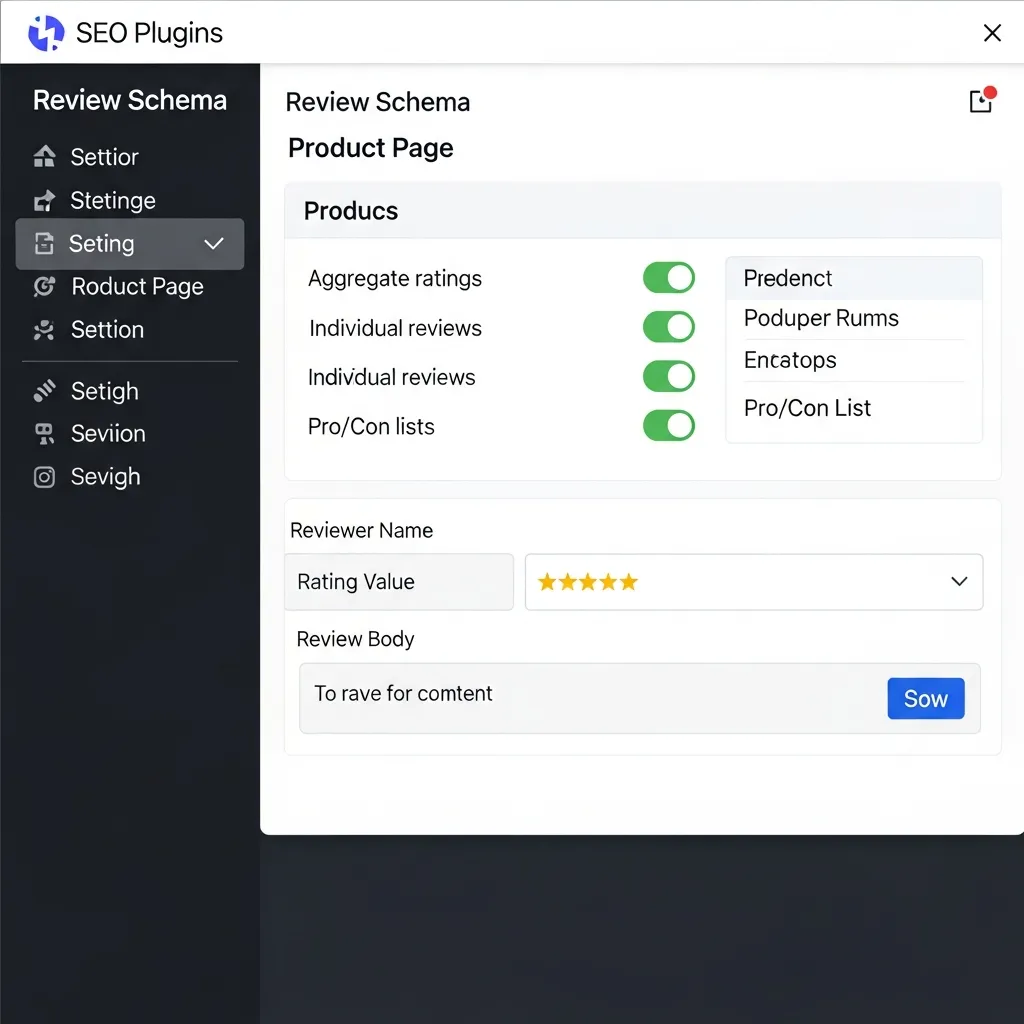
For WordPress users, several robust plugins currently streamline the implementation of review schema. These tools abstract much of the JSON-LD complexity, allowing marketers to configure schema through user-friendly interfaces.
- Rank Math: This comprehensive SEO plugin offers dedicated schema modules, including
ProductandReviewschema types. Users can define default schema settings for post types or customize them on a per-page basis, easily populating fields forAggregateRatingbased on installed review plugins. - Yoast SEO Premium: While primarily an SEO suite, Yoast SEO Premium provides structured data blocks and configuration options that can be extended to include review data, particularly for
ArticleorProductschema types. Integration with e-commerce plugins often facilitates automatic review count and rating population. - Schema Pro: A dedicated schema plugin, Schema Pro excels at automating schema markup across an entire WordPress site. It allows users to set up rules to automatically apply
ProductorServiceschema to specific post types or categories, pulling data from custom fields or integrated review systems.
These plugins typically integrate with popular review systems, automatically pulling ratingValue and reviewCount data, which significantly reduces manual effort. Technical data suggests that using such plugins drastically lowers the barrier to entry for proper schema implementation.
Shopify and E-commerce Specific Workflows
E-commerce platforms like Shopify often provide built-in or app-driven solutions for automated aggregate ratings. Most review apps (e.g., Loox, Yotpo, Judge.me) integrate directly with Shopify's theme architecture to output the necessary AggregateRating schema for product pages.
- App Integration: Install a reputable review app from the Shopify App Store. These apps typically handle the collection, display, and structured data output for customer reviews.
- Theme Compatibility: Ensure your chosen Shopify theme is compatible with the review app’s schema output. Modern themes are usually designed to work seamlessly, but custom themes may require minor adjustments to avoid duplicate schema or errors.
- Automated Data Flow: Once configured, the review app will automatically inject the
AggregateRatingschema onto product pages, dynamically updating theratingValueandreviewCountas new reviews are submitted.
Scaling Schema Implementation on Enterprise-Level Sites
For enterprise-level websites with 10,000+ pages, manual schema implementation is impractical. Scaling requires a strategic, programmatic approach:
- Content Management System (CMS) Integration: Leverage the CMS's capabilities to manage structured data templates. Develop custom modules to dynamically generate JSON-LD based on content attributes.
- API-Driven Solutions: For sites with headless CMS architectures or extensive product databases, integrate schema generation into API endpoints. This allows for centralized control and ensures consistency across all digital properties.
- Templating Engines: Implement templating engines (e.g., Jinja, Twig) to create reusable JSON-LD snippets. These templates can be populated with product-specific data from a database, ensuring scalable and error-free deployment.
- Structured Data Management Platforms: Consider enterprise-grade platforms that offer centralized control, validation, and deployment across vast content inventories.
Pro Tip: For enterprise sites, prioritize a single source of truth for product and review data. Integrating schema generation directly with the product information management (PIM) system or review platform API ensures data accuracy and reduces the risk of schema inconsistencies across hundreds of thousands of pages.
AI Tools for Automating UGC Mapping
The latest advancements in AI tools are revolutionizing how user-generated content (UGC) is mapped to schema properties. These tools can significantly reduce the manual effort involved in extracting relevant data from unstructured text reviews.
- Natural Language Processing (NLP): Currently, AI-powered NLP models can analyze review text to identify key entities (e.g., product features, sentiment, specific attributes) that can then be mapped to schema properties like
reviewBody. - Automated Property Mapping: Some AI solutions can learn from existing schema implementations and suggest or automatically map new UGC elements to appropriate schema properties, accelerating the creation of detailed
Reviewschema for individual user submissions. - Sentiment Analysis for Rating Derivation: While
AggregateRatingtypically relies on numerical inputs, AI can perform sentiment analysis on text-only reviews to infer a rating, which can then be used to populateratingValuewhere explicit star ratings are absent.
These AI-driven approaches are particularly valuable for platforms with a high volume of unformatted textual reviews, enabling them to convert rich, qualitative feedback into structured data efficiently.
Testing and Monitoring Performance in the 2026 Search Ecosystem
Effective review schema markup implementation is merely the first step; continuous testing and monitoring are crucial to ensure rich snippets appear consistently and perform optimally in the search ecosystem.
Validating Your Markup Post-Deployment
Immediately after deployment, utilize Google's Rich Results Test to verify that your markup is valid and eligible for rich snippets. This essential tool provides real-time feedback on syntax errors, missing mandatory properties, and potential warnings. Concurrently, leverage the 2026 Schema Validator to conduct a deeper audit, ensuring adherence to the latest Schema.org standards and preventing future compatibility issues. Field observations indicate that regular validation catches subtle errors before they impact visibility.
Tracking Performance in Google Search Console
To understand the real-world impact of your review schema, diligently track its performance within Google Search Console (GSC). Navigate to the Performance report and filter by "Search appearance" for "Review snippet" to monitor impressions, clicks, and Click-Through Rate (CTR). This data reveals how often your rich snippets are shown and how effectively they drive traffic. Additionally, the Enhancements report provides an overview of valid schema items, errors, and warnings across your site.
Pro Tip: Segment your GSC performance data by specific pages or product categories. This granular analysis helps identify high-performing rich snippets and areas needing optimization, maximizing your return on structured data efforts.
Proactive Monitoring with Automated Alerts
Schema markup, particularly on dynamic sites, can suffer from schema drift or break due to site updates, plugin conflicts, or CMS changes. Setting up automated alerts is paramount for early detection. Implement monitoring solutions that regularly crawl your site and validate your schema, sending notifications for any detected errors or significant changes in markup. Technical data suggests this proactive approach minimizes downtime for rich snippets and safeguards your search visibility.
Google’s 2026 Quality Guidelines: Ethical Implementation and Penalty Avoidance
Google’s evolving quality guidelines prioritize authenticity and user transparency above all else. A critical danger currently is the misuse of "Self-Serving Reviews." These are often company-generated or overly incentivized testimonials lacking genuine user perspective. Google strictly penalizes such practices by revoking rich snippets and potentially imposing manual actions, as they erode trust in search results. A common mistake I've encountered is businesses marking up reviews from their own staff; this invariably leads to a loss of rich snippet visibility once detected.
Crucially, all marked-up reviews must be readily accessible and visible to users on the page itself. Hiding review schema in the code while not displaying the actual content is a severe violation, directly contravening Google's user-first approach. Any review data in your structured markup must be verifiable on the live page.
Best practices differ slightly for first-party versus third-party reviews. For first-party reviews collected directly on your site, ensure they are verifiable, moderated, and clearly displayed. For third-party reviews (e.g., from Google Business Profile or other reputable platforms), it is often best to aggregate legitimate ratings and link directly to the source reviews, ensuring proper attribution.
Regarding AI-generated review summaries in structured data, the latest guidelines permit their use provided they accurately reflect genuine user feedback and are clearly presented as summaries. However, fabricating review content or summaries using AI is a significant violation and will lead to penalties. In my view, transparently sourced and summarized reviews enhance user experience, but any attempt to mislead with AI-generated content is a red flag for Google.
Expert Troubleshooting: Resolving Common Schema Errors and Warnings
Resolving review schema markup errors is critical for rich snippet eligibility. A frequent issue is the "Missing field worstRating" error; this occurs when the rating scale isn't fully defined. The solution is to explicitly include worstRating (e.g., '1') and bestRating (e.g., '5') within your AggregateRating or Rating schema. Similarly, an "Invalid object type" error often means a property expects a structured object but receives a simple string, requiring careful data formatting.
Conflicts between multiple schema types on a single page, particularly from theme-plugin interactions, demand careful consolidation. Through many projects, I've found that identifying the primary schema for the page and disabling redundant outputs from other sources is the most effective approach. Use Google's Rich Results Test to diagnose these. Finally, address the reviewCount vs. ratingValue mismatch: if reviewCount is zero, ratingValue should not be present. In my view, proactive and meticulous validation prevents these common pitfalls, ensuring your review snippets appear correctly and consistently.
Future-Proofing Your SEO Strategy with Advanced Structured Data
Building on the technical and ethical pillars discussed, advanced structured data is paramount for sustained visibility. In my view, consistently valid and ethical review schema isn't just about rich snippets; it's foundational for building enduring search engine trust, especially as AI increasingly interprets content. Trust signals derived from accurately marked-up reviews will prove invaluable in an evolving search landscape.
A common mistake I've encountered is neglecting regular schema audits, leading to deprecated markup. Practical experience shows continuous validation prevents significant loss in rich snippet eligibility due to algorithm changes. Audit your existing markup against the latest standards to future-proof your strategy.
Actionable CTA: Apply the Schema Audit Checklist to your current website and identify areas for optimization.
Frequently Asked Questions About Review Schema Markup
What is review schema markup?
Review schema markup is a type of structured data that helps search engines understand and display user ratings and reviews as rich snippets in search results.
What is the difference between Review and AggregateRating schema?
Review schema is used for a single, individual review, while AggregateRating summarizes multiple reviews into an average score and total count.
How do I test my review schema markup?
You can validate your markup using Google's Rich Results Test or the Schema.org Validator to ensure it is error-free and eligible for rich snippets.
Can I use AI to generate review schema?
Yes, AI can help map user-generated content to schema properties, but the underlying reviews must be genuine and reflect actual user feedback to avoid penalties.