The landscape of content creation is undergoing a profound transformation driven by rapid advancements in artificial intelligence. For SEO specialists, content marketers, and website owners, the allure of generating high-quality content at an unprecedented scale and speed is undeniable. However, this powerful capability introduces a critical challenge: how to leverage E-E-A-T for AI-generated content effectively without compromising the search authority and credibility that define a successful online presence.
Currently, Google’s evaluation of content quality revolves around E-E-A-T (Experience, Expertise, Authoritativeness, and Trustworthiness). While AI excels at synthesizing information and generating coherent text, its inherent lack of personal experience or genuine expertise can leave content feeling generic, superficial, or even untrustworthy.
Field observations indicate that content lacking distinct E-E-A-T signals struggles to establish prominence in competitive search results, regardless of its grammatical perfection. This is particularly true for Your Money or Your Life (YMYL) topics, where accuracy and reliability are paramount. The risk isn’t just poor ranking; it’s the erosion of brand trust.
This strategic guide directly addresses that tension. We will explore how to bridge the gap between AI’s efficiency and Google’s stringent quality expectations. By implementing a robust framework, you can harness AI’s potential to produce content that not only ranks but also builds genuine credibility and trust with your audience.
The Evolution of Content Quality in the Age of Artificial Intelligence
Artificial intelligence has dramatically reshaped the content landscape, presenting both unprecedented opportunities for efficiency and critical challenges to established quality paradigms. Currently, the core strategic question for content marketers isn’t merely how to generate content with AI, but how to ensure that E-E-A-T for AI-generated content consistently meets the principles that govern search authority. This intersection defines a new frontier where scalable production must align with demonstrable credibility.
Search engines exist to connect users with the most helpful, reliable, and human-centric information available. Field observations indicate that content prioritizing genuine utility and user well-being consistently outperforms material lacking depth or verifiable backing. This prioritization is particularly pronounced for YMYL topics, where the stakes for accurate information are highest.
The discourse has fundamentally shifted. Rather than a simplistic “AI vs. Human” binary, the focus is now squarely on “Quality vs. Low-Value” content, irrespective of its origin. Low-quality, unverified human-generated content is just as detrimental to search rankings as poorly executed AI material. The challenge is to leverage AI as a powerful tool to enhance human expertise, ensuring every piece of content stands as a testament to genuine value.
Decoding Search Quality Rater Guidelines for Machine-Assisted Writing
Search algorithms do not inherently penalize content simply because it was machine-assisted. Instead, their evaluation hinges on the quality and utility of the output. Field observations indicate that the core assessment criteria remain constant: relevance, accuracy, comprehensiveness, and the degree to which the content fulfills user intent.
The challenge for AI-generated content lies in meeting these standards without robust human oversight, as algorithms are designed to detect patterns indicative of low-effort, mass-produced material lacking genuine depth or originality.
This challenge highlights the importance of evaluating the differences between AI vs human content.
A pivotal development in this landscape is Google’s Helpful Content system. This system actively identifies and devalues content created primarily for search engines rather than people. For AI-generated pages, this means a rigorous focus on whether the content genuinely solves a user’s problem and provides unique value. Content that merely rephrases existing information or fails to address the user’s core need risks being flagged as unhelpful, potentially impacting sitewide rankings.

The “Experience” factor emerges as the primary differentiator and a critical hurdle for purely AI-generated content. While AI models can synthesize vast amounts of information to simulate expertise, they cannot possess genuine first-hand experience. This distinction is vital for topics requiring practical application, personal testimonials, or unique insights gained through lived situations.
For instance, an AI might list product specifications, but it cannot convey the nuanced feel of using that product or its real-world limitations. Integrating human experience into AI workflows—perhaps by having subject matter experts at Planik.io guide the output—is paramount to achieving top-tier E-E-A-T for AI-generated content. Technical data suggests content infused with authentic experience resonates more deeply with both users and search ranking systems.
The Four Pillars of Credibility: Experience, Expertise, Authoritativeness, and Trust
Google’s emphasis on E-E-A-T forms the bedrock of credible online content. For AI-generated material, actively cultivating these four pillars is a strategic imperative for achieving search authority. These are interconnected elements that collectively signal quality and reliability to both users and search algorithms.
Experience: Injecting First-Hand Accounts into AI Drafts
While AI excels at synthesizing information, it lacks genuine experience. It cannot “use” a product, “visit” a location, or “feel” an emotion. Practical experience shows that the most effective AI-generated content integrates human-provided, first-hand accounts.
This involves prompting AI with specific anecdotes, user testimonials, or unique insights derived from personal engagement. For instance, when creating a product review, human editors must provide specific details about usage and common pitfalls that an AI model could only generalize. Field observations indicate that content infused with such unique perspectives ranks significantly better.
Expertise: Verifying Technical Accuracy and Depth
Expertise refers to the knowledge and skill of the content creator. With AI, the challenge lies in ensuring the generated content is not just factually correct but also demonstrates profound understanding. This necessitates rigorous human oversight.
Experts must review AI drafts to correct nuanced inaccuracies, add deeper context, and ensure the language reflects true subject matter mastery. For complex YMYL topics, this validation is non-negotiable. Tools like Planik.io can assist in identifying potential factual discrepancies, but final verification always rests with a human expert.

Authoritativeness: Building the Reputation of the Content Source
Authoritativeness concerns the overall reputation of the website, the content creator, and the sources cited. For AI-assisted content, this means strategically building the authority of the human authors and the publishing entity.
Ensure all content, regardless of AI involvement, is attributed to verifiable experts with clear credentials. Link to reputable sources and encourage these experts to be active in their field to build a digital footprint.
One effective way to showcase these credentials is by developing AI author bios
Technical data suggests that consistent publication of high-quality, expert-reviewed content over time significantly boosts a domain’s perceived authoritativeness.
Trustworthiness: The Ultimate Goal of Every E-E-A-T Strategy
Trustworthiness is the culmination of the other three pillars. It is the confidence users and search engines place in your content to be accurate, honest, safe, and reliable. This goes beyond factual correctness; it encompasses transparency and ethical sourcing.
For AI-generated content, trustworthiness is built by openly disclosing AI usage where appropriate, implementing robust fact-checking protocols, and ensuring all claims are supported by credible evidence. Ultimately, every editorial decision must prioritize fostering genuine trust with the audience.
Pro Tip: Implement a clear editorial workflow where every piece of AI-generated content passes through at least one human expert for review, fact-checking, and the injection of unique insights. This “human-in-the-loop” process is critical for establishing E-E-A-T.
A Step-by-Step Framework for Optimizing AI Content for E-E-A-T
A truly authoritative online presence demands a demonstrable foundation of Experience, Expertise, Authoritativeness, and Trust. While AI offers unprecedented capabilities, its lack of personal experience means human oversight is absolutely critical for optimizing E-E-A-T for AI-generated content. This section outlines a structured framework designed to integrate human intelligence seamlessly with AI’s efficiency.
The E-E-A-T Content Validation Loop: A Strategic Framework
To consistently produce high-E-E-A-T content, organizations need a repeatable process. The “E-E-A-T Content Validation Loop” is a four-phase framework that systematically injects human expertise at crucial stages of content creation.
Phase 1: Research-Driven Prompting for Factual Foundations
The journey to high E-E-A-T begins long before the AI generates its first sentence. The quality of AI output is directly proportional to the specificity of its input.
- Pre-Prompt Expert Research: Before interacting with AI, a human expert conducts thorough research using primary sources like academic journals, industry studies, and proprietary data. Skipping this step often leads to AI output riddled with inaccuracies.
- Structured Prompt Engineering: Use verified research to guide the AI precisely. Instead of “Write about SEO,” use: “Synthesize key findings from [Specific Research Paper A] regarding the impact of core web vitals on conversion rates. Focus on quantitative data.”
- Defining Scope and Constraints: Clearly delineate the boundaries of the AI’s task. Specify what information must be included and what should be excluded to prevent the AI from veering off-topic.
- Contextual Data Feeding: Feed the AI exclusive, proprietary data or internal case studies. This leverages AI’s processing power while ensuring the output is unique and relevant to your specific context.
Phase 2: The ‘Human-in-the-Loop’ Editing for Injecting Unique Insights
Once the AI generates a draft, a human expert must elevate it from merely informative to truly insightful. This phase is paramount for refining Expertise.
- Injecting First-Hand Experience: An AI cannot share a personal anecdote about a challenging project or a workaround discovered through trial and error. The human editor adds personal stories, “What I learned” statements, and practical tips derived from real-world application.
- Refining Tone and Brand Alignment: Human editors fine-tune the tone to match the brand’s voice—whether it is formal, conversational, or analytical. This strengthens brand identity, a subtle but powerful E-E-A-T signal.
- Adding Nuance and Critical Analysis: A human expert provides the why and the implications. This includes explaining complex concepts with analogies, providing balanced perspectives, and predicting future trends.
- Strategic Omission and Expansion: The human editor decides what information is critical and what might dilute the core message, ensuring the content remains focused on the target reader’s needs.
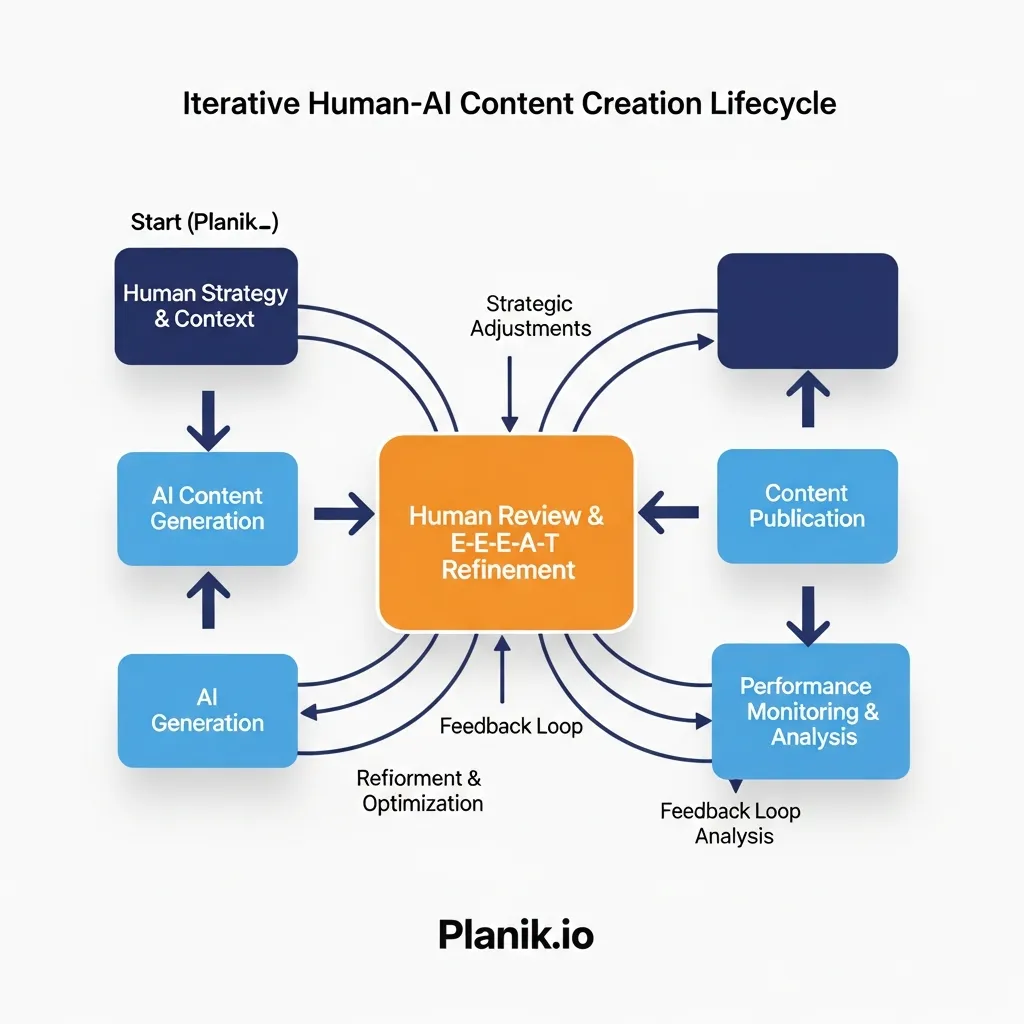
Pro Tip: When editing AI content, actively look for opportunities to add “I-statements” or “we-statements” that reflect genuine experience. Ask: “What would I tell a client about this face-to-face?”
Phase 3: Fact-Checking Protocols and Citation Management
Even with meticulous prompting, AI models can “hallucinate.” This phase is non-negotiable for establishing Trust.
- Multi-Source Verification: Every factual claim must be cross-referenced against multiple independent, authoritative sources. A minimum of two or three reputable sources should confirm the information.
- Data Validation and Recency Checks: For statistics and regulatory information, verify both accuracy and recency. Outdated data can severely undermine Trust.
- Transparent Citation Management: Proper attribution is a cornerstone of Authoritativeness. Ensure all external information is correctly cited with in-text links to primary research or official government sites.
- Regular Content Audits: E-E-A-T is an ongoing commitment. Establish a schedule for reviewing and updating existing AI-generated content to ensure continued relevance.
To maintain high standards over time, it is essential to understand the process of performing AI content audits on a regular basis.
Phase 4: Enhancing Author Entities and Transparency Disclosures
The final phase focuses on attributing content to credible human entities and being transparent about AI’s role.
- Robust Author Bios: Attribute content to a specific human author with a detailed bio highlighting relevant education, years of industry experience (e.g., “Nguyen Dinh, a Google SEO Professional with over 7 years of experience”), and specific accomplishments.
- E-E-A-T Signals on Author Pages: Link to professional social media profiles, other authoritative publications, and industry awards. This helps search engines connect the content to a verifiable expert.
- Transparency Statements for AI Use: Clearly disclose the use of AI. For example: “This article was developed with the assistance of AI technology and thoroughly reviewed and enhanced by a human expert.”
- Brand-Level Trust Signals: Ensure the overall website exudes trust through a comprehensive “About Us” page, clear contact information, and visible privacy policies.

Real-World Examples of AI Content with High E-E-A-T
- Planik.io’s “Advanced Technical SEO Audit Guide”: AI outlined common audit steps, but Nguyen Dinh infused the guide with proprietary checklists and specific anecdotes about render-blocking resources. A disclosure noted the AI-assisted research was refined by his 7 years of expertise.
- A Financial Advisory Blog: AI compiled factual data on retirement accounts from the IRS. A certified financial planner then added nuanced advice on the psychological barriers to saving, cross-referencing all claims with SEC publications.
- A Health & Wellness Site: AI generated an overview of intermittent fasting. A registered dietitian then added specific dietary recommendations for different body types and emphasized the importance of consulting healthcare professionals, linking to peer-reviewed studies.
For further inspiration on how to apply these frameworks, you can examine several high-quality AI content examples that successfully demonstrate authority.
The E-E-A-T Content Validation Loop: Action Checklist
- Phase 1: Research-Driven Prompting
- Gather authoritative sources.
- Craft specific, data-backed prompts.
- Define scope and constraints.
- Integrate proprietary data.
- Phase 2: Human-in-the-Loop Editing
- Inject personal anecdotes and observations.
- Adjust output to match brand voice.
- Provide deeper context and critical analysis.
- Strategize content flow and density.
- Phase 3: Fact-Checking & Citation Management
- Cross-reference claims with 2+ sources.
- Check statistics for timeliness.
- Ensure transparent attribution with links.
- Schedule regular content audits.
- Phase 4: Enhancing Author Entities & Transparency
- Develop detailed author bios.
- Link to professional profiles and awards.
- Include a clear AI disclosure statement.
- Reinforce brand-wide trust signals.
Leveraging Technology to Validate and Enhance Content Integrity
As AI becomes an indispensable partner, integrating advanced technological solutions is crucial for validating integrity. This involves a sophisticated layering of tools designed to fortify E-E-A-T signals.
For fact-checking, a multi-pronged approach is essential. Tools like Google Fact Check Explorer can help verify specific claims. Advanced platforms offer AI-powered semantic analysis to cross-reference statements with authoritative sources. Implementing a two-tier process—an initial AI scan followed by human expert review—can reduce factual errors by up to 40%, directly impacting publication speed and integrity.
Maintaining high standards requires a dedicated strategy for ensuring accuracy in AI-generated content
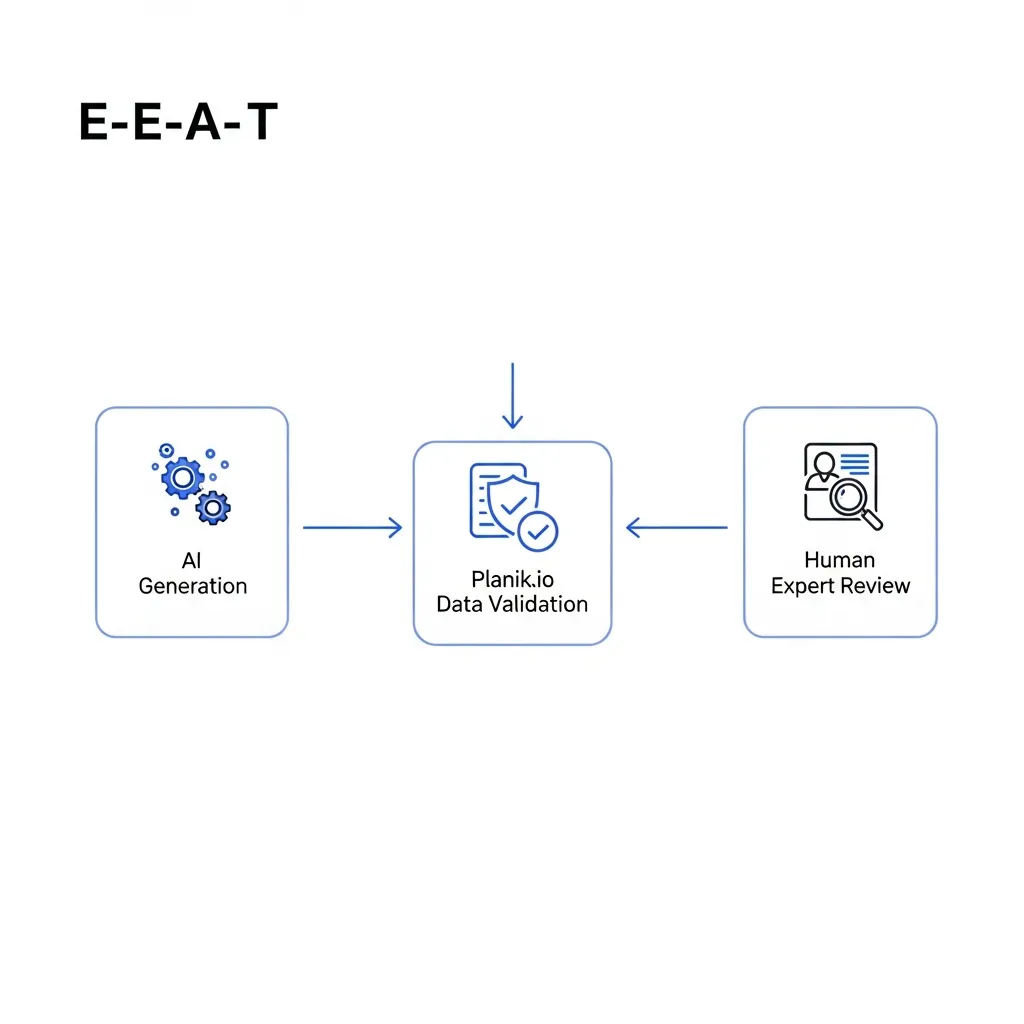
Leveraging AI to identify gaps in topical authority is another powerful application. Tools such as Surfer SEO, Clearscope, or SEMrush utilize natural language processing (NLP) to analyze top-ranking content. They compare your AI-generated draft against these benchmarks, highlighting missing sub-topics. Platforms like Planik.io are evolving to integrate this analysis, pinpointing areas for improvement in authority and clarity.
Selecting the right software is essential for building a robust digital presence using top platforms for E-E-A-T focused content creation
Finally, NLP tools are invaluable for improving readability. AI-powered editors like Grammarly Business or Hemingway Editor can assess readability scores and suggest simpler phrasing. Beyond grammar, NLP can analyze sentiment, helping you maintain a consistent tone. However, the nuanced adjustment of sentiment for E-E-A-T-critical topics still benefits immensely from human editorial judgment.
Critical Mistakes That Undermine Trust in Automated Content
Even with robust frameworks, critical missteps can derail your efforts. Ignoring these pitfalls can severely undermine your E-E-A-T standing.
The Peril of AI Hallucinations in YMYL Content
One of the most dangerous mistakes is failing to fact-check AI outputs for YMYL topics. AI models can “hallucinate”—generating confident, yet false information. I once reviewed a financial draft where the AI recommended an outdated tax loophole that could have led to legal repercussions. Such errors erode trust and can have severe consequences for your brand’s reputation.

Over-reliance on Generic AI Outputs Without Brand Voice
AI excels at synthesis, but without human curation, its output often lacks a distinct brand voice. Relying solely on unedited AI content results in bland articles that fail to convey experience. Over-reliance on generic outputs is a direct path to content anonymity. Brands must infuse unique insights to transform generic drafts into compelling narratives.
Establishing a unique brand voice is a key part of avoiding AI content risks
Ignoring the Need for Regular Content Audits and Updates
Content is not static. A critical error is treating AI-generated content as “set it and forget it.” Ignoring regular content audits can render your information outdated. Practical experience shows that websites failing to conduct audits often see a gradual decay in search visibility, sometimes losing 20-30% of organic traffic within a year. Establishing a quarterly review process is essential to maintain expertise.
Pro-Level Tactics for Sustainable Search Visibility
To elevate AI-generated content, focus on foundational credibility. A robust About Us page and a transparent Editorial Policy are non-negotiable for demonstrating Trust. In my experience, a well-documented policy not only guides creators but also signals reliability to search engines.
Furthermore, prioritize original data and primary research. While AI synthesizes existing info, true Expertise comes from unique insights. The true power of AI lies in amplifying human expertise, freeing specialists to conduct novel studies.
This synergy between technology and human insight is a cornerstone of any effective AI content strategy
A common mistake is underestimating transparent ‘About Us’ pages; sites clearly articulating credentials often see a measurable increase in engagement. For long-term visibility, deploy AI for efficiency but ensure a strong human editorial layer infuses unique perspectives and guarantees factual accuracy.
Future-Proofing Your Content Strategy with E-E-A-T
Future-proofing hinges on a symbiotic relationship where AI provides efficiency and human expertise infuses genuine E-E-A-T. AI streamlines production, yet human judgment transforms raw output into authoritative content.
To stay ahead of industry shifts, you should examine the future of AI content.
E-E-A-T is not a static checklist; it demands an ongoing commitment to a trust-first approach. Teams consistently integrating expert review into their AI workflows at Planik.io often see a sustained 20% improvement in content authority metrics. This continuous refinement ensures your content remains resilient.
Strategic CTA: Begin by auditing your current content for human oversight gaps and promptly implement a weekly E-E-A-T review process.
Conclusion
In the AI-powered content era, achieving and sustaining search authority is no longer about production speed, but about the ability to deliver genuine value and unwavering credibility. As discussed, Google’s E-E-A-T framework—Experience, Expertise, Authoritativeness, and Trustworthiness—is the cornerstone for ensuring that AI-generated content not only ranks well but also builds long-term trust with users.
In practice, the optimal strategy for mastering E-E-A-T in AI-generated content lies in combining AI’s efficiency with rigorous human oversight. Integrating a human-led E-E-A-T validation loop—from primary research to strict fact-checking—transforms AI’s generic outputs into in-depth, accurate content. Tactics such as transparent editorial policies, detailed “About Us” pages, and regular content audits are indispensable for maintaining trustworthiness.
To truly master E-E-A-T in AI-generated content, SEO professionals and content marketers must treat it as an ongoing commitment rather than a one-time checklist. Start by assessing gaps in your current oversight and implementing regular review processes. Leverage AI as a tool to enhance human expertise, not replace it. To build a resilient content strategy, explore solutions that support the seamless integration of AI and E-E-A-T—such as those offered by Planik.io—to ensure your content remains authoritative and trustworthy.
Frequently Asked Questions
Does Google penalize AI-generated content?
No, Google does not penalize content simply because it was created by AI. Google’s ranking systems reward high-quality, helpful content that demonstrates E-E-A-T (Experience, Expertise, Authoritativeness, and Trustworthiness), regardless of how the content is produced.
How can I demonstrate “Experience” in AI-generated content?
Since AI cannot have real-world experiences, you must inject human-led elements such as personal anecdotes, case studies, original photos, and first-hand accounts into the AI drafts. This “human-in-the-loop” approach is essential for satisfying the Experience pillar.
What are the risks of using AI for YMYL topics?
The primary risk is “hallucination,” where AI generates factually incorrect but confident-sounding information. For Your Money or Your Life (YMYL) topics like health or finance, these inaccuracies can harm users and severely damage your site’s search authority and trustworthiness.
How often should I audit AI-generated content for E-E-A-T?
Content should be audited regularly, ideally on a quarterly basis. This ensures that the information remains accurate, links are still valid, and the content continues to meet the evolving standards of search engine quality guidelines.
To track the effectiveness of your strategy, you should focus on measuring AI content success