Defining Article Schema and Its Role in Modern SEO
To truly master search visibility, understanding article schema markup is fundamental. Structured data, leveraging the collaborative Schema.org vocabulary, provides search engines with explicit, machine-readable information about your content. This clarity is paramount; without it, search engines must infer meaning, often missing crucial context.
Article schema specifically communicates details like headlines, authors, and publication dates, directly enhancing content understanding and increasing eligibility for rich results like enhanced snippets. Industry observations indicate that proper implementation significantly improves visibility and click-through rates. For a comprehensive overview, see enhancing AI visibility. This explicit communication ensures your valuable content is understood and presented optimally.
Choosing Between Article, BlogPosting, and NewsArticle Types
Choosing the correct article schema type is fundamental for accurate search engine representation. The NewsArticle type is specifically designed for time-sensitive, journalistic content like breaking news or event reports. Its nuances signal immediate relevance, often including properties vital for news publishers, making it unsuitable for static, evergreen pieces.
For personal or corporate blogs, BlogPosting is the appropriate and most common choice. This type clearly identifies content typical of a blog format, often featuring author insights and regular updates. The general Article type serves as a versatile default for evergreen content, detailed guides, or any publication not strictly news or blog-specific.
In my experience, a common mistake is indiscriminately using Article for everything or applying NewsArticle to outdated content. From an expert perspective, selecting the precise schema type is not merely semantic; it directly informs search engines about your content's nature and intent. This ensures proper categorization, preventing a detailed guide from being misinterpreted as breaking news and helping achieve relevant rich results.
Required and Recommended Properties for Rich Snippets
To unlock the potential for rich snippets, articles must include several required properties. These foundational elements are the article's headline, a representative image (meeting Google's size requirements), and the datePublished. Practical experience shows that without these core identifiers, search engines lack the essential context to display visually enhanced results.
Additionally, several recommended properties significantly bolster an article's search presence and E-E-A-T signals. These include the author (detailing name and url), the publisher (with name and logo), and the dateModified, which is particularly vital for frequently updated content.
The mainEntityOfPage property is equally critical, serving to explicitly link the schema markup to the content's canonical URL, confirming its authoritative source. Observations consistently indicate that the absence of these mandatory or key recommended properties will prevent rich result display, directly impacting an article's visibility and click-through rates in search engine results.
Implementing Article Schema with JSON-LD: A Technical Deep Dive
Implementing article schema markup with JSON-LD (JavaScript Object Notation for Linked Data) is currently the most robust and recommended method for structured data implementation. Unlike microdata or RDFa, JSON-LD is injected directly into the HTML as a script, making it less intrusive to the visible content and often easier for developers to manage dynamically. Technical analysis indicates that proper JSON-LD implementation significantly correlates with higher eligibility for rich results.
The process involves constructing a JavaScript object that describes your article's properties, then embedding it within a <script type="application/ld+json"> tag. This approach provides a clear, machine-readable format for search engine crawlers.
Here are the critical steps to technically construct and optimize your Article schema using JSON-LD:
The Article Schema JSON-LD Blueprint
-
Initiate the JSON-LD Script Tag: The JSON-LD script should ideally be placed within the
<head>section of your HTML document. While placement in the<body>is also technically valid, putting it in the<head>ensures that search engine crawlers encounter the structured data early in the parsing process, potentially improving indexing efficiency.html
-
Define Core Article Properties: Begin by specifying the
@context(alwayshttps://schema.org) and@type(e.g.,Article,BlogPosting, orNewsArticleas determined in previous sections). Then, include essential properties likeheadline(your article's title),url(the canonical URL of the page), and a concisedescription(often matching your meta description). ThemainEntityOfPageproperty, referencing the article's URL, explicitly tells search engines that this schema describes the current page. -
Optimize the Image Object: The
imageproperty is crucial for rich results, especially for visual elements like carousels. It requires an array of image objects, each containing aurl,width, andheight. For optimal display across various rich result formats, provide images with specific aspect ratios:- 16:9: Ideal for horizontal displays, typically resolutions like 1920×1080.
- 4:3: A more traditional photographic ratio, e.g., 1200×900.
- 1:1: Square images, often used in mobile carousels, e.g., 1200×1200.
Ensure images are high resolution (at least 1200px wide for width-dependent ratios) and directly relevant to the article's content.
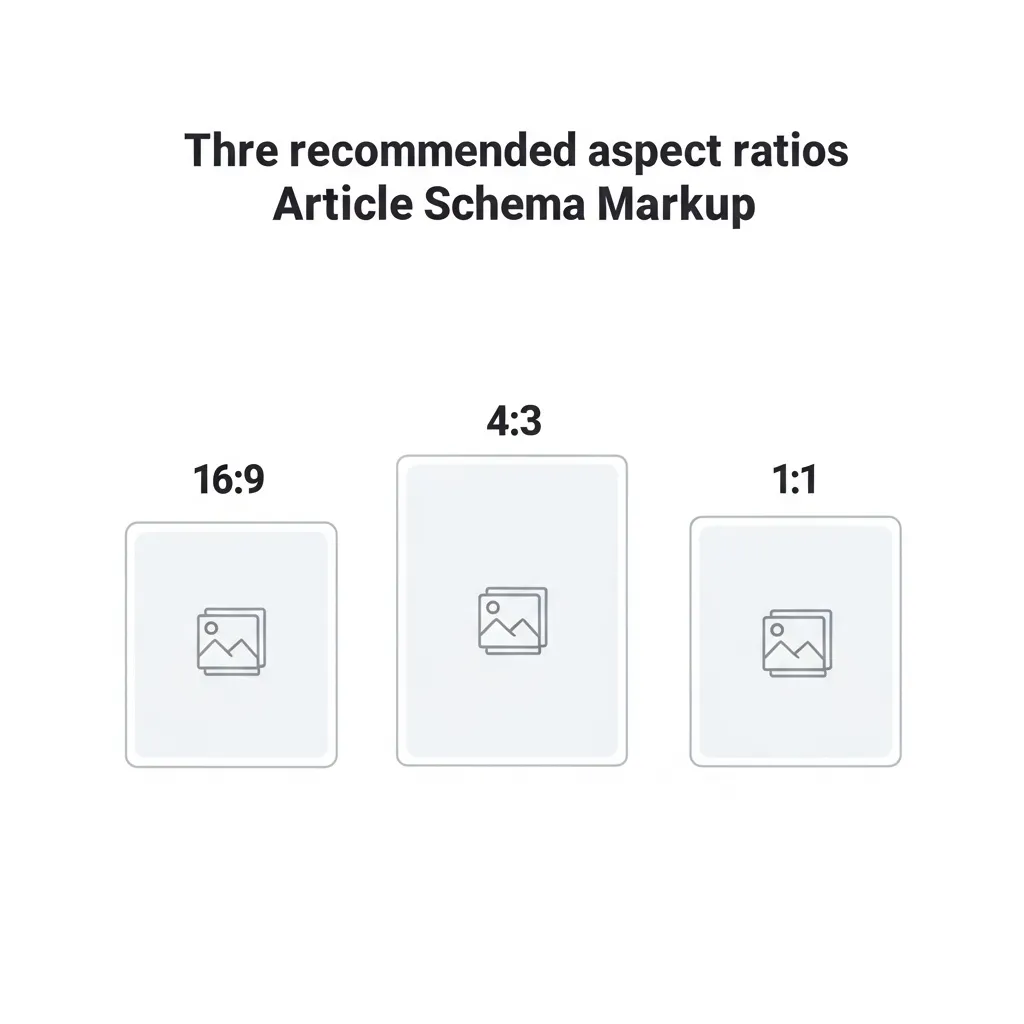
Diagram showing optimal 16:9, 4:3, and 1:1 aspect ratios for Article Schema markup image optimization.
-
Nest Author and Publisher Objects: Establishing E-E-A-T (Experience, Expertise, Authoritativeness, Trustworthiness) signals is paramount. The
authorproperty should be nested as aPersonorOrganizationobject, includingnameand potentiallyurl(e.g., a social media profile or author page). Similarly, thepublisherproperty should be anOrganizationobject, detailing itsname,url, and alogo(anotherImageObjectwithurl,width, andheight). This clear attribution strengthens credibility. -
Manage Timestamps: Accurate timestamps are vital for content freshness and relevance. Use
datePublishedfor the original publication date anddateModifiedfor the last significant update. Both should be in ISO 8601 format (e.g.,YYYY-MM-DDTHH:mm:ssZ). It's critical that these timestamps accurately reflect the actual publication and modification dates of the HTML document itself, preventing discrepancies that could confuse crawlers.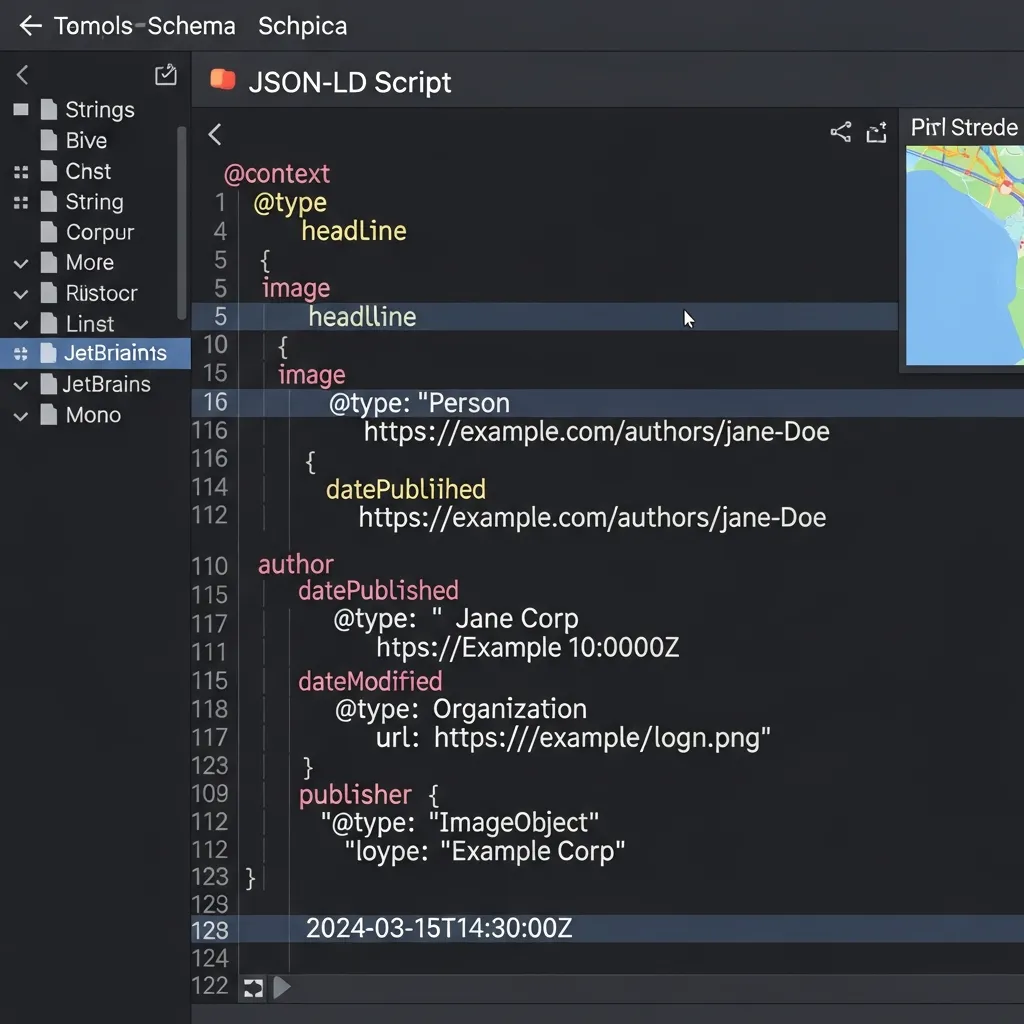
Screenshot of structured JSON-LD Article schema markup featuring nested author, publisher, and ISO 8601 timestamps.
Pro Tip: For dynamic content, leverage your CMS or server-side scripting to automatically generate and inject JSON-LD. This ensures consistency and reduces manual errors, especially for
dateModifiedwhich should update every time the article content changes.
By meticulously following this blueprint, you construct a robust JSON-LD script that accurately describes your article, enhancing its eligibility for rich results and providing search engines with comprehensive context. This technical precision is a cornerstone of advanced SEO.
How to Validate and Test Your Structured Data
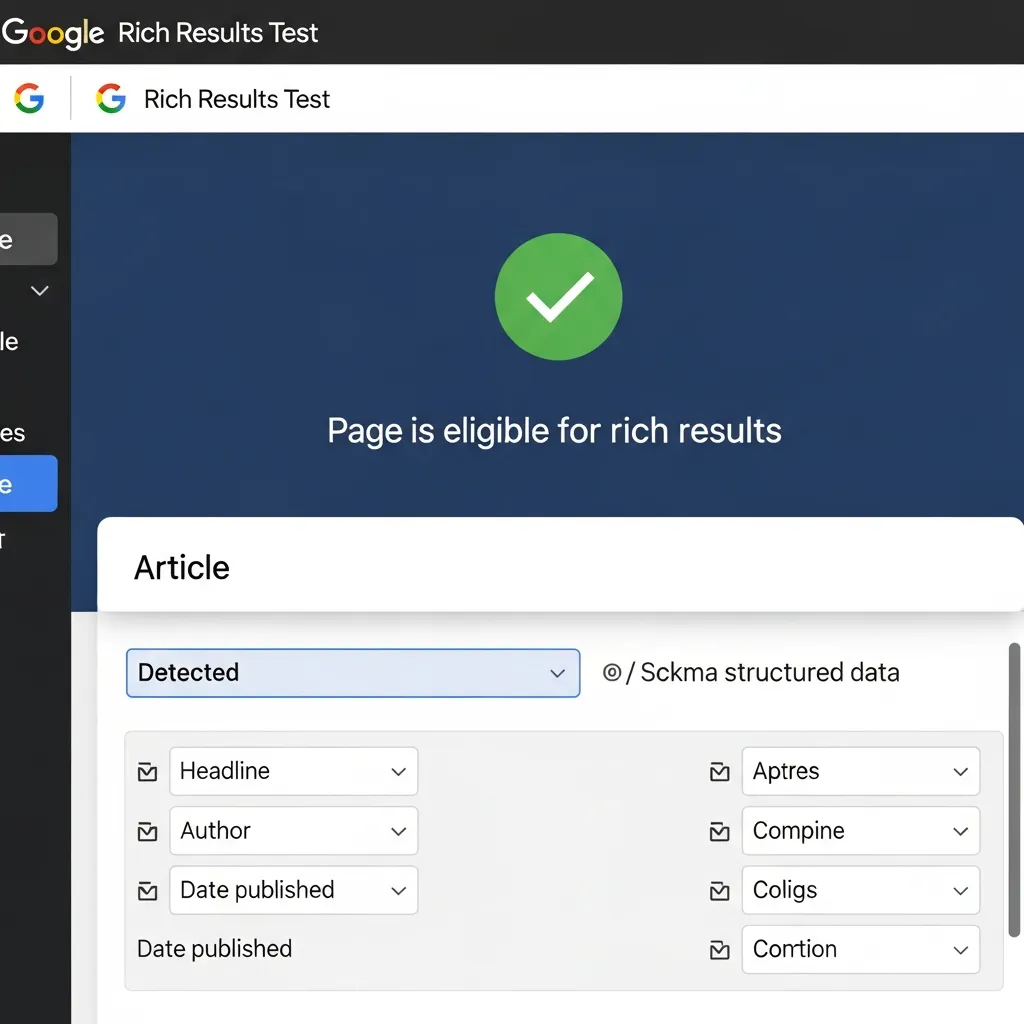
After implementing your Article schema, validation is paramount for search engine interpretation. The Google Rich Results Test is your primary tool, previewing how content might appear in search results and identifying eligibility for rich snippets. For deeper syntax accuracy, utilize the Schema Markup Validator (formerly Schema.org's official validator). This tool meticulously checks your JSON-LD's structural correctness.
It's crucial to distinguish between warnings and critical errors. Critical errors prevent schema processing, whereas warnings suggest optional improvements for enhanced visibility. Experience indicates that addressing errors is immediate, but resolving warnings contributes to long-term robustness. Finally, always verify live URL deployments. Testing the actual published page confirms schema is correctly rendered in the live HTML, ensuring full operational implementation.
Common Implementation Errors to Watch Out For
A prevalent error is marking up hidden or irrelevant content within Article schema. A common mistake I've encountered involves including elements like sidebar navigation or unrelated disclaimers in articleBody, which can confuse search engines and risk misleading practices.
Equally critical is the failure to update the dateModified property. When content receives significant updates, neglecting this timestamp diminishes its perceived freshness, impacting how search engines recrawl and re-evaluate the page.
Furthermore, implementing multiple conflicting schema types on a single page, such as both NewsArticle and Product for the same content, sends mixed signals to crawlers, often resulting in no rich snippet display.
In my view, the most effective approach is to treat implementation not as a one-time task but as an ongoing article schema markup maintenance process. The 'set and forget' mentality is detrimental; regular audits are essential for sustained benefit.
Leveraging Schema to Support E-E-A-T and Future Search Trends
Leveraging schema is increasingly vital for establishing Expertise, Experience, Authoritativeness, and Trustworthiness (E-E-A-T). By connecting author profiles to Person schema, you explicitly signal content creators' credentials. From my practical experience, consistently linking author profiles via schema significantly boosts the perceived Expertise of content in the eyes of search algorithms.
This structured data is also crucial for how AI systems and generative search features source information, providing clear, disambiguated facts that enhance data confidence. It empowers content for voice search optimization, enabling quick, direct answers from search results. In my view, this strategic approach to schema isn't just about rich snippets; it's foundational for future-proofing content in the evolving landscape of semantic search.
Final Thoughts on Maintaining Structured Data
Mastering article schema markup is a long-term investment that boosts visibility and E-E-A-T. My experience shows regular audits are vital; it's not a "set it and forget it" task. Consistent validation prevents critical errors and ensures sustained impact. Start now: review your existing schema implementations to ensure they are optimized for today's search environment.
Frequently Asked Questions About Article Schema Markup
What is article schema markup?
Article schema markup is a type of structured data that provides search engines with detailed information about a page's content, such as the headline, author, and date published.
Why is article schema important for SEO?
It helps search engines understand the context of your content, making it eligible for rich results like enhanced snippets and carousels, which can improve click-through rates.
What is the best format for implementing article schema?
JSON-LD is the recommended format by Google for implementing article schema because it is easy to maintain and doesn't interfere with the visible HTML content.
How do I validate my article schema?
You can use the Google Rich Results Test to check for eligibility and the Schema Markup Validator to ensure the technical syntax of your JSON-LD is correct.