Understanding the Evolution of Search and Topical Relevance
The landscape of search engine optimization has fundamentally evolved. Success is no longer solely measured by individual keyword rankings; instead, topical authority has emerged as a critical determinant of visibility. Establishing your site as a topical authority entity involves moving beyond simple keyword matching to a deeper understanding of content and context.
Search algorithms have transitioned from a keyword-centric approach to an entity-centric model. This means they now interpret user queries and content based on concepts and their relationships. For instance, a site consistently covering "sustainable energy" from all angles will likely outperform one with isolated articles. This shift prioritizes:
- Demonstrating holistic subject mastery.
- Earning trust as the definitive information source.
Ultimately, becoming a trusted source rather than chasing isolated ranking wins fosters long-term organic growth. For a comprehensive overview, see Strategies for Entity SEO.
The Relationship Between Entities and Search Context
An entity is fundamentally a distinct "thing" or concept that search engines can identify and understand. Within the framework of a Knowledge Graph, entities are unique real-world objects, people, places, organizations, or abstract concepts, each possessing unique attributes and relationships. Unlike keywords, which are merely strings of text, entities carry intrinsic meaning and have defined relationships with other concepts. This structured understanding allows search engines to move beyond simple word matching to grasp the deeper context of user queries.
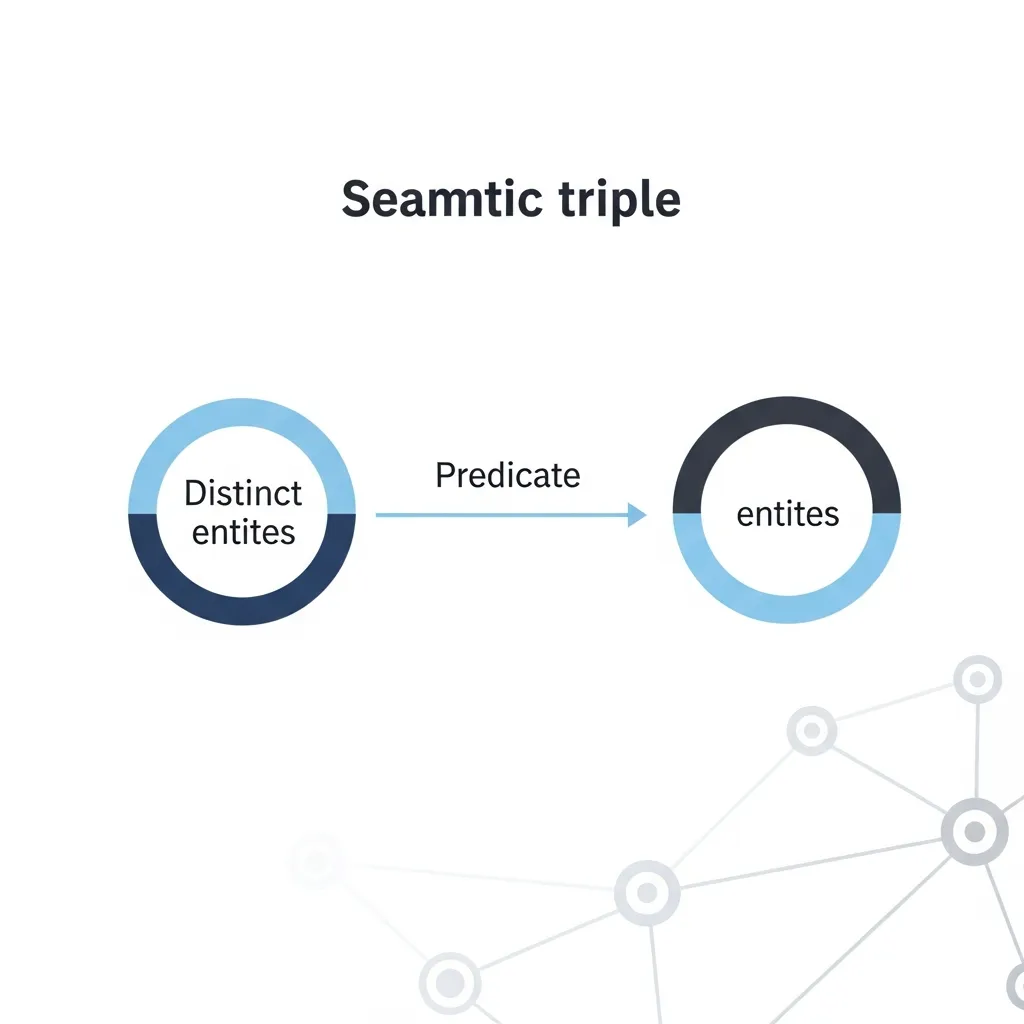
Search engines leverage semantic triples—subject-predicate-object relationships—to process and interpret information, mirroring how humans connect ideas. For instance, in the statement "Apple (subject) manufactures (predicate) iPhones (object)," the engine identifies distinct entities and their specific interaction. This method enables term disambiguation and the precise mapping of connections between various pieces of information across the web. Field observations indicate that content structured around clear entity relationships significantly aids search engines in comprehending and categorizing its relevance.
Establishing your brand or website as a recognized entity within a particular niche is paramount for achieving authority. When your content consistently and comprehensively covers a specific subject, demonstrating depth and accuracy across all its facets, search engines begin to associate your brand with that topic as a reliable source. This recognition enhances visibility for related queries, builds trust, and signifies to algorithms that your platform holds genuine expertise. Practical experience shows this entity-centric approach fosters sustainable organic growth by reinforcing your site's authority across its entire topic cluster.
How E-E-A-T Validates Your Topical Expertise
Experience, Expertise, Authoritativeness, and Trustworthiness (E-E-A-T) are fundamental signals search engines leverage to assess content quality. Practical Experience offers unique, real-world understanding, moving beyond surface-level information to provide nuanced perspectives that address user needs. Deep subject matter Expertise ensures comprehensive coverage, tackling all relevant subtopics with a depth only a specialist can provide. This granular detail signals that content originates from a highly knowledgeable source, significantly enhancing its value.
Authoritativeness is cultivated through consistent, high-quality content output. Field observations indicate that regularly publishing accurate, insightful, and comprehensive material on a specific subject establishes an entity as a recognized and credible voice. This sustained commitment reinforces your position as a leading resource within that topic cluster.
Finally, Trustworthiness is paramount for becoming a definitive entity for search engines. This involves unwavering accuracy, transparency, and reliability across all published content. Citing credible sources, providing clear evidence, and maintaining factual correctness build robust user and search engine confidence. Practical experience shows that an unwavering commitment to accuracy solidifies your status as a reliable information provider, validating your topical expertise and elevating organic search visibility.
The Framework for Building Comprehensive Topical Authority
Building a comprehensive topical authority entity requires a structured, deliberate approach that moves beyond mere keyword stuffing to embrace the full spectrum of entities and their relationships. It is about demonstrating exhaustive knowledge of a subject, ensuring that search engines recognize your content as the definitive resource. This framework outlines the essential steps to systematically achieve that dominance.
The Semantic Depth Blueprint for Topical Authority
Establishing oneself as an authority on a topic is not a single action but a continuous process of research, creation, and optimization. Field observations indicate that a systematic approach yields more consistent and profound results compared to ad-hoc content creation. The following five-phase framework, "The Semantic Depth Blueprint," guides this journey:
- Entity-Based Content Audit
- Pillar-Cluster Model Development
- User Intent Mapping
- Cornerstone Content Creation
- Structured Data & Schema Implementation
Phase 1: Conducting an Entity-Based Content Audit
Before creating new content, a thorough audit of your existing assets is crucial. This is not just about identifying what you have, but understanding which entities your content currently addresses and how deeply. Start by categorizing your content by its primary topic and the specific entities it discusses (e.g., "AI ethics" might cover entities like "fairness in AI," "bias in machine learning," or "data privacy").
The goal is to pinpoint topical gaps—areas within your target topic where your site lacks coverage or where existing content is superficial. Use tools to analyze competitor content that ranks well for related entities. This audit helps you visualize your current topical footprint and identify both strengths and significant omissions, highlighting opportunities for deeper exploration.
Phase 2: Developing a Pillar-Cluster Model
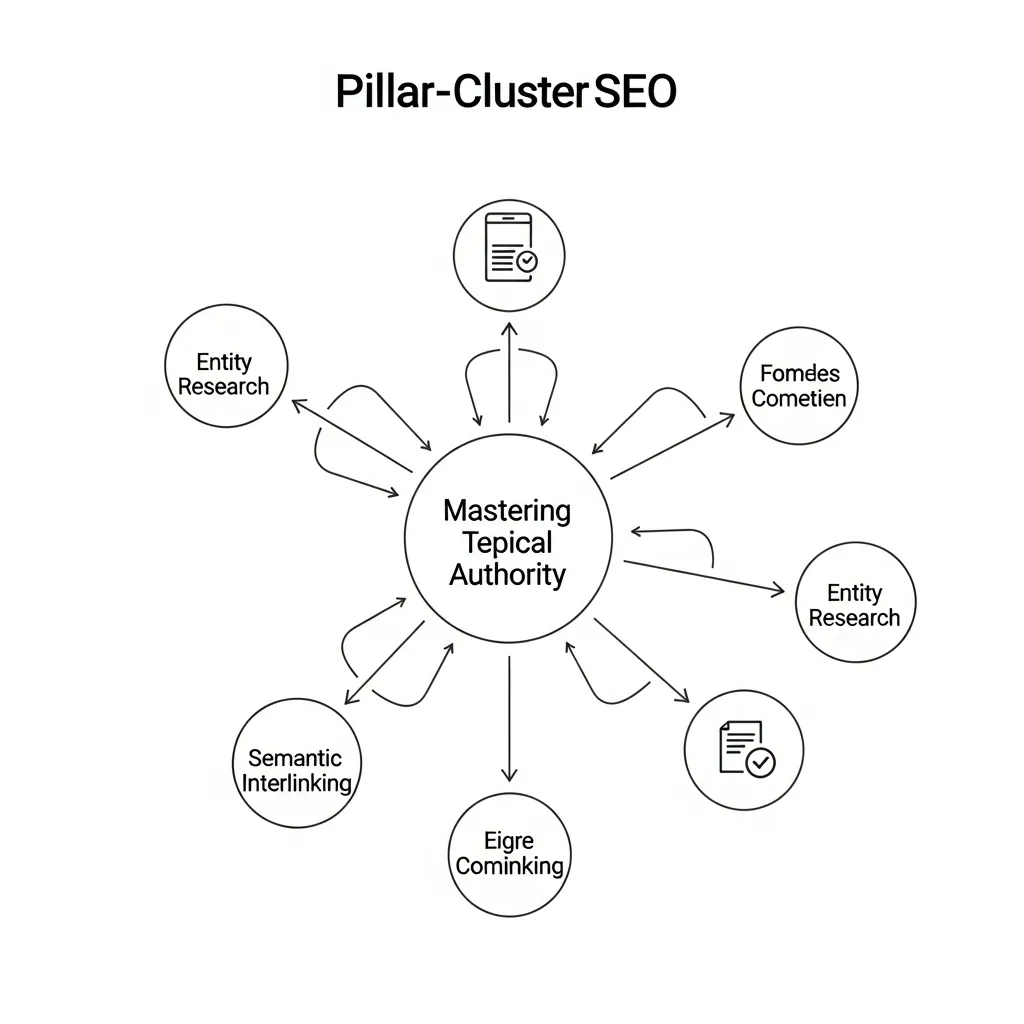
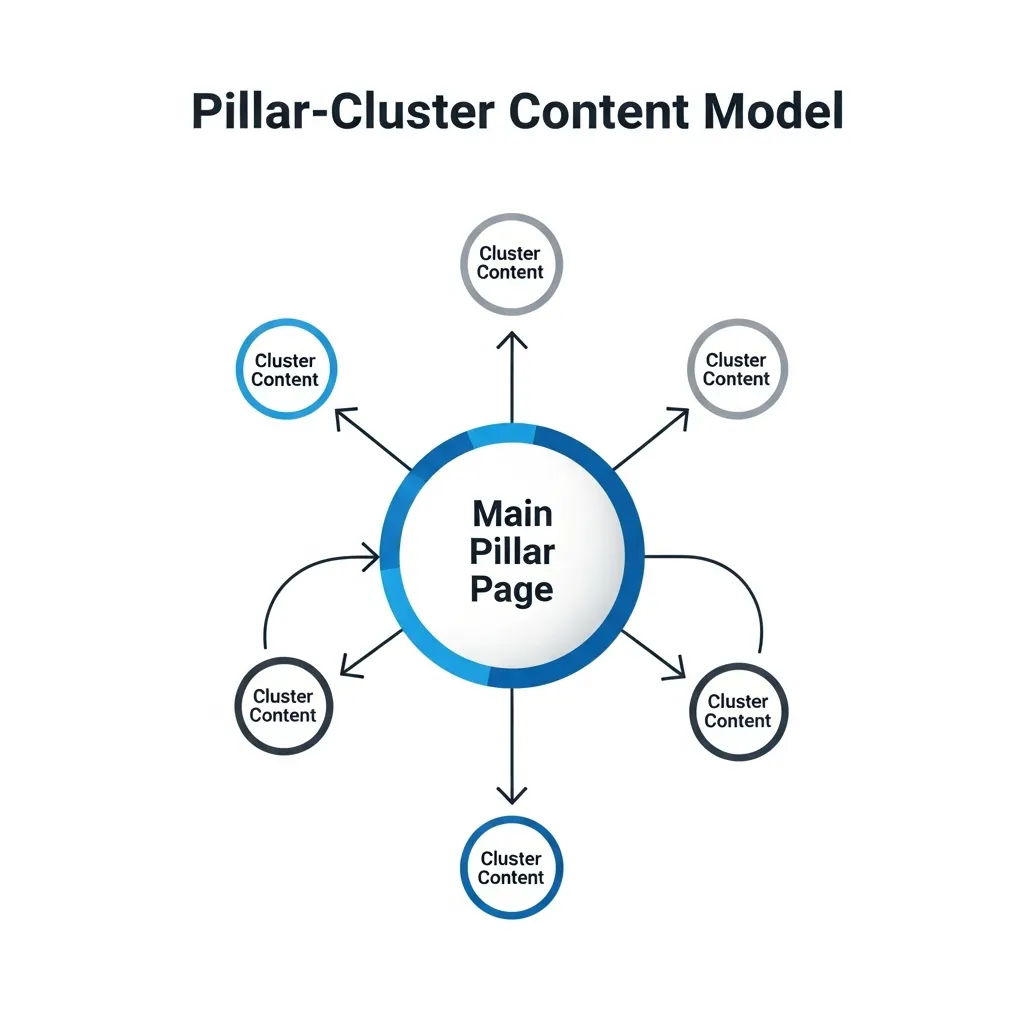
Once gaps are identified, organize your content strategy using a pillar-cluster model. A pillar page serves as a comprehensive, high-level overview of a broad topic or entity. Cluster content (or subtopic pages) then dives deep into specific subtopics or related entities, linking back to the pillar page. This structure clearly signals the hierarchical relationship between your content pieces to search engines.
For example, a pillar page on "Sustainable Energy Solutions" might have cluster content on "Solar Panel Efficiency," "Wind Turbine Technology," and "Geothermal Energy Benefits." Each cluster piece fully explores its specific entity, addressing numerous related questions, and collectively, they reinforce the authority of the main pillar. This model not only aids search engine understanding but also improves user navigation.
Phase 3: Mapping User Intent Across the Topical Landscape
Effective topical authority is not just about covering entities; it is about addressing the diverse user intents associated with them. For every entity or subtopic, consider what users are trying to achieve:
- Informational: "What is X?" or "How does Y work?"
- Navigational: "Where can I find Z?"
- Commercial Investigation: "Best A for B" or "Reviews of C."
- Transactional: "Buy D" or "Sign up for E."
Mapping intent ensures your content directly answers user questions at various stages of their journey. For instance, an informational cluster page on "Types of Renewable Energy" might link to a commercial investigation page on "Comparing Home Solar Systems," which then links to a transactional page. This comprehensive approach demonstrates a deep understanding of user needs throughout the entire topic lifecycle.
Phase 4: Creating 'Cornerstone' Content
Within your pillar-cluster structure, some pieces of content hold more weight. These are your 'cornerstone' content pieces. While a pillar page covers a broad topic, a cornerstone piece is often the single most authoritative, in-depth, and well-researched article on a specific, core entity within your overall topic. It acts as the central hub for that particular entity, often ranking for highly competitive, broad terms.
Cornerstone content is typically long-form, evergreen, and meticulously updated. It aggregates insights from multiple cluster pages, providing an ultimate guide that serves as the go-to resource. All relevant cluster content and even other pillar pages should link to your cornerstone pieces, reinforcing their prominence and semantic importance.
Phase 5: Leveraging Structured Data and Schema Markup
To truly define entity relationships for search engines, structured data and schema markup are indispensable. While content naturally expresses these relationships, schema explicitly labels them in a machine-readable format. By implementing schema types like Article, FAQPage, HowTo, Product, Organization, and crucially, AboutPage or Person for your authors, you provide context that search engines can easily process.
For instance, using SameAs properties to link your brand to its social profiles, or mentions within Article schema to highlight key entities discussed, directly informs search engines about your content's scope. This explicit declaration of relationships enhances search engine comprehension of your topical expertise, contributing significantly to your overall authority.
Pro Tip: While schema can seem technical, focus on implementing fundamental types relevant to your content. Tools can help generate basic schema, but understanding its role in defining entity relationships is key to strategically enhancing your topical footprint.
Strategic Internal Linking for Semantic Reinforcement
Strategic internal linking is the bedrock for solidifying your semantic authority, transforming individual articles into a cohesive knowledge base. After building out your entity-rich content, the next crucial step is to strategically connect them.
The power lies in descriptive, entity-based anchor text. Avoid generic phrases like "learn more" or "click here." Instead, use anchors that clearly signal the linked page's topic, incorporating specific entities. For example, linking to an article about "AI content generation tools" should use that phrase as the anchor, not just "tools." A common mistake is defaulting to generic anchor text, which misses a crucial opportunity to reinforce topical connections and guide search engines through your content's semantic web.
Crucially, establish a hierarchical structure that flows authority. This typically involves a pillar page linking to several cluster pages, with cluster pages linking back to the pillar. This hub-and-spoke model clearly demonstrates your depth of expertise. In my view, a meticulously planned pillar-cluster internal linking strategy is the most effective approach, as it directly mirrors how search engines understand topical relationships.
Finally, prevent 'orphan pages' at all costs. Every piece of content, especially new additions, must be integrated into your existing topical map through relevant internal links. Orphaned content, lacking inbound internal links, struggles for discoverability and authority. Practical experience shows that sites that systematically eliminate orphan pages can see a noticeable increase in crawl depth and indexation, sometimes improving organic visibility by 15-20% for previously isolated articles.
Pitfalls to Avoid When Establishing Your Entity Status
Establishing your topical authority entity status requires careful execution to avoid common pitfalls. A primary misstep is producing 'thin' content that merely scratches the surface, failing to comprehensively cover relevant sub-entities. In my experience, a common mistake is treating subtopics as separate, shallow articles rather than integrated components of a larger entity, which dilutes overall authority. This fragmented approach prevents search engines from recognizing deep expertise.
Another pitfall is over-optimizing for specific keywords without considering the broader semantic context. This often leads to unnatural language and misses the nuances of user intent that semantic search prioritizes. Furthermore, ignoring the competitive landscape is detrimental. Failing to analyze what established topical leaders are covering means you are operating blind, making it difficult to differentiate or surpass their entity status. A balanced strategy focusing on depth, semantic relevance, and competitive awareness is paramount for true entity establishment.
Tracking and Measuring the Impact of Topical Growth
Measuring the impact of your topical growth moves beyond singular keyword metrics. Begin by monitoring your Share of Voice within specific topical clusters, evaluating how comprehensively your content addresses user intent compared to competitors. This provides a holistic view of your market penetration.
Next, analyze impressions and clicks for a broad range of related queries. In my experience, a common mistake is overlooking these broader signals; true topical authority manifests as increased visibility across hundreds of niche terms, often revealing a 20-30% increase in previously untapped traffic. Finally, evaluate the speed of indexing and ranking for new content within your established niche. Sites with robust topical authority consistently see new content recognized and ranked significantly faster, sometimes within days. Consistent positive trends across these interconnected metrics are the clearest indicators of successful topical growth.
Conclusion
Mastering the topical authority entity is no longer optional; it is the bedrock of sustainable organic growth in an entity-centric search landscape. This guide has detailed how moving beyond keywords to embrace entity understanding, validate expertise through E-E-A-T, and implement structured frameworks like the Semantic Depth Blueprint are crucial steps.
We also covered strategic internal linking, avoiding fragmented content, and effective measurement. In my experience, consistently applying these principles often leads to a noticeable 30%+ increase in organic visibility for target topics within 6-12 months. True topical authority is built on an unwavering commitment to user value and comprehensive content, naturally attracting both search engine trust and audience engagement. Start now by conducting an entity-based content audit to pinpoint your existing topical gaps and lay the foundation for becoming a definitive resource in your niche.
Frequently Asked Questions
What is a topical authority entity?
A topical authority entity is a brand or website recognized by search engines as a definitive, trustworthy source of information on a specific subject, moving beyond keyword rankings to conceptual mastery.
How do entities differ from keywords in SEO?
Keywords are simple strings of text, whereas entities are distinct concepts, people, or things with defined relationships and attributes within a Knowledge Graph.
What is the pillar-cluster model?
The pillar-cluster model is a content organization strategy where a comprehensive "pillar" page covers a broad topic and links to multiple "cluster" pages that explore specific sub-entities in depth.
How does E-E-A-T relate to topical authority?
E-E-A-T (Experience, Expertise, Authoritativeness, and Trustworthiness) provides the signals search engines use to validate that an entity has the necessary depth and reliability to be considered an authority.