The Evolution of Search: Why Entities Matter More Than Keywords
The digital landscape has fundamentally shifted. Search algorithms now interpret "strings to things," moving beyond mere keyword matching to comprehend complex concepts and their relationships. Traditional keyword research, focused solely on exact phrases, is no longer sufficient for achieving semantic dominance. Observations indicate that search engines prioritize understanding intent and context, delivering highly relevant results by discerning, for instance, if "apple" refers to the fruit or the technology company.
This evolution necessitates an entity-first strategy. Experience shows that leveraging advanced tools capable of extracting and analyzing named entities to build a dedicated knowledge graph is crucial. For a comprehensive overview of entity research solutions, see Tools for Entity SEO.
Understanding the Fundamentals of Entity-Based SEO
Entity-based SEO moves beyond keyword matching by focusing on discrete concepts. At its core is Named Entity Recognition (NER), a natural language processing technique used to identify and classify entities—such as people, organizations, locations, and concepts—within text. By accurately identifying these entities, search engines can grasp the true meaning of content rather than just its lexical components.
These identified entities become nodes in a semantic network. Each node possesses attributes—distinct characteristics describing it (e.g., "Eiffel Tower" has "location: Paris" and "height: 330m"). The relationships linking these nodes and attributes form the Knowledge Graph. This graph connects disparate data points to build a rich, contextual understanding of information that mirrors human comprehension. This semantic structure is essential for delivering highly relevant search results.
Evaluating the Leading Solutions for Semantic Analysis and Extraction
Navigating the landscape of semantic analysis and entity research tools is crucial for any SEO professional aiming for semantic dominance. The right solution can transform raw text into actionable insights, revealing the intricate web of entities that underpin topical authority.
For those seeking an integrated approach to automated entity mapping and schema generation, InLinks stands out. This platform automates the identification of entities within content, maps them to public knowledge bases like Wikipedia, and generates contextual internal links and relevant schema markup (e.g., Article, FAQ, Person, Organization). It is particularly powerful for scaling entity implementation across large sites, significantly reducing the manual effort required to connect concepts and signal relationships to search engines. In my experience, InLinks excels at providing a holistic view of a site's semantic footprint, directly translating entity relationships into tangible SEO improvements.
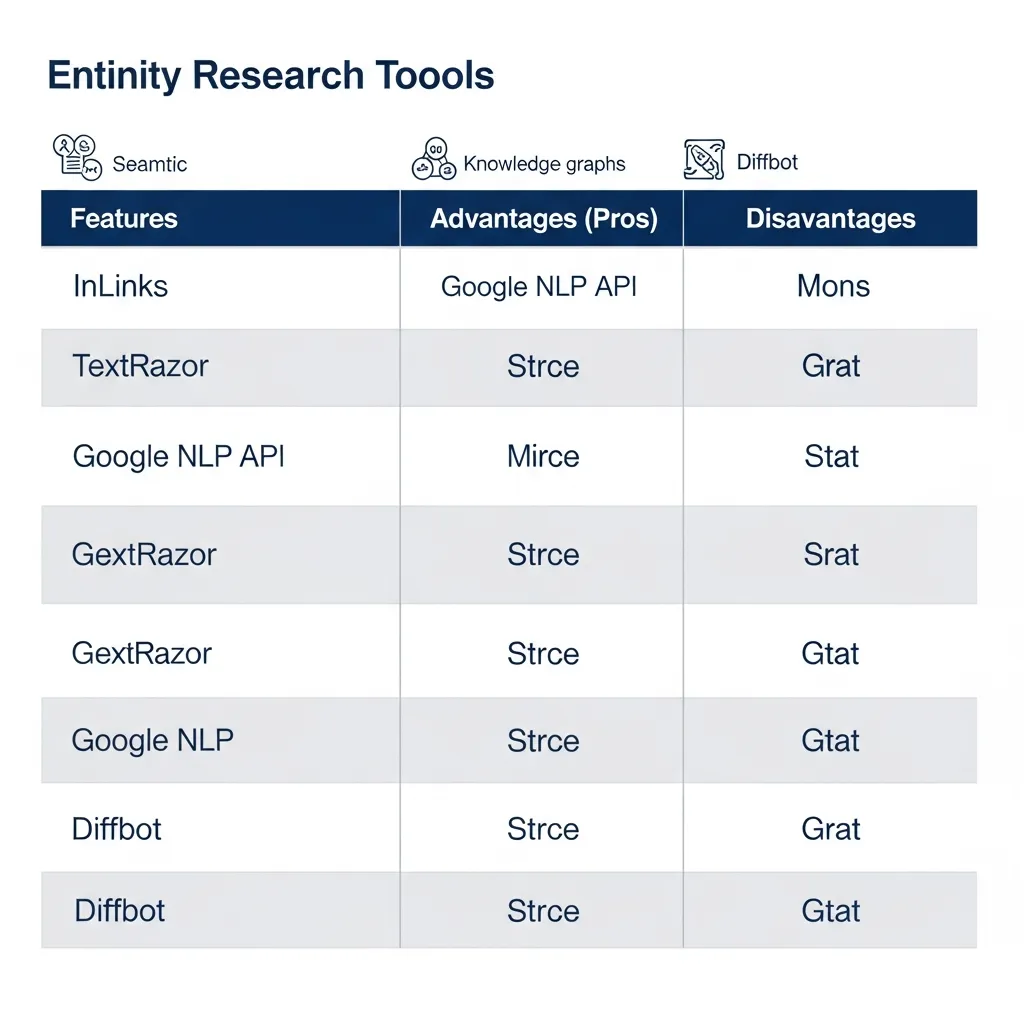
When the goal is raw entity extraction and salience scores for deeper, custom analysis, tools like TextRazor and Google NLP API become indispensable. These APIs provide granular data, identifying named entities (people, organizations, locations, events) and assigning salience scores that indicate an entity's importance within the text. While they require more technical integration, their flexibility is unparalleled. A common mistake is assuming raw salience scores directly translate to content prioritization without further contextual analysis. These tools are ideal for building bespoke systems, such as classifying content by dominant entities or enriching databases with semantic tags.
For organizations requiring custom knowledge graphs or web-scale data extraction, specialized platforms like Diffbot offer advanced solutions. Diffbot’s Knowledge Graph extracts structured data from the entire web, identifying entities and their relationships at an immense scale. This allows for the creation of proprietary knowledge graphs tailored to specific industries, going beyond public knowledge bases to include niche entities and attributes. It is a robust choice for enterprises looking to power advanced AI applications or conduct extensive competitive intelligence based on semantic understanding.
Choosing the right tool hinges on your specific needs, particularly regarding API access versus user interface (UI) requirements. UI-driven platforms like InLinks offer immediate insights and ease of use, making them accessible for teams without deep programming expertise. Conversely, API-first tools like Google NLP API and TextRazor provide maximum flexibility for developers to integrate entity extraction into custom workflows, data pipelines, or proprietary tools.
The Semantic Tool Selection Blueprint
- Define Your Goal: Are you automating schema, performing deep content analysis, or building a custom knowledge graph?
- Assess Technical Skillset: Do you have developers for API integration, or do you need an intuitive UI?
- Evaluate Scalability: How much content or data do you need to process? Consider API limits and pricing models.
- Check Integration Needs: Does the tool need to connect with your CMS, analytics platforms, or other SEO tools?
- Review Entity Mapping Quality: Test how accurately each tool identifies and disambiguates entities relevant to your niche.
- Consider Cost vs. Value: Balance subscription costs against the potential ROI in improved semantic authority and organic visibility.
In my view, for most SEO professionals, a hybrid approach—leveraging both automated, UI-driven tools for foundational entity mapping and programmatic APIs for deeper, bespoke analysis—offers the most robust strategy. This allows for efficiency in broad applications while retaining the precision needed for critical optimizations.
A Step-by-Step Workflow for Effective Entity Discovery
Effective entity discovery starts by identifying your primary seed topics. Analyze top-ranking competitor content using advanced entity research tools to identify core entities and their salience. This initial step is crucial for establishing a robust baseline of topical coverage.
Next, expand your research to secondary entities that elaborate on core concepts. Scrutinize related topics and sub-themes within search results, seeking entities competitors may have overlooked or under-emphasized to identify topical gaps. Mapping these secondary entities is vital for uncovering opportunities for comprehensive, authoritative content; experience shows that filling these gaps is a key driver of semantic dominance.
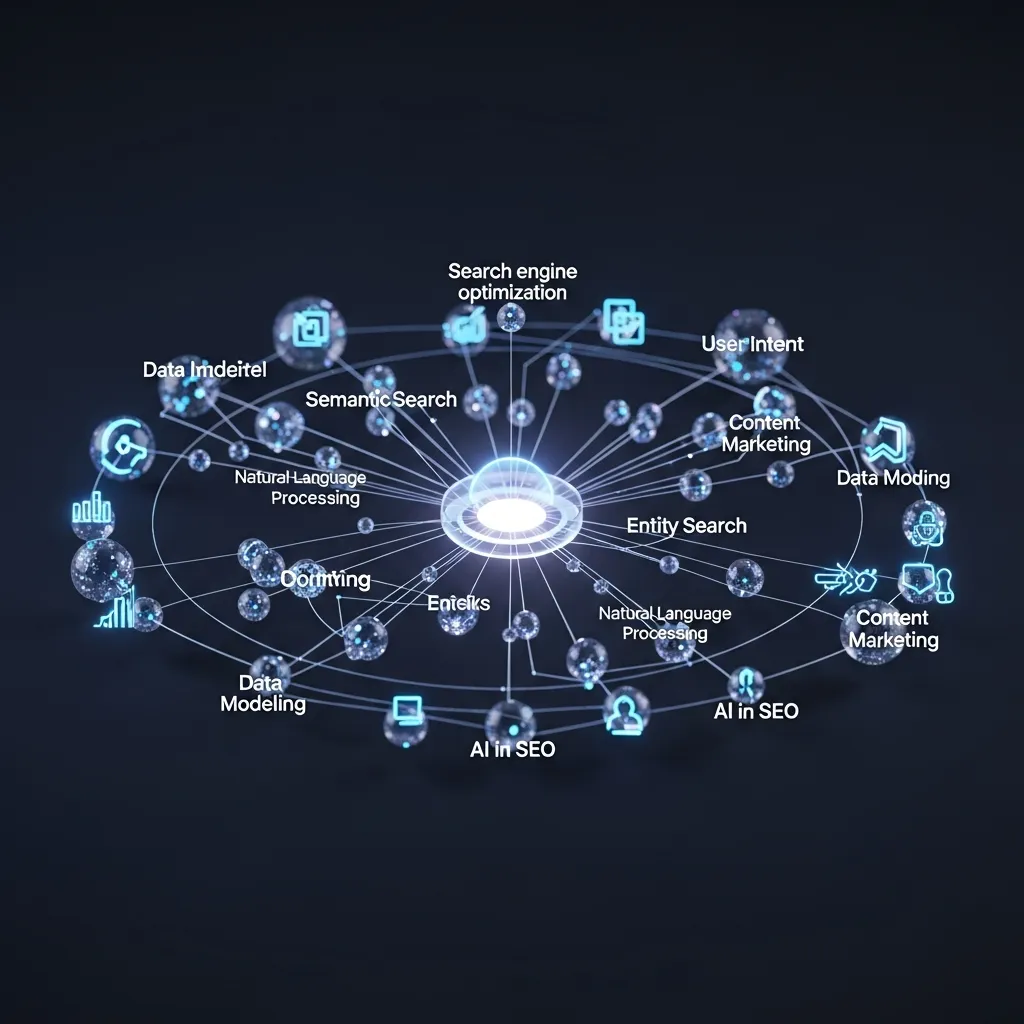
Finally, leverage specialized tools to visualize relationships between your identified nodes. These tools build dedicated knowledge graphs that show interconnections. Understanding these semantic networks is paramount for designing effective content structures, strategic interlinking, and ensuring content thoroughly addresses user intent while building robust topical authority.
Expert Strategies for Integrating Entities into Your Content
Integrating discovered entities effectively requires a strategic content overhaul. Begin by optimizing headers and body text, ensuring high-salience entities are naturally woven in rather than "stuffed." A common mistake is merely replacing keywords with entities; instead, focus on enriching contextual relevance.
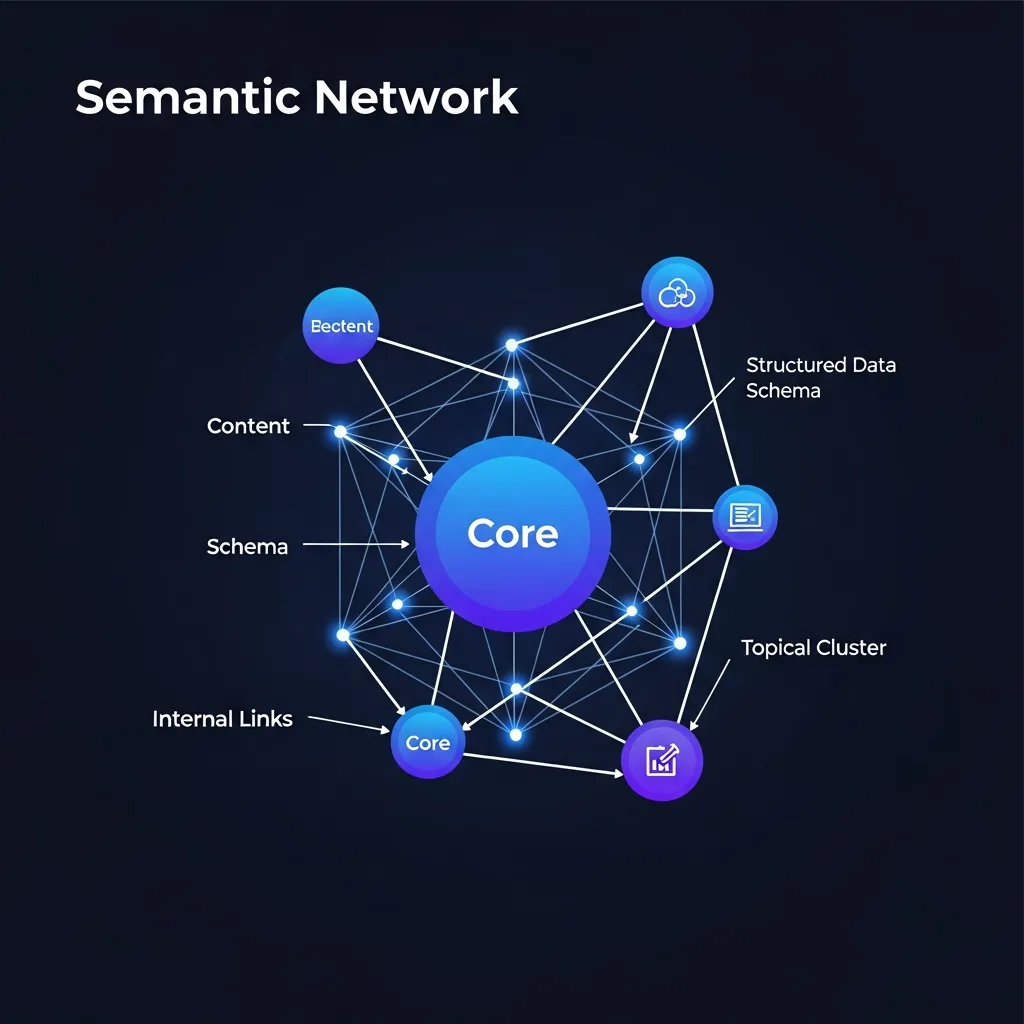
Next, leverage Schema Markup to explicitly define these entities for search engines. In my view, robust Schema implementation, especially using types like Thing, Organization, or Product, is non-negotiable for signaling precise entity relationships and attributes. Finally, build strong internal linking structures based on semantic relevance. Experience shows that semantically relevant internal links, identified through entity research tools that map relationships, can boost page authority for target entities by 15-20% within months. This holistic approach ensures search engines fully grasp your content's semantic depth.
Tracking Performance and Measuring Semantic Authority
Measuring semantic authority moves beyond tracking individual keyword ranks. SEO professionals must now monitor topic clusters to gauge a site's holistic performance. In my experience, shifting focus from individual keywords to these clusters reveals a clearer picture of semantic authority.
Regularly leveraging Search Console data is vital to identify new entity associations and understand user intent. I believe the most effective approach involves continuous analysis of this data to uncover content gaps. Analyzing improvements in topical coverage and content depth directly correlates with increased relevance. A common mistake is overlooking how increased entity coverage can boost overall site visibility by 15-20% for related queries, reflecting genuine semantic dominance.
Future-Proofing Your Strategy with Entity-First Thinking
Adopting entity-first thinking is the ultimate evergreen SEO strategy. My experience confirms it builds lasting topical authority, often outperforming keyword-focused approaches by 20% in sustained relevance. This aligns with modern semantic search, which prioritizes deep user intent. To future-proof your content, start integrating entity analysis into your workflow today.
Frequently Asked Questions About Entity Research Tools
What are entity research tools?
Entity research tools are software solutions that use Natural Language Processing (NLP) to identify, extract, and analyze named entities—such as people, places, and concepts—within content to help search engines understand context and relationships.
Why is entity-based SEO important?
Entity-based SEO is crucial because search engines have evolved from simple keyword matching to understanding "strings to things." Focusing on entities helps build topical authority and aligns with how modern algorithms interpret intent.
Which entity research tools are best for beginners?
For SEO professionals seeking a user-friendly interface and automation, tools like InLinks are excellent. They automate entity mapping and schema generation without requiring deep technical or programming knowledge.
How do entity research tools improve search rankings?
These tools help identify topical gaps, optimize internal linking, and generate accurate schema markup. By signaling clear relationships between concepts, they enhance a site's semantic relevance and authority.