The Evolution of Search: Defining Entities in a Semantic World
The landscape of online search has undergone a profound transformation. Gone are the days when simply stuffing content with exact-match keywords guaranteed visibility. Consider searching for "jaguar"—without context, are you seeking information about the luxury car, the majestic big cat, or a vintage guitar model? This ambiguity highlights the limitations of traditional keyword-centric approaches.
At its core, an entity is a unique, well-defined "thing" or concept that can be clearly identified and understood within a specific context. This includes people, places, organizations, events, and even abstract ideas. The fundamental shift in search has moved from merely matching literal strings of words (keywords) to comprehending the underlying entities (things) these strings represent.
Modern search engines prioritize deep contextual understanding over exact phrase matching. Field observations indicate that algorithms now interpret user intent by analyzing relationships between entities, synonyms, and the overall semantic meaning of a query, rather than just isolated terms. This ensures more relevant and accurate search results.
This evolution demands a strategic shift in how we approach content creation and SEO, requiring us to:
- Deconstruct complex topics into their foundational entities.
- Build comprehensive digital representations of our subject matter.
Keywords vs. Entities: Why Traditional SEO is No Longer Enough
Traditional keyword-based optimization focuses on matching specific search phrases to content, often driven by search volume metrics. The goal was to include target keywords strategically within page titles, headings, and body text. While this approach yielded results for many years, its limitations become clear when contrasted with entity-based optimization, which delves into the conceptual understanding of topics and their relationships.
To determine which approach aligns best with your specific marketing goals, you can explore the comparison of entity SEO vs keyword SEO.
Keywords are essentially strings of words; they lack inherent context or meaning beyond their literal interpretation. For instance, the keyword "jaguar" could refer to a car manufacturer, a big cat, or a specific sports team. Relying solely on the keyword itself makes it challenging for search engines to discern user intent accurately.
Entities, however, represent specific, unambiguous concepts, providing the necessary context. The entity "Jaguar Cars" is distinct from the entity "Jaguar (animal)," allowing for a much more precise understanding of a user's query.
Field observations indicate that relying solely on search volume as the primary indicator for content strategy is a declining approach. While search volume offers a quantitative measure of interest, it often fails to capture the intricate nuances of user intent. High-volume keywords can be highly ambiguous, leading to content that superficially addresses a broad topic but misses the specific needs of the searcher.
Our analysis at Planik.io suggests that a focus on building content around well-defined entities ensures deeper relevance, even for queries with lower individual search volumes, because it aligns with how modern search engines process information.
The critical role of intent bridges the gap between keywords and entities. Keywords are the initial expression of a user's need, but entities are the semantic units that search engines use to fulfill that intent. A user searching "best coffee maker reviews" is likely looking for the entity "drip coffee maker" or "espresso machine" and information related to "performance," "durability," and "value." By optimizing for entities, we move beyond surface-level matching to truly address the underlying informational need.
Key Insight: Shifting from a "what keywords are searched" mindset to a "what entities are users truly interested in" perspective is fundamental for future-proof SEO. This ensures your content answers the deeper questions, not just the surface queries.
How Search Engines Connect the Dots: The Knowledge Graph and NLP
Search engines don't just read words; they interpret meaning through a sophisticated understanding of how concepts interconnect. Central to this capability is the Knowledge Graph, a vast, semantic network that organizes real-world entities and their relationships. Think of it as a dynamic, digital brain, constantly learning and mapping the world's information. Each unique concept—be it a person, place, or abstract idea—is an entity represented as a distinct node.
The power to build and maintain this network comes from Natural Language Processing (NLP). NLP algorithms analyze text, images, and video to extract nuanced meaning. Field observations indicate that NLP identifies entities within your content, disambiguates them (e.g., distinguishing "Apple Inc." from "apple" the fruit), and determines the context in which they appear. This allows search engines to grasp the deeper intent behind a user's query.
Mastering these linguistic patterns is key to successful search visibility, especially regarding NLP and entity SEO.
Relationships between these entities are defined by edges. For instance, an "edge" might connect the "node" for "Planik.io" with the "node" for "SEO Software" via a relationship like "provides." Another edge could link "SEO Software" to "improved organic traffic" through a "leads to" relationship. This network of nodes and edges empowers search engines to understand complex interdependencies and answer multifaceted queries with precision.
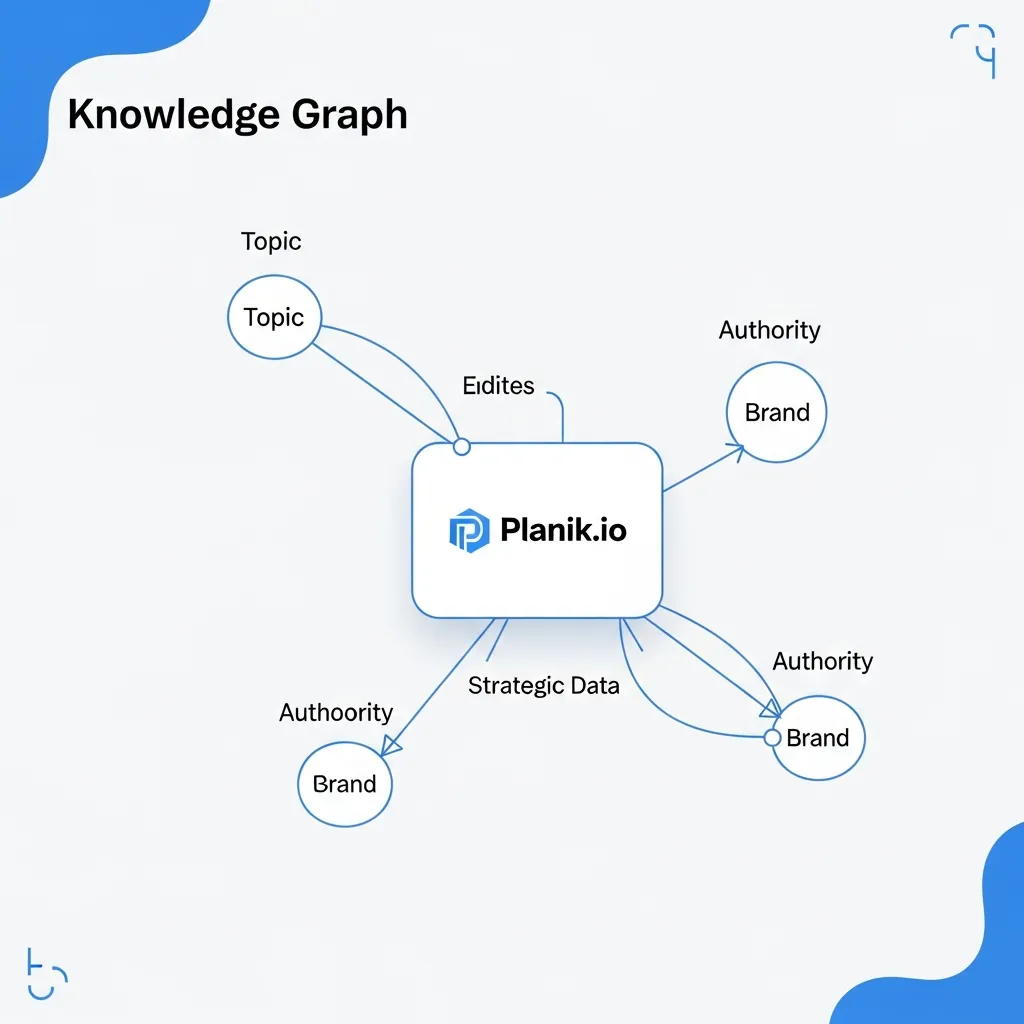
Technical data suggests that entity recognition isn't always absolute. Search engines assign confidence scores to each identified entity and its relationships. A high confidence score signifies that the engine is certain about the entity's identity and its role within the content. Conversely, a low score indicates uncertainty, which might lead to misinterpretation or reduced ranking signals. Clearly defining entities within your content aids search engines in achieving high confidence, ensuring your information is correctly interpreted.
The Core Framework: A Step-by-Step Guide to Building Your entity SEO strategy
Embarking on an entity SEO strategy requires a methodical approach that transcends traditional keyword-centric tactics. This framework provides a structured pathway, enabling SEO specialists and content marketers to build a robust semantic foundation for sustainable growth.
Field observations indicate that many organizations struggle with the initial shift from a keyword mindset to an entity-first perspective. Common challenges include:
- Identifying truly relevant entities beyond surface-level keywords.
- Structuring content and website architecture to reflect semantic relationships.
- Measuring the impact of entity-focused optimizations.
Consider a digital marketing agency aiming to rank for "local SEO services." Instead of merely optimizing for that phrase, an entity-first approach would involve identifying related entities like "Google Business Profile optimization," "geo-fencing marketing," "local citation building," and "online reputation management." The strategy then focuses on building authority around the broader "Local SEO" entity by comprehensively covering its constituent parts.
This section outlines The Semantic Growth Sprint: An Entity SEO Checklist, a five-phase framework designed to guide you through the process of developing and implementing a sophisticated entity SEO strategy.
Phase 1: Entity Research – Identifying Your Core Semantic Landscape
The foundational step in any entity SEO strategy is to meticulously identify the core entities relevant to your business, industry, and target audience. These are the "things" that your content discusses and that search engines recognize and categorize. Moving beyond simple keywords means understanding the semantic context in which those keywords exist.
To achieve this, advanced tools and methodologies are essential:
- Google's Natural Language Processing (NLP) API: This tool allows you to input text and receive an analysis of the entities identified within it, along with their salience (importance). By analyzing your existing high-performing content and competitor articles, you can uncover the entities Google's algorithms are already valuing. For instance, an article about "sustainable energy solutions" might highlight entities like "solar power," "wind turbines," and "carbon footprint" as key concepts.
- Wikidata: As a free, open knowledge base that feeds into Google's Knowledge Graph, Wikidata is an invaluable resource. By searching for your core business concepts, you can discover associated properties and relationships. For example, searching for "electric vehicle" reveals attributes like "manufacturer," "battery type," and "range," providing a structured view of the entity's identity.
Beyond these tools, manual analysis of search results for broad, informational queries can reveal entities that frequently appear in top-ranking content and "People Also Ask" sections. The goal is to build a comprehensive list of primary and secondary entities that define your topical authority.
To further refine your strategy, you can follow a detailed framework for building topical authority with entity SEO
Pro Tip: Don't limit entity research to just your immediate product. Explore tangential entities that address user pain points. For a financial planning service, this might include "retirement savings plans" or "tax efficiency."
Phase 2: Mapping Entity Relationships – Creating Your Semantic Blueprint
Once you've identified your entities, the next step is to understand how they interconnect. This phase involves creating a topical map that visually represents the relationships between your core entities, mirroring how semantic clusters are formed in search engines.
A topical map illustrates:
- Hierarchical Relationships: A broad entity like "Digital Marketing" might have sub-entities such as "SEO" and "PPC."
- Associative Relationships: "SEO" might be associated with "Keyword Research" and "Link Building."
- Attribute Relationships: An entity like "Planik.io" might have attributes such as "SaaS platform" and "semantic search analytics."
Building this map involves grouping related entities, defining primary and secondary concepts, and visualizing connections using mind-mapping software.
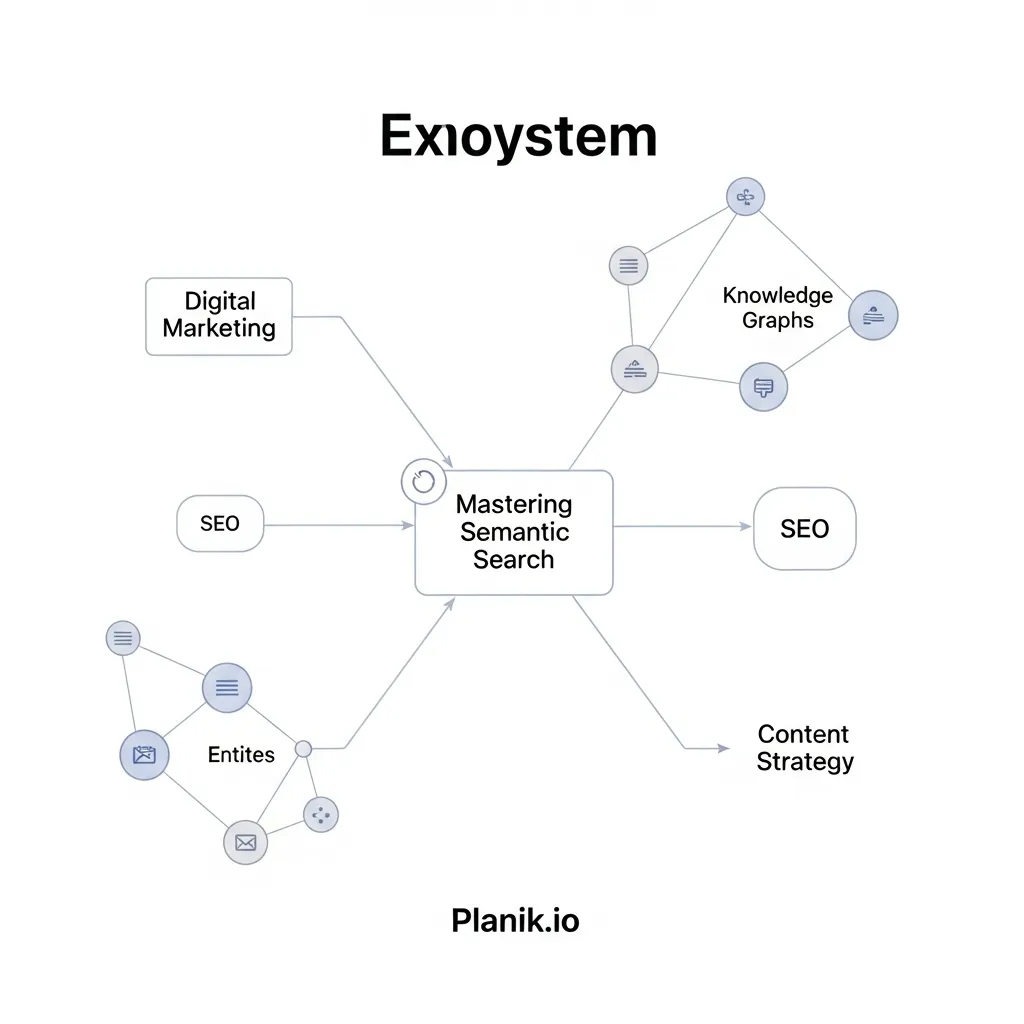
This semantic blueprint becomes your guiding document for content creation and website architecture. It ensures your content addresses topics comprehensively and that your site structure logically reflects the connections between information.
Phase 3: Content Optimization – Writing for Semantic Relevance
With your topical map in hand, the focus shifts to creating content that satisfies semantic relevance rather than keyword density. This means writing to fully cover an entity and its related attributes.
Key aspects of entity-based content optimization include:
- Comprehensive Coverage: Ensure main content pieces thoroughly explore a primary entity. For "Sustainable Architecture," cover materials, design principles, and energy efficiency.
- Integration of Related Entities: Naturally weave in secondary entities. If the primary entity is "Cloud Computing," include "SaaS," "PaaS," and "scalability."
- Anticipating User Intent: Address likely questions surrounding an entity. Use your research to identify common queries and provide authoritative answers.
- Clarity and Conciseness: While comprehensive, content should remain easy to understand. Use headings, subheadings, and lists to improve readability.
Technical data suggests that content which thoroughly covers an entity and its related concepts tends to rank better for a broader range of long-tail queries, as it signals deeper expertise.
Mastering these nuances is essential when learning how to create entity-based content that ranks
Phase 4: Entity-Based Internal Linking – Connecting Concepts, Not Just Keywords
Internal linking is no longer just about passing "link juice." In an entity-first strategy, internal links reinforce conceptual hierarchy and demonstrate relationships between entities.
- Linking by Conceptual Hierarchy: Link pages based on their semantic relationship. A top-level page on "Artificial Intelligence" should link down to "Machine Learning" and "Deep Learning."
- Demonstrating Associative Relationships: Link between pages that cover related, but not necessarily hierarchical, entities, such as "electric car batteries" linking to "charging infrastructure."
- Contextual Anchor Text: Prioritize descriptive, natural-language anchor text that reflects the relationship between entities. Use "learn more about our advanced entity SEO strategies" instead of "click here."
- Hub-and-Spoke Models: Implement a model where a central "pillar page" covers a broad entity and "spoke pages" delve into specific sub-entities.
Key Insight: Think of your internal links as the "edges" in your website's internal Knowledge Graph. Each link should strengthen the relationship between two nodes (entities), helping search engines understand your full scope of expertise.
Phase 5: External Validation – Aligning Your Brand Entity with Authority
The final phase extends your strategy beyond your website, focusing on how your brand is perceived across the wider web. This builds external trust and authority.
- Consistent Entity Representation: Ensure your brand name, personnel, and products are consistently represented across your Google Business Profile, social media, and industry directories.
- Authoritative Mentions and Digital PR: Seek mentions from topically relevant websites. When an industry publication mentions "Planik.io" regarding "entity SEO tools," it reinforces the association between your brand and those concepts.
- Wikipedia and Wikidata Presence: For established brands, a presence on these platforms is a powerful validator, as they are directly consumed by search engines to build the Knowledge Graph.
- Industry Consensus and Citations: Participate in industry discussions and research. When your insights are cited, it contributes to your entity's authority.
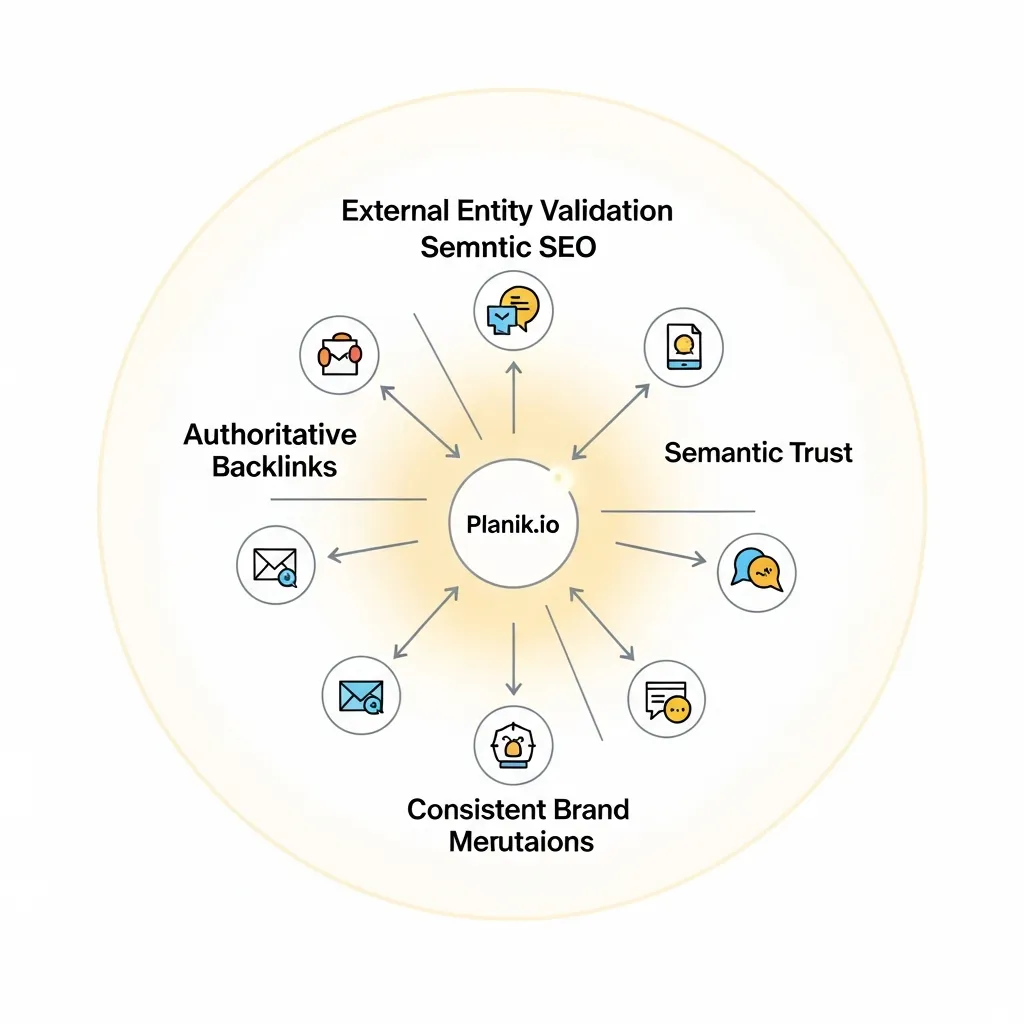
Industry consensus points to a strong correlation between consistent external entity validation and improved search visibility. It signals that your brand is a recognized and trustworthy source of information.
The Semantic Growth Sprint: An Entity SEO Checklist
This framework synthesizes the five crucial phases into an actionable checklist for building your entity SEO strategy:
-
Phase 1: Entity Research
- Identify core entities using Google's NLP API on top-performing content.
- Leverage Wikidata to explore entity properties and relationships.
- Analyze SERPs for broad queries to identify related entities.
- Compile a list of primary and secondary entities.
-
Phase 2: Mapping Entity Relationships
- Group entities into semantic clusters.
- Define hierarchical and associative relationships.
- Create a visual topical map as a semantic blueprint.
- Use the map to guide content and architecture.
-
Phase 3: Content Optimization
- Develop comprehensive coverage of primary entities.
- Integrate secondary entities and attributes naturally.
- Write with user intent in mind, answering related questions.
- Prioritize semantic relevance over keyword density.
-
Phase 4: Entity-Based Internal Linking
- Link based on conceptual hierarchy and associations.
- Utilize descriptive, natural-language anchor text.
- Develop hub-and-spoke models to reinforce clusters.
- Ensure links guide users and crawlers through the semantic network.
-
Phase 5: External Validation
- Maintain consistent brand representation across all properties.
- Pursue authoritative mentions and digital PR.
- Explore Wikipedia and Wikidata opportunities where applicable.
- Foster citations through industry participation.
Technical Foundations: Using Schema Markup to Define Entities
Following the strategic framework, the next critical phase involves equipping search engines with explicit data. This is achieved through Schema Markup, specifically JSON-LD (JavaScript Object Notation for Linked Data). JSON-LD is the preferred method for embedding structured data directly into HTML without altering visible content.
Field observations indicate that JSON-LD's ability to communicate entities and their attributes significantly enhances search engine comprehension. It acts as a bridge, translating human-readable content into machine-readable facts. This is vital for disambiguating entities—ensuring search engines correctly interpret the specific "things" you discuss.
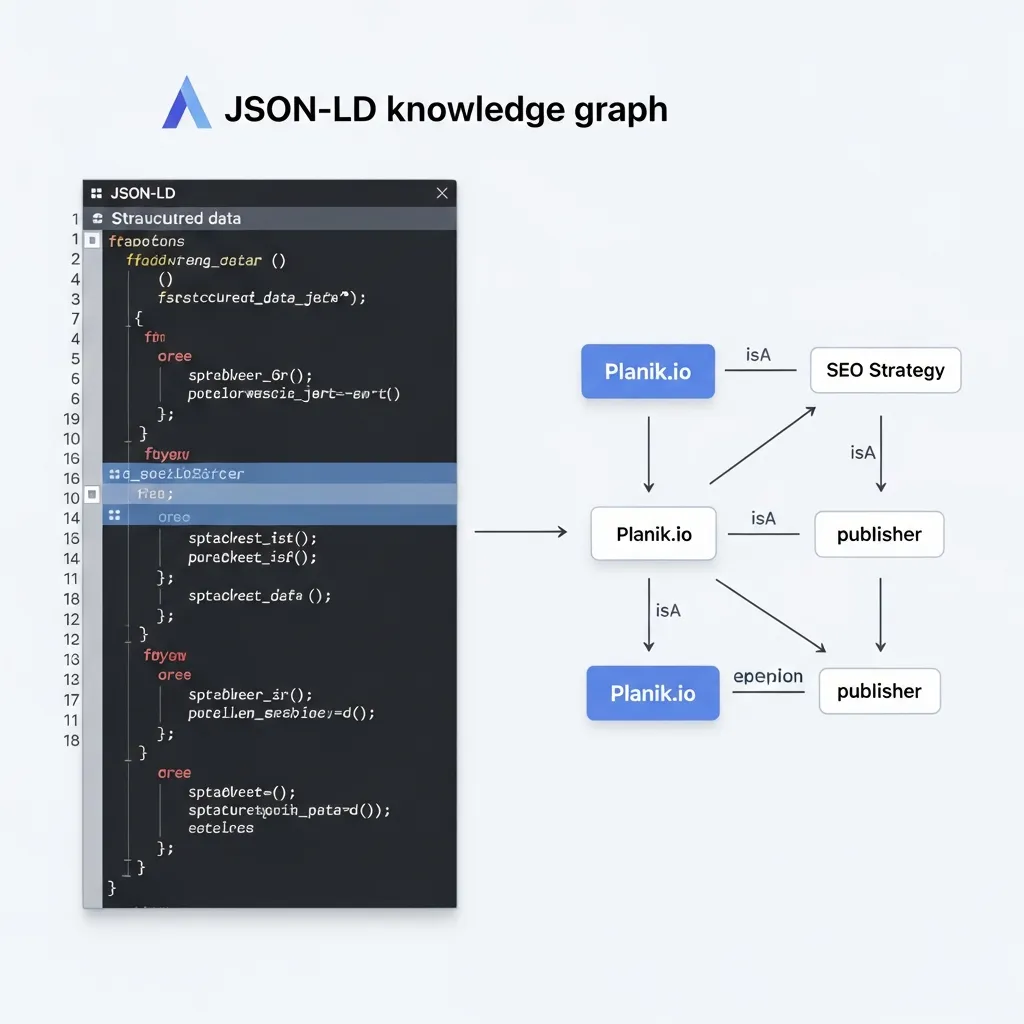
To effectively define entities, several schema types are indispensable. The **SameAs** property is crucial for disambiguation, allowing you to link your entity to authoritative databases like Wikipedia or Wikidata. For instance, declaring that "Planik.io" SameAs its official Wikipedia entry helps search engines confirm its identity. The **About** property states the primary subject of your page, while **Mentions** identifies other significant entities referenced.
Best practices extend to nested schema, which involves structuring schema types within each other to illustrate complex relationships. For example, a WebPage schema might contain an Article schema, which specifies its Author and what the article is about. Technical data suggests that well-structured nested schema provides a nuanced understanding of your content's ecosystem.
This ecosystem is further reinforced when you master internal linking for entity SEO to connect related concepts.
Entity-Based Competitor Analysis: Finding Gaps in the Knowledge Graph
Entity-Based Competitor Analysis marks a shift from identifying keywords to understanding the semantic landscape your rivals command. This phase is crucial for uncovering knowledge graph gaps that can enhance your topical authority.
Begin by analyzing competitors for entity density and variety. Meticulously scrutinize their content for the specific people, places, and abstract concepts they consistently mention. If a competitor ranks for "sustainable urban planning," investigate whether they reference specific urban theorists or policy frameworks like Agenda 2030.
Next, identify 'missing' entities in your own content. Technical data suggests top-ranking content typically covers a more complete set of related entities. You might discover competitors discussing "circular economy principles" while your content focuses only on infrastructure. This disparity reveals opportunities for expansion.
Specialized semantic analysis tools are effective for extracting and visualizing these relationships. Platforms like Planik.io can process competitor content at scale to highlight semantic relationships and entity clusters, streamlining the identification of overlooked areas.
Beyond these platforms, you can find a wider range of entity research tools
Measuring Success: How to Track Entity Visibility and Authority
Measuring an entity-first strategy requires moving beyond traditional keyword metrics. Field observations indicate that tracking Knowledge Panel appearances for your brand offers a direct signal of improved recognition. Monitoring these brand-entity associations through SERP analysis provides insight into how search engines categorize your business.
To track your progress effectively, it is essential to establish clear KPIs for measuring entity SEO success.
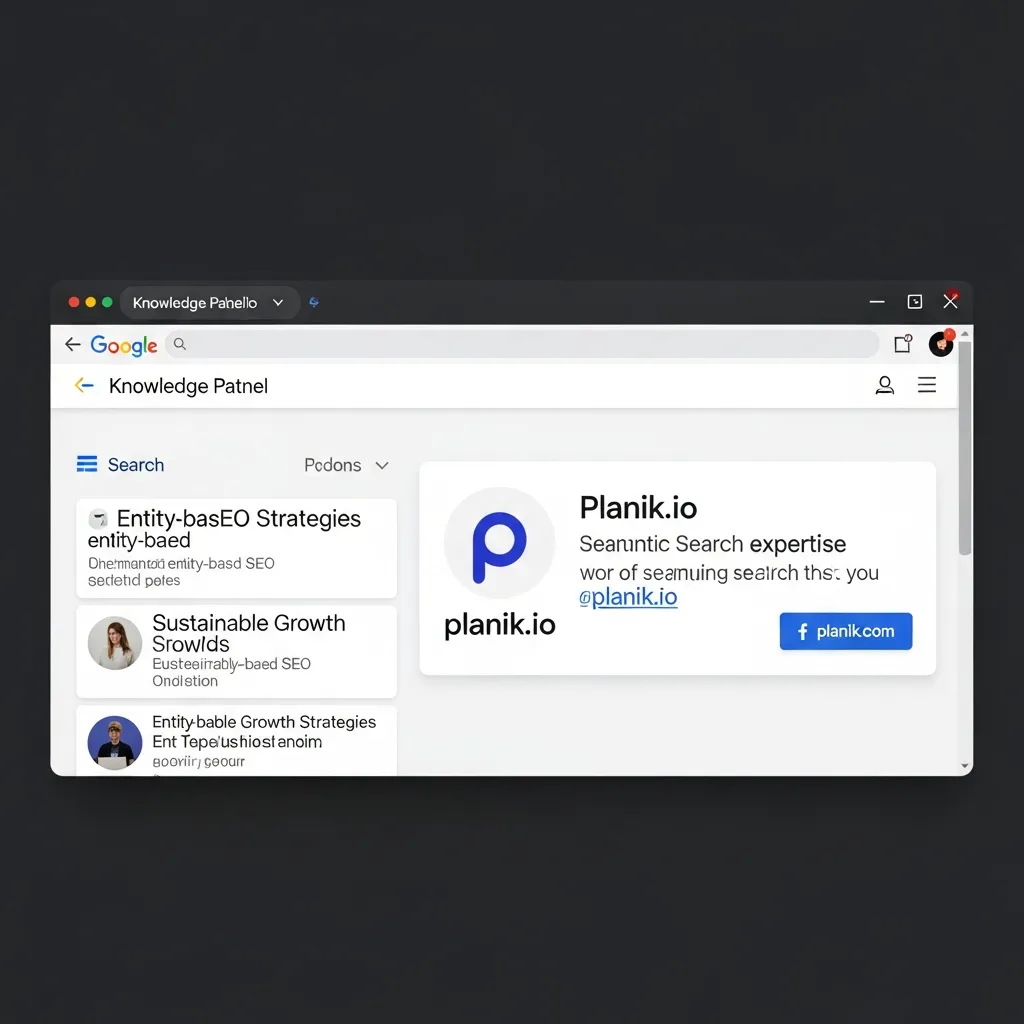
Significant improvements in topical authority can be observed across content clusters. This involves tracking ranking advancements for groups of semantically related keywords, indicating that search engines perceive your entity as a comprehensive resource. Platforms like Planik.io assist in visualizing these cluster-wide gains.
Expert advice emphasizes metrics such as entity reach—how widely your entity is referenced across the web—and semantic relevance. Technical data suggests that robust entity profiles lead to more resilient search visibility, offering sustainable growth less susceptible to algorithm fluctuations.
Avoiding Common Pitfalls: Where Entity Strategies Go Wrong
Even with a robust strategy, common missteps can hinder progress.
- Entity Stuffing: Just as keyword stuffing was penalized, entity stuffing—unnaturally saturating content with entity mentions—degrades user experience and triggers quality flags. Focus on natural language and contextual relevance.
- Ignoring E-E-A-T's 'E': Simply identifying entities isn't enough; search engines seek genuine entity authority rooted in expertise. Content must demonstrate a nuanced understanding of its subject matter.
- Over-Complicating Schema Without Content Quality: Sophisticated schema on weak content offers minimal gains. Schema should describe quality, not attempt to create it in a vacuum.
- Disconnected Entity Maps: Entity maps must align with the user journey. A strategy must anticipate user intent, providing a cohesive journey through related concepts.
In addition to avoiding these common errors, technical maintenance is crucial for troubleshooting knowledge graph issues
Key Insight: True entity SEO success lies in strategic, user-centric implementation that prioritizes authentic expertise and content quality, moving beyond mere technical compliance.
Future-Proofing Your Search Presence with Entity-First Thinking
The digital landscape has shifted toward an intelligent, semantic web, where contextual relationships and user intent supersede keyword matching. This evolution demands that SEO be treated as a knowledge-building exercise. By mapping entities relevant to your domain, you construct a durable, authoritative digital presence.
Field observations indicate entity-first thinking offers superior longevity, keeping content discoverable despite future algorithm updates. Planik.io's semantic content approach ensures enduring visibility. Apply the Semantic Growth Sprint checklist to your next project to secure your place in the evolving search landscape.
Stay ahead of industry shifts by exploring the future of entity SEO.
Frequently Asked Questions
What is an entity SEO strategy?
An entity SEO strategy focuses on optimizing for topics, concepts, and "things" rather than just keywords. It involves building a semantic network of information that helps search engines understand the context and relationships within your content.
How do entities differ from keywords?
Keywords are literal strings of text, while entities are unique, well-defined concepts (people, places, things). Entities provide context, allowing search engines to distinguish between different meanings of the same word, like "Jaguar" the car versus the animal.
Why is schema markup important for entity SEO?
Schema markup, particularly JSON-LD, provides search engines with explicit, machine-readable data about entities. It helps disambiguate concepts and defines relationships, making it easier for search engines to include your content in the Knowledge Graph.
What is the Knowledge Graph?
The Knowledge Graph is a semantic network used by search engines to store and connect information about entities. It allows search engines to provide more accurate, context-aware results by understanding how different concepts are related.