The Evolution of Digital Content Creation
Digital content creation has undergone a profound transformation, shifting from labor-intensive manual production to sophisticated AI-assisted workflows. Historically, marketers grappled with immense pressure to scale content volume while maintaining quality. Today, AI acts as a powerful catalyst, fundamentally reshaping how content is conceptualized, drafted, and refined.
The current role of AI in the content ecosystem is one of augmentation, not replacement. It serves as an indispensable co-pilot, handling repetitive tasks and generating initial drafts, which frees human experts for strategic refinement. The critical balance lies in leveraging AI for increased speed without compromising quality and authenticity. For a comprehensive overview of maintaining authority, see AI content and E-E-A-T tools.
Consider a team facing tight deadlines and high content demands. AI integration enables:
- Accelerated ideation and brainstorming.
- Improved consistency across various channels.
Categorizing the Landscape of AI Content Solutions
The landscape of AI content tools is remarkably diverse, offering specialized capabilities to augment every facet of content creation. Strategic observations indicate a shift from general-purpose tools to platforms tailored for specific marketing needs.
At its core are generative writing assistants, which excel at producing both long-form content like articles and blog posts, and short-form copy such as headlines, social media updates, and ad snippets. These tools address writer's block and accelerate initial draft creation, significantly boosting output efficiency.
Complementing these are SEO-focused optimization platforms. Practical experience shows these are indispensable for enhancing search visibility by providing granular keyword research, competitive analysis, and content grading against top-ranking pages, ensuring content aligns with search intent.
Beyond text, visual and multimedia generators empower marketers to create engaging images, videos, and infographics, which are crucial for holistic content strategies. These tools democratize design, enabling the rapid production of compelling visual assets. Finally, specialized tools for research and data analysis leverage AI to unearth trends, analyze audience sentiment, and derive actionable insights from vast datasets. This multi-faceted toolkit allows marketers to build a robust, data-driven content ecosystem.
Building a Scalable Content Engine: Integrating AI into Your Workflow
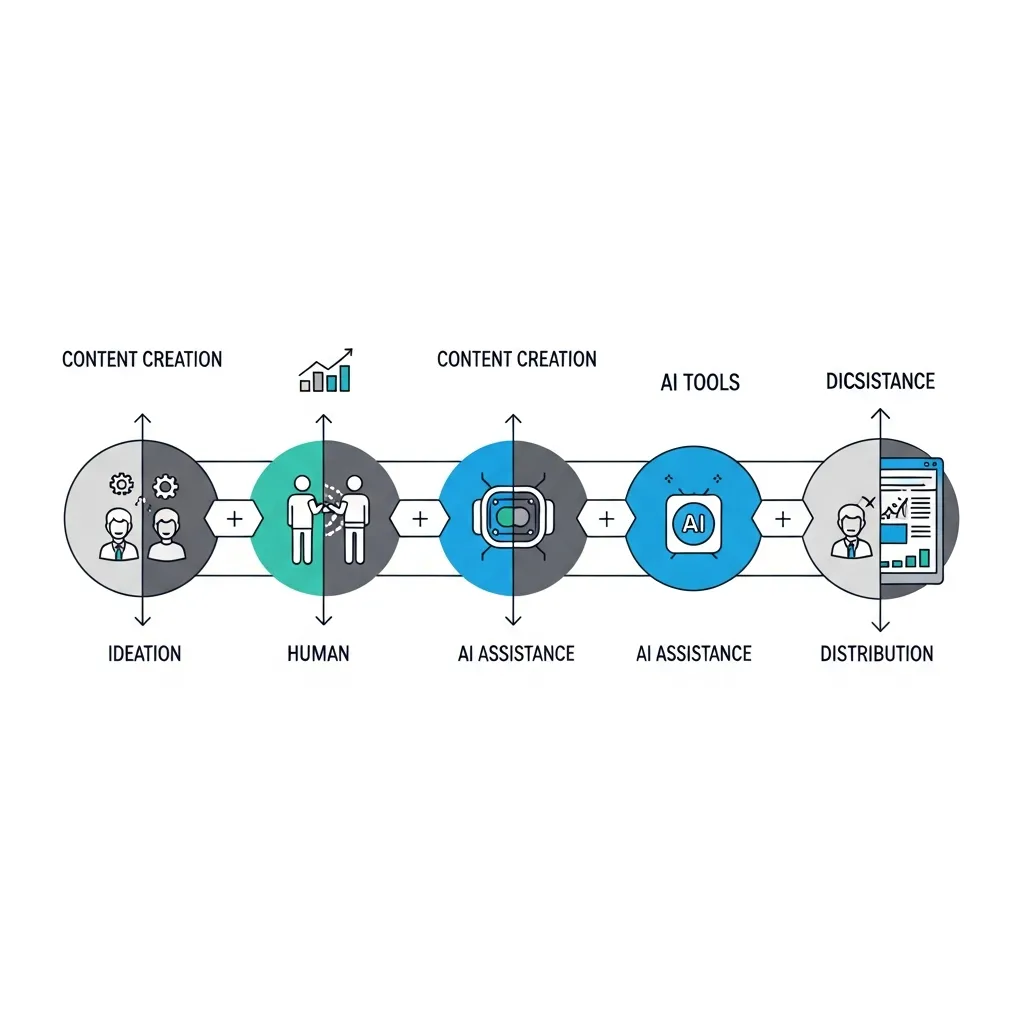
Integrating AI into content operations isn't merely about adopting new tools; it's about fundamentally rethinking the content lifecycle to foster greater efficiency and strategic impact. Building a truly scalable content engine requires a systematic approach that leverages AI's strengths at every juncture, from initial concept to final distribution. This integration transforms traditional, manual processes into a streamlined, data-informed workflow.
To achieve this, marketers can follow a structured framework that embeds AI capabilities into their existing content creation pipeline. Practical experience shows that a phased adoption, focusing on specific value-add areas, yields the most effective and sustainable results.
The AI-Powered Content Workflow Blueprint
This strategic blueprint outlines how AI can be systematically integrated to optimize content generation, ensuring both speed and quality.
-
AI for Research, Ideation, and Semantic Clustering:
- Leverage AI for comprehensive market analysis: AI tools excel at sifting through vast datasets to identify emerging trends, popular topics, and audience pain points. This extends beyond basic keyword research to uncovering latent semantic indexing (LSI) opportunities.
- Generate diverse content ideas: AI can brainstorm countless headlines and blog post concepts based on specific parameters, significantly reducing the initial ideation phase.
- Perform semantic clustering: Advanced AI can group related keywords and topics, helping marketers build comprehensive content pillars and ensure thorough coverage of a subject, thereby boosting topical authority.
-
Structuring Outlines and Briefs for Strategic Alignment:
- Automate outline generation: Once a topic is chosen, AI can construct detailed outlines, including suggested headings and key talking points, ensuring a logical flow.
- Enrich content briefs: AI assists in populating briefs with essential data, such as target keywords, competitor analysis, and suggested internal/external links.
- Maintain brand voice consistency: By training AI on existing brand guidelines, it can help enforce specific tones and styles even at the outlining stage.
-
Collaborative Drafting between Human Editors and AI Assistants:
- Accelerate initial drafts: AI tools can generate foundational text for articles, reports, or social media posts rapidly. This first pass serves as a robust starting point, allowing human writers to focus on refinement and unique insights.
- Enhance human creativity: Rather than replacing writers, AI frees them from repetitive tasks, enabling them to dedicate more time to complex storytelling and original thought leadership.
- Iterative refinement: Human editors can guide AI to rewrite sections, expand on ideas, or condense content, turning the drafting process into a dynamic feedback loop.
-
Fact-Checking and Verification Protocols for Accuracy:
- Implement AI-powered preliminary checks: While AI can generate text, its "understanding" of factual accuracy is limited. However, specific AI tools can perform initial checks for grammatical errors and flag statements requiring human verification.
- Establish human oversight as paramount: Every AI-generated claim, statistic, or reference must undergo rigorous human fact-checking. This protocol is non-negotiable to maintain credibility.
- Cross-referencing with authoritative sources: Integrate a process where human editors cross-reference AI-suggested facts with trusted, up-to-date sources.
-
Tailoring Output for Different Business Sizes and Audience Segments:
- Dynamic content adaptation: AI enables content to be quickly adapted for various platforms (blog, social, email), adjusting tone, length, and complexity.
- Personalization at scale: For larger enterprises, AI can help personalize content recommendations and generate variations of copy tailored to individual user profiles.
- Resource optimization for smaller businesses: Smaller teams can leverage AI to stretch their content budget further, producing a broader range of formats without needing extensive in-house resources.
Pro Tip: When integrating AI, start with a pilot project in a less critical content area. This allows your team to familiarize themselves with the tools and establish clear human-AI collaboration protocols before scaling.
Strategic SEO Optimization for AI-Assisted Content
Optimizing content for search engines with AI transcends basic keyword density. The focus must shift to search intent, where AI tools excel at analyzing SERP results and user queries to understand the true needs behind a search. A common mistake is over-relying on AI for raw keyword optimization without human validation of intent, which can lead to content that ranks but fails to engage.
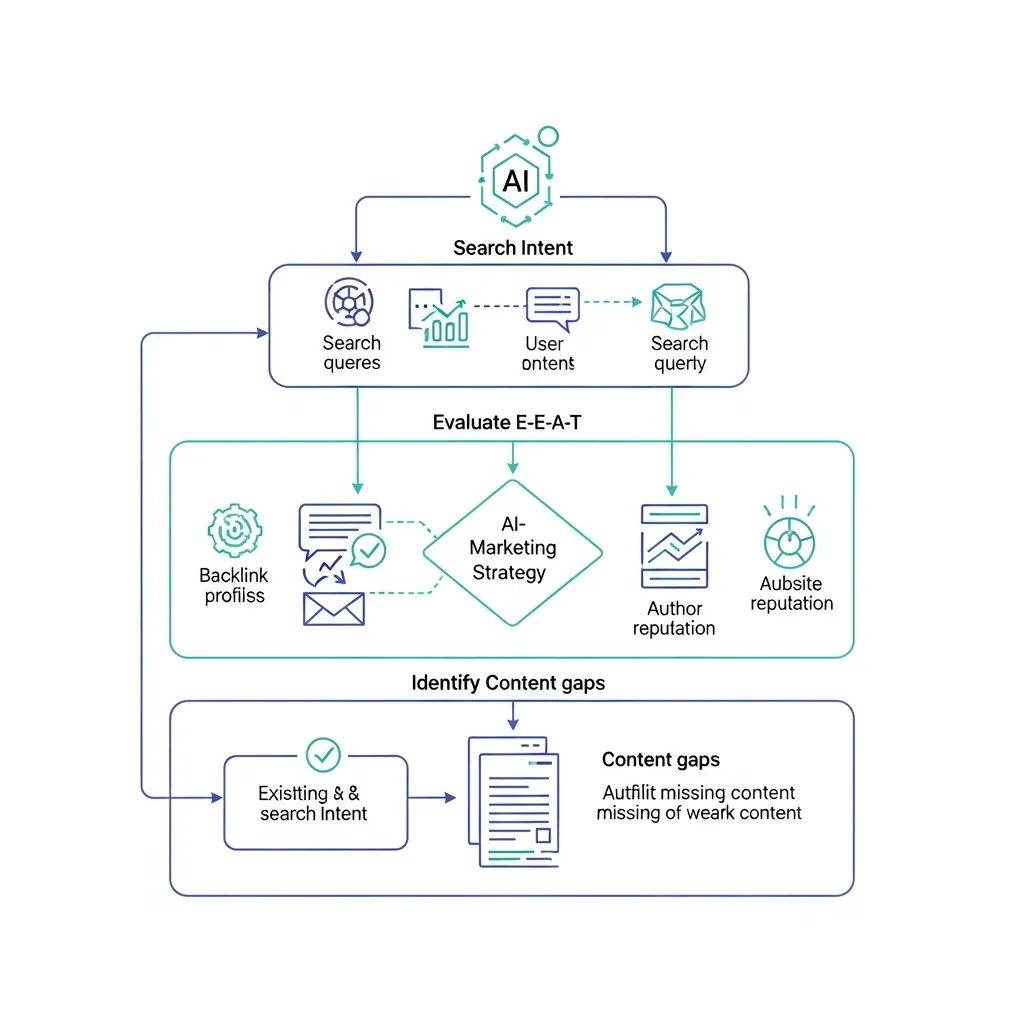
Enhancing E-E-A-T (Experience, Expertise, Authoritativeness, Trustworthiness) in AI-generated drafts requires a strategic human overlay. While AI can structure information, the unique perspective and real-world experience that underpin strong E-E-A-T must be infused by expert editors. The most effective approach involves leveraging AI to identify opportunities and generate foundational text, which human specialists then enrich with their distinct voice.
Furthermore, AI proves invaluable for identifying internal linking opportunities and content gaps. Tools can efficiently scan your entire content library, suggesting relevant connections that strengthen topic clusters and improve crawlability. AI-powered analysis significantly reduces the manual effort of mapping out linking strategies, uncovering overlooked connections that enhance site authority.
Navigating Ethical Challenges and Brand Consistency
While AI content tools offer immense efficiency, marketers must proactively address ethical challenges. A common mistake is over-reliance on AI without subsequent manual verification, leading to unintentional plagiarism or duplicate content. Robust human review and advanced plagiarism checkers are essential safeguards to mitigate these risks.
Furthermore, maintaining a unique brand voice becomes paramount in a landscape increasingly populated by generic AI output. The most effective approach to preserving brand voice is to treat AI as a robust first draft generator, not the final author; human editors must infuse the content with the brand's distinct personality. Finally, transparency and disclosure regarding AI usage are non-negotiable. Clearly indicating AI assistance builds reader trust and manages expectations, ensuring long-term brand integrity.
The Synergy of Human Creativity and Machine Efficiency
Modern AI content tools offer unprecedented efficiency, yet human oversight remains the ultimate quality gatekeeper. While machines can generate drafts rapidly, only human strategists can infuse content with genuine nuance, empathy, and strategic alignment.
Purely automated content often results in generic, superficial output that demands significant post-production. The most effective approach is a human-led AI content strategy. A common mistake is the assumption that AI can replace strategic thinking; this often leads to a 30-40% increase in revision cycles.

The content strategist's role is transforming from creator to curator and director. They leverage AI for efficiency while focusing their expertise on strategic direction, ethical review, and ensuring the final content resonates deeply with the target audience.
Future-Proofing Your Content Strategy
Integrating AI content tools responsibly is paramount. This means leveraging their efficiency while maintaining human strategic oversight and ethical standards. In my experience, a common mistake is over-reliance on initial AI drafts, which can lead to a 30% increase in revision cycles due to a lack of brand voice.
To avoid this, continually experiment with the latest methodologies, adapting your prompts and workflows to guide AI effectively. Marketers who actively shape AI outputs, transforming them into truly unique, high-value content, will secure a decisive competitive edge. This proactive approach ensures your strategy remains agile and impactful. To truly future-proof your efforts, start refining your AI prompting techniques today.
Frequently Asked Questions
What are AI content tools?
AI content tools are software applications that use artificial intelligence to assist in creating, optimizing, and managing digital content, from text generation to SEO analysis.
Can AI content tools replace human writers?
No, AI serves as a co-pilot. While it can generate drafts and handle repetitive tasks, human oversight is essential for strategic alignment, brand voice, and factual accuracy.
How do AI content tools improve SEO?
These tools help identify search intent, perform keyword research, and suggest internal linking opportunities, ensuring content is structured to rank higher on search engines.