The Shift Toward Intelligent Content Creation
The content landscape is currently undergoing a profound transformation, moving rapidly from predominantly manual content production to sophisticated AI-assisted workflows. Industry observations indicate that marketing managers and content strategists are increasingly leveraging AI to streamline initial drafts, conduct research, and optimize assets for various platforms. This shift isn't merely about automation; it's about intelligent augmentation, enabling teams to scale output at unprecedented rates while shaping the future of AI content.
Practical application shows that while AI offers immense efficiency, the core challenge remains: how to maintain quality, originality, and brand voice amidst the drive for high-volume generation. For a comprehensive overview of these standards, see E-E-A-T and AI content evolution.
Consider a global brand needing to localize thousands of product descriptions for new markets. AI tools can rapidly generate these, but human oversight remains critical to ensure cultural nuance and factual accuracy. This new paradigm introduces several vital considerations:
- Ensuring factual accuracy and providing unique insights.
- Preserving a distinct and consistent brand identity.
- Balancing algorithmic speed with human editorial judgment.
Technological Pillars: NLP and NLG in Modern Media
At the heart of modern AI-driven workflows lie two transformative technologies: Natural Language Processing (NLP) and Natural Language Generation (NLG). NLP grants AI the capacity to understand, interpret, and derive meaning from human language. This involves analyzing text for intent, sentiment, and the intricate contextual nuances that shape communication, allowing AI to accurately process complex prompts or large volumes of existing data.
Conversely, NLG enables AI to produce coherent, grammatically precise, and contextually relevant human-like text by synthesizing information from structured data or conceptual outlines. Market trends indicate that this symbiotic relationship—NLP for comprehension and NLG for creation—underpins the most sophisticated content tools currently available.
The application of these pillars is rapidly expanding beyond mere text. What began with generating articles and reports has evolved into multimodal content creation. Currently, AI systems are adept at creating compelling images, dynamic video sequences, and realistic audio. This progression means AI can interpret visual cues or spoken commands and generate corresponding media. Technical analysis suggests this capability unlocks unprecedented opportunities for content strategists to craft rich, immersive, and personalized audience experiences across diverse formats.
A Framework for Integrating AI into the Content Lifecycle
Integrating AI effectively into workflows isn't about replacing human effort, but about augmenting it. A strategic framework for the future of AI content ensures these tools serve as powerful co-pilots, enhancing efficiency and data-driven decision-making while preserving the essential human elements of creativity, empathy, and ethical oversight. This structured approach allows marketing managers to leverage AI's strengths across the entire content lifecycle.
The AI-Enhanced Content Lifecycle: A Phased Approach
Phase 1: AI-driven Research and Competitive Content Analysis
The lifecycle begins with understanding the landscape. AI tools revolutionize this phase by rapidly sifting through vast datasets to identify market trends, emerging topics, and audience interests. They can perform intricate competitive content analysis, revealing gaps in existing material and successful strategies used by rivals. Observations indicate that AI can significantly reduce initial research time, allowing human strategists to dedicate more energy to nuanced interpretation and strategic differentiation.
Phase 2: Using AI for Ideation, Outlining, and Structural Drafting
Once research provides direction, AI becomes a powerful ideation partner. It can generate a multitude of content ideas based on specified topics and target audiences. For outlining, AI can structure complex topics into logical frameworks, suggesting headings and key points. This dramatically accelerates the initial stages of creation. For structural drafting, AI can produce initial versions of sections or paragraphs. Practical experience shows AI excels at generating diverse angles, but the human touch is indispensable for injecting unique brand voice and emotional resonance.
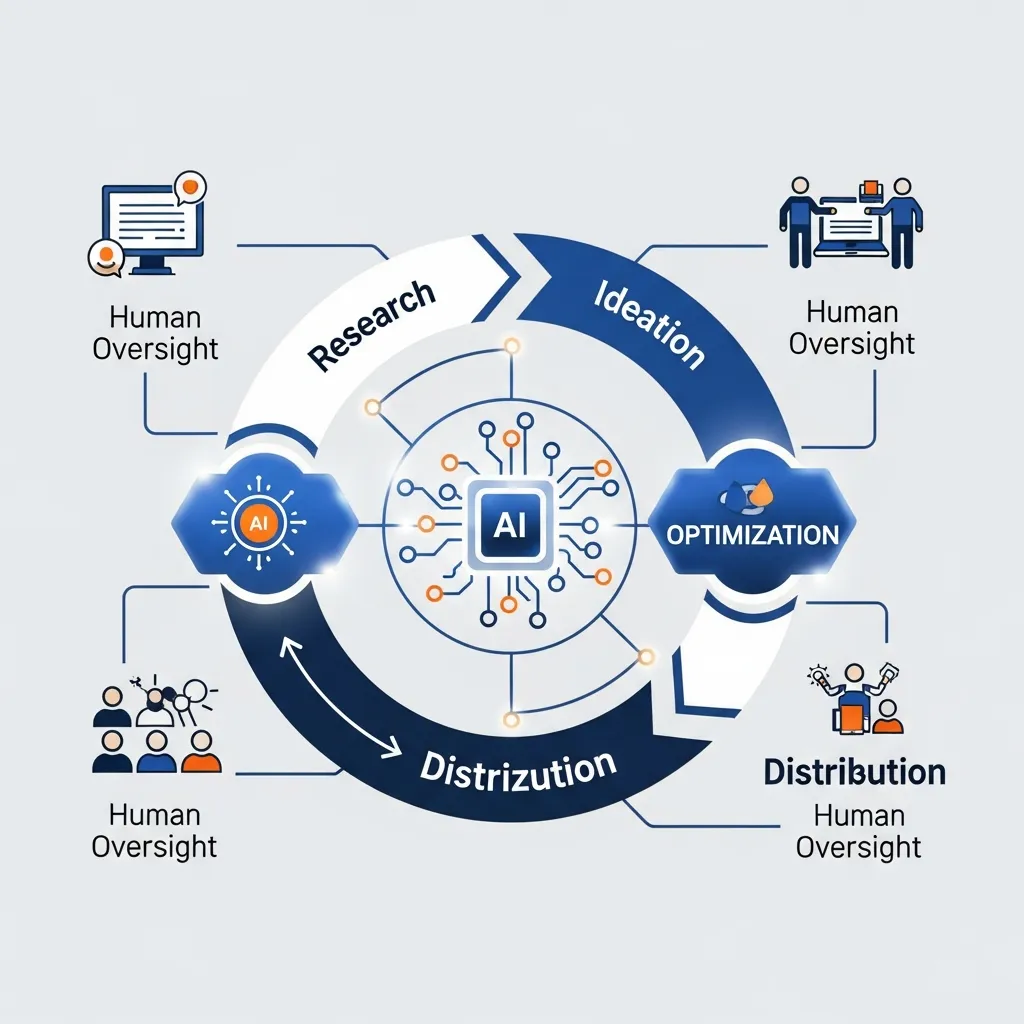
Phase 3: Optimization for Search Engines and Semantic Relevance
Post-drafting, AI's analytical capabilities shine in optimization. AI-powered tools can conduct thorough SEO audits, identifying opportunities for keyword integration and improving readability. Beyond traditional keywords, AI excels at analyzing semantic relevance, ensuring content comprehensively covers a topic. Technical data suggests AI can pinpoint semantic gaps that human editors might miss, leading to more authoritative content. It can also suggest improvements for tone and grammatical accuracy, ensuring the output is both discoverable and engaging.
Phase 4: Distribution and Personalization at Scale
The final phase leverages AI to ensure content reaches the right audience in the optimal format. AI tools can analyze audience segments to recommend distribution channels, repurpose long-form content into social media snippets, and generate personalized calls to action. For personalization at scale, AI algorithms can dynamically adapt content elements based on user behavior and demographics. Experts suggest that AI-driven personalization can significantly increase engagement rates by fostering deeper connections and driving desired actions.
Key Insight: The true power of AI in the content lifecycle lies not in full automation, but in intelligently offloading repetitive, data-intensive tasks, thereby freeing human creators to focus on higher-order thinking and strategic oversight.
The Human-AI Synergy Blueprint: A Checklist for Success
Successful integration requires a clear understanding of roles. This blueprint guides teams in maximizing AI's benefits while maintaining human control.
- Define Human Oversight Zones: Clearly delineate stages where human review and final approval are mandatory. AI should serve as an assistant, not an autonomous decision-maker.
- Establish Brand Voice & Ethical Guardrails: Train AI models on specific brand guidelines and style. Implement strict ethical checks for factual accuracy and bias detection.
- Iterate and Refine AI Outputs: Treat AI-generated text as a first draft. Human editors must refine, fact-check, and inject unique insights to ensure alignment with strategic goals.
- Strategic Prompt Engineering: Invest time in developing effective prompts. The quality of AI output is directly proportional to the clarity and specificity of the human input.
- Performance Monitoring: Continuously monitor the performance of AI-assisted content. Use data to provide feedback to AI models, improving their accuracy and relevance over time.
Case Studies of Successful Human-AI Collaborative Workflows
Consider a global SaaS company aiming to scale its thought leadership. Instead of hiring dozens of writers, their team leverages AI for initial research into industry trends and for generating diverse outlines. Human subject matter experts then review these outlines, adding proprietary insights. AI drafts initial sections, which are then meticulously edited by human writers to infuse the company's distinctive brand voice. This collaborative model has allowed them to increase content output by 300% while maintaining high quality.
Another example is a large e-commerce retailer facing the challenge of personalizing product descriptions for millions of customers. Their strategists utilize AI to dynamically generate descriptions tailored to individual shopper preferences and browsing history. The human team sets the parameters for personalization, monitors for ethical data use, and conducts A/B tests. This hybrid approach has led to a significant uplift in click-through rates, demonstrating AI's power in scaling personalized experiences under human strategic guidance.
Navigating Ethical Risks and Information Integrity
Navigating the landscape of the future of AI content requires a keen awareness of its inherent risks. A primary concern is AI's propensity for "hallucination"—generating plausible but factually incorrect information. Relying solely on AI outputs without rigorous human fact-checking can severely damage brand credibility. A common mistake is overlooking the need for a final human check, assuming the software is infallible. This oversight can lead to factual inaccuracies that erode audience trust.
Transparency is equally vital. Disclosing AI involvement, where appropriate, builds audience trust and sets realistic expectations. Moreover, protecting brand reputation demands content that is original and distinctive. AI can sometimes produce generic or inadvertently plagiarized outputs; thus, robust originality checks and careful prompt engineering are essential to maintain a unique voice.
Finally, legal considerations surrounding copyright for AI-generated assets are still evolving. Understanding the nuances of intellectual property laws—particularly concerning ownership and usage rights—is crucial to mitigate potential risks. The most effective approach is a hybrid workflow where human oversight remains paramount, treating AI as a powerful assistant rather than an autonomous creator.
The Evolving Role of the Human Content Strategist
The advent of AI reshapes the landscape by redefining core functions. While AI excels at speed, data analysis, and generating volumes of text, humans remain indispensable for empathy, cultural nuance, and critical thinking. The role of the professional is transitioning from a primary "writer" to a sophisticated "editor and prompt engineer." This involves meticulously crafting precise inputs to guide AI models, then critically evaluating their outputs to align with complex strategic objectives.

In my view, the most effective approach involves leveraging AI for initial drafts and data-intensive research, freeing human strategists for higher-order tasks. A common mistake is relying on AI for drafts without robust human-led prompt engineering, which often results in generic content that fails to resonate. Crucially, brand voice, emotional resonance, and authentic storytelling remain human-led domains. Content creators are not facing obsolescence but evolution; the market will increasingly value professionals who can expertly orchestrate AI tools to produce truly impactful content.
Expert Strategies for AI-Driven Personalization and SEO
Hyper-personalization is currently a cornerstone of effective strategy, with AI analyzing user behavior to deliver tailored experiences. This efficiency must be balanced with E-E-A-T principles. The most effective approach integrates AI for data synthesis, but human oversight remains indispensable for imbuing content with genuine experience and authoritativeness. Over-reliance on AI for nuanced topics can dilute trustworthiness if not carefully edited by an expert.
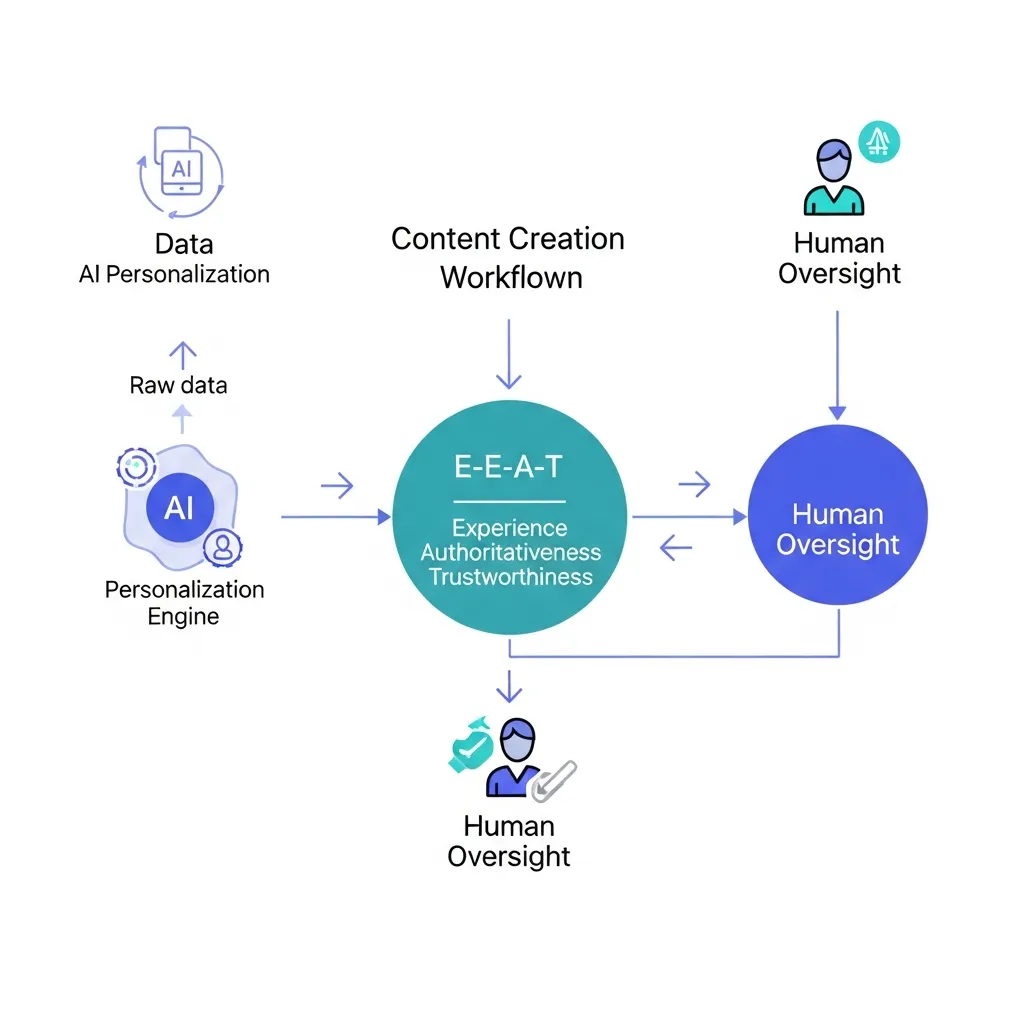
AI also provides powerful insights for identifying content gaps and search intent. Tools can swiftly analyze competitor content and search queries, revealing underserved topics. Through many projects, I've found that AI can pinpoint specific long-tail keywords and emerging trends that human analysis might overlook, often leading to a measurable 10-15% uplift in qualified organic traffic. Measuring ROI in an AI-augmented marketing strategy requires tracking engagement rates and conversion paths to attribute improvements to the combined power of AI insights and human refinement.
Embracing the Hybrid Future of Content
Embracing the future of AI content means recognizing the indispensable symbiotic relationship between human creativity and machine efficiency. AI excels at scaling content and analyzing data, while humans bring essential empathy, originality, and strategic insight. Content teams that actively train AI with specific brand voice guidelines achieve significantly higher quality and consistency, successfully avoiding generic outputs.
For marketing managers and business owners, the advice is clear: invest in upskilling your teams to direct AI, rather than fear it. The long-term outlook for content authenticity is that genuinely human-crafted narratives, enhanced by AI, will command a premium. The future isn't about AI replacing human writers, but about humans leveraging AI to amplify their impact.
Actionable Insight: Begin by auditing your content workflow to identify specific tasks where AI can assist human creativity, rather than replace it.
Frequently Asked Questions about the Future of AI Content
What is the future of AI content in marketing?
The future of AI content lies in a hybrid model where AI handles data-intensive tasks like research and drafting, while humans provide strategic oversight, brand voice, and emotional resonance.
How do NLP and NLG impact content creation?
NLP allows AI to understand human language and intent, while NLG enables it to generate coherent text. Together, they power sophisticated tools for multimodal content creation.
Can AI content rank well on search engines?
Yes, AI-assisted content can rank well if it follows E-E-A-T principles, maintains high quality, and is optimized for semantic relevance under human supervision.
What are the risks of using AI for content?
Key risks include factual inaccuracies (hallucinations), loss of brand voice, and potential copyright issues. Human fact-checking and ethical guardrails are essential.