Understanding the Role of Intelligence in Modern Content Frameworks
The content creation landscape is currently undergoing a profound transformation. While many associate AI solely with simple text generation, a true AI content strategy extends far beyond merely automating writing tasks. It represents a fundamental shift from manual content production to an AI-augmented orchestration of the entire content lifecycle—from ideation and research to optimization and distribution.
Experience shows that without a robust strategic framework, AI outputs can quickly become generic, undifferentiated, and fail to resonate with target audiences or uphold brand voice. This strategic approach is crucial for:
- Ensuring content relevance and impact.
- Scaling operations without sacrificing quality.
- Maintaining a distinct brand identity.
Consider a scenario where a content team, overwhelmed by manual research and drafting, struggles to meet fluctuating demand. A strategically integrated AI system can transform this bottleneck, providing data-driven insights for topics and efficiently drafting initial content, allowing human experts to refine and add unique value.
As discussed in AI content and E-E-A-T optimization, a thoughtful strategy is paramount to leverage intelligence effectively, avoiding the pitfall of merely generating noise and ensuring genuine authority.
Addressing Common Strategic Challenges with Automation
Automation provides potent solutions to long-standing content strategy hurdles. The pervasive 'blank page' syndrome, which often stalls production, is effectively overcome as AI generates initial outlines, topic ideas, and draft content at speed.
This capability allows organizations to scale content production without a proportional increase in human resource allocation, freeing up creative teams for higher-value refinement. Field observations indicate that using AI for initial drafting significantly accelerates the content lifecycle.
A critical challenge is maintaining a consistent brand voice across an expanding array of digital channels. AI models, when trained on a brand's specific style guides and existing content corpus, can enforce this consistency. From blog articles to social media snippets and email campaigns, automation ensures uniform messaging and tone—a common struggle for distributed content teams.
Moreover, the imperative for high-volume output must not compromise search engine quality standards. AI tools assist by embedding SEO best practices—such as keyword integration, semantic optimization, and structural formatting—directly into the content generation process. This allows human experts to concentrate on factual accuracy, adding unique perspectives, and ensuring the content meets robust E-E-A-T criteria. Practical experience shows this strategic integration yields both high volume and superior organic search performance.
A Step-by-Step Roadmap for Implementing an AI Content Strategy
Implementing an AI content strategy is not merely about adopting new tools; it is a fundamental shift in how content teams operate, demanding a structured approach to ensure scalability and effectiveness. For content marketers and strategists seeking to navigate this transformation, a clear roadmap is essential.
This strategic integration promises several key outcomes:
- Significantly increased content velocity and output.
- Enhanced consistency in brand voice and messaging.
- Improved resource allocation, allowing human experts to focus on high-value tasks.
- Data-driven content optimization for superior search performance.
Consider a B2B SaaS company that consistently struggles to produce enough in-depth articles to cover all facets of its complex product suite. Their small content team is constantly overwhelmed, leading to missed opportunities in search visibility and thought leadership. A phased AI integration can systematically address this by automating research, initial drafting, and optimization, freeing up human specialists to focus on strategic insights and expert validation.
To guide this transition, we present The AI Content Integration Roadmap, a five-phase framework designed for seamless and impactful AI adoption.
Phase 1: Conducting a Content Audit to Identify Automation Opportunities
The foundational step for any successful AI content strategy is a comprehensive content audit. This involves more than just identifying existing content; it requires understanding performance, identifying gaps, and pinpointing where AI can introduce efficiencies.
Actionable Steps:
- Inventory All Existing Content: Catalog every piece of content—blog posts, landing pages, product descriptions, social media snippets, and email sequences.
- Analyze Performance Metrics: Evaluate each content piece against key KPIs such as organic traffic, engagement rates, conversion rates, and time on page. Identify top-performing assets and underperforming ones.
- Map Content to Customer Journey: Understand how existing content serves different stages of the buyer’s journey. Pinpoint areas where content is missing or ineffective.
- Identify Repetitive Tasks & Bottlenecks: Look for content types that are high-volume and template-driven (e.g., localized product descriptions, routine news updates, basic FAQs). These are prime candidates for AI automation. Also, identify bottlenecks in your current workflow, such as extensive manual research or first-draft generation.
Field observations indicate that teams often discover a significant portion of their content production involves tasks that are highly predictable and structured, making them ideal for AI assistance. For example, generating content briefs based on keyword research and competitor analysis is a prime automation opportunity, saving hours for human strategists.
Phase 2: Selecting a Specialized Tool Stack for Research, Drafting, and Optimization
No single AI tool currently offers a complete solution for every content need. A robust AI content strategy relies on a specialized tool stack tailored to different stages of the content lifecycle.
Key Considerations for Tool Selection:
- Research & Ideation: Tools that excel at keyword research, topic clustering, competitive analysis, and trend identification. These help generate data-backed content ideas and outlines.
- Drafting & Generation: AI writers capable of producing various content formats, from short-form social media copy to long-form articles. Focus on tools offering customization options for tone and style.
- Optimization & Enhancement: AI-powered SEO tools for content scoring, readability analysis, plagiarism checks, and grammar/style suggestions.
- Integration Capabilities: Prioritize tools that can integrate with your existing CMS, project management software, or other content marketing platforms to ensure a smooth workflow.
- Scalability & Customization: Assess whether tools can handle your projected content volume and if they allow for training on your specific data or style guides.
Practical experience shows that investing in a few specialized tools that perform specific tasks exceptionally well often yields better results than relying on a single, generalist AI platform.
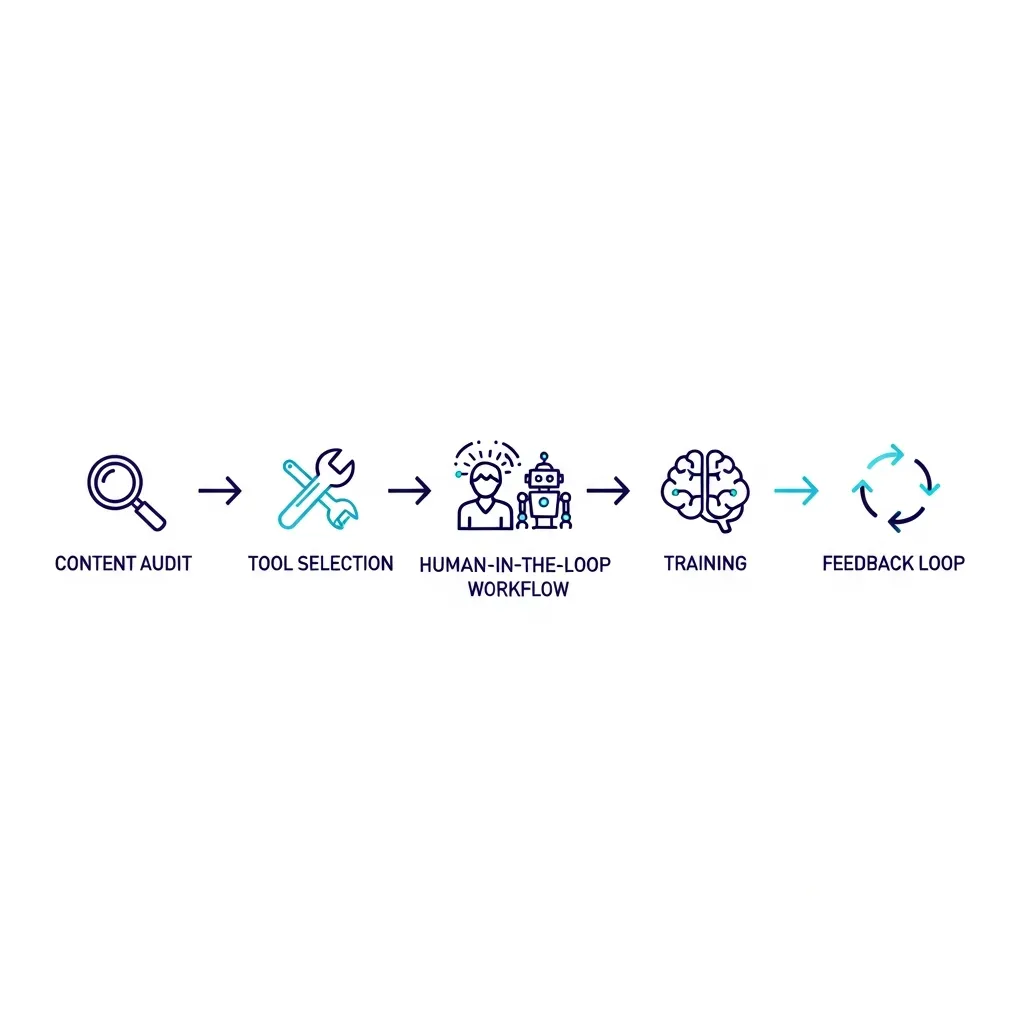
Phase 3: Developing a 'Human-in-the-Loop' Editorial Workflow
The "human-in-the-loop" (HITL) model is central to preserving quality, accuracy, and brand voice in an AI-driven environment. AI should augment, not replace, human creativity and critical thinking.
Workflow Integration:
- AI-Generated First Draft: AI produces initial content based on detailed prompts and outlines. This could be a full article, a section, or a collection of ideas.
- Human Editor Review & Refinement: A human editor reviews the AI output for factual accuracy, coherence, tone, and brand alignment. This phase is crucial for injecting unique insights, storytelling, and E-E-A-T (Experience, Expertise, Authoritativeness, Trustworthiness).
- Fact-Checking & Validation: For sensitive or technical topics, content proceeds to subject matter experts (SMEs) for validation and additional layers of accuracy.
- SEO & Readability Optimization: Human content strategists or SEO specialists refine the content further for search performance and audience readability, leveraging AI suggestions but making final strategic decisions.
- Final Approval: The content undergoes a final review before publication.
Pro Tip: Define clear roles and responsibilities within your HITL workflow from the outset. Assign specific editors to review AI output for factual accuracy, brand voice, and SEO optimization. This prevents bottlenecks and ensures accountability, significantly improving the quality and speed of your content pipeline.
Phase 4: Training AI Models on Internal Style Guides and Proprietary Data
To truly differentiate your AI-generated content and ensure it aligns perfectly with your brand, training AI models on your specific internal data is paramount. This moves beyond generic AI outputs to truly proprietary content.
Customization Strategy:
- Ingest Style Guides & Brand Voice Documents: Provide AI models with your comprehensive style guides, tone-of-voice documents, and brand messaging guidelines. This teaches the AI your preferred linguistic nuances, formatting, and overall communication style.
- Upload High-Performing Content: Feed the AI examples of your most successful blog posts, whitepapers, social media campaigns, and marketing copy. This helps the model understand what resonates with your audience and aligns with your strategic goals.
- Leverage Proprietary Research & Data: Integrate internal research, customer data, product specifications, and unique insights that are exclusive to your organization. This empowers the AI to generate content that is unique, authoritative, and truly valuable to your niche.
- Develop Custom Prompts: Create a library of highly specific and effective prompts that guide the AI to produce content consistent with your brand and objectives.
Technical data suggests that AI models trained on proprietary datasets can achieve up to a 30% improvement in brand consistency and factual accuracy compared to those relying solely on generic pre-trained models.
Phase 5: Establishing a Feedback Loop for Continuous Prompt Refinement
An AI content strategy is not a set-it-and-forget-it system. It is an iterative process that thrives on continuous feedback and refinement.
Implementing a Feedback Loop:
- Systematic Output Evaluation: Develop a consistent method for evaluating AI-generated content. This could involve scoring systems for accuracy, relevance, tone, and adherence to prompts.
- Log Edits and Revisions: Track all human edits made to AI-generated content. Categorize these edits (e.g., factual corrections, stylistic changes, additions for E-E-A-T).
- Identify Common Issues: Regularly review the logged feedback and edits to identify recurring patterns or weaknesses in the AI's output. Are there specific topics where it struggles? Does it consistently miss the mark on a certain tone?
- Refine Prompts & Training Data: Use these insights to refine your prompts, making them more specific and directive. If possible, use the corrected and improved content to further train or fine-tune your AI models.
- Monitor Performance Metrics: Continuously track the performance of AI-assisted content (e.g., SEO rankings, engagement, conversions) and correlate it with changes made to your prompts and models.
According to experts, a well-implemented feedback loop can reduce editing time for AI-generated content by 15-20% within the first few months, while simultaneously increasing output quality and relevance. This iterative refinement is key to unlocking the full potential of your AI content strategy.
Optimizing Search Visibility and Competitive Analysis
Harnessing AI transforms traditional SEO and competitive analysis from a labor-intensive endeavor into a strategic powerhouse. Currently, content marketers leverage AI to gain profound insights, moving beyond surface-level keyword research to truly understand user intent and market dynamics.
AI excels at identifying semantic keyword clusters and uncovering critical content gaps. Field observations indicate that AI-driven platforms can analyze vast datasets of search queries and top-ranking content to map comprehensive topic clusters, revealing not just individual keywords but the underlying themes and user questions. This allows strategists to build topical authority by addressing an entire spectrum of related queries, rather than chasing isolated keywords. Practical experience shows this approach is far more effective at capturing diverse search intent and establishing an authoritative presence.
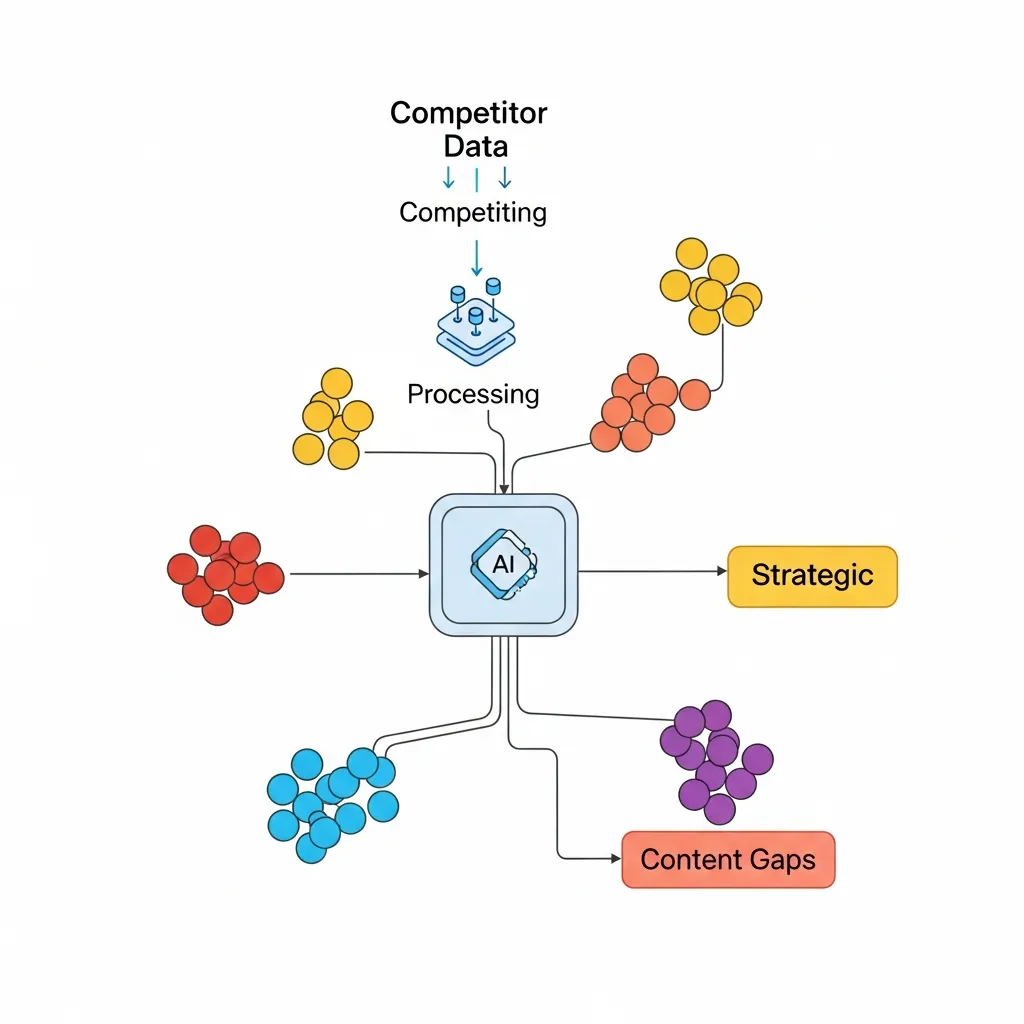
Automating competitor content structure analysis is another area where AI delivers significant value. Manually dissecting competitor content for structure, depth, and on-page optimization is time-consuming. AI tools can rapidly parse hundreds of competitor pages, identifying common patterns in heading structures, content formats, internal linking strategies, and even the types of rich media used. This allows for swift identification of successful structural elements and potential weaknesses in rival content, informing your own content architecture decisions.
Finally, preparing content for AI-powered search engines and generative snapshots is paramount. As search evolves with features like AI Overviews, content must be structured for machine comprehension. This means prioritizing clarity, conciseness, and direct answers to potential user questions. According to experts, incorporating structured data, clear subheadings, and summary sections greatly enhances the likelihood of content being selected and presented effectively in generative summaries, ensuring visibility in the latest search paradigms.
Pro Tip: Focus on creating "answer-first" content. By directly addressing common user questions early in your articles, you increase the chances of your content being chosen by AI models for direct answers or generative summaries, boosting visibility.
Expert Strategies for Preserving Brand Identity and Authority
Raw AI output often falls short of capturing a brand’s unique voice and identity, frequently failing the crucial "vibe check." This is because AI models, by nature, generalize from vast datasets, resulting in content that can feel generic, sterile, or lack the distinctive personality that resonates with your audience.
The solution isn't to abandon AI, but to view it as a powerful co-pilot, not an autonomous creator. In my view, the most effective approach is to treat AI-generated content as a highly capable assistant's initial draft, requiring significant human refinement for tone, authenticity, and precise brand alignment.
To truly preserve brand authority and differentiate your content, human editors must actively inject personal experience and unique industry insights. This means going beyond simple grammatical edits, meticulously weaving in specific anecdotes, proprietary research findings, or nuanced perspectives that only a human expert possesses.
For example, if AI suggests a general marketing tactic, an expert editor might add: "When applying this method with a B2B SaaS client, we observed a 20% uplift in MQLs by segmenting email lists based on product usage behavior, a critical detail AI alone might not infer." This transforms generic advice into authoritative, experience-backed guidance.
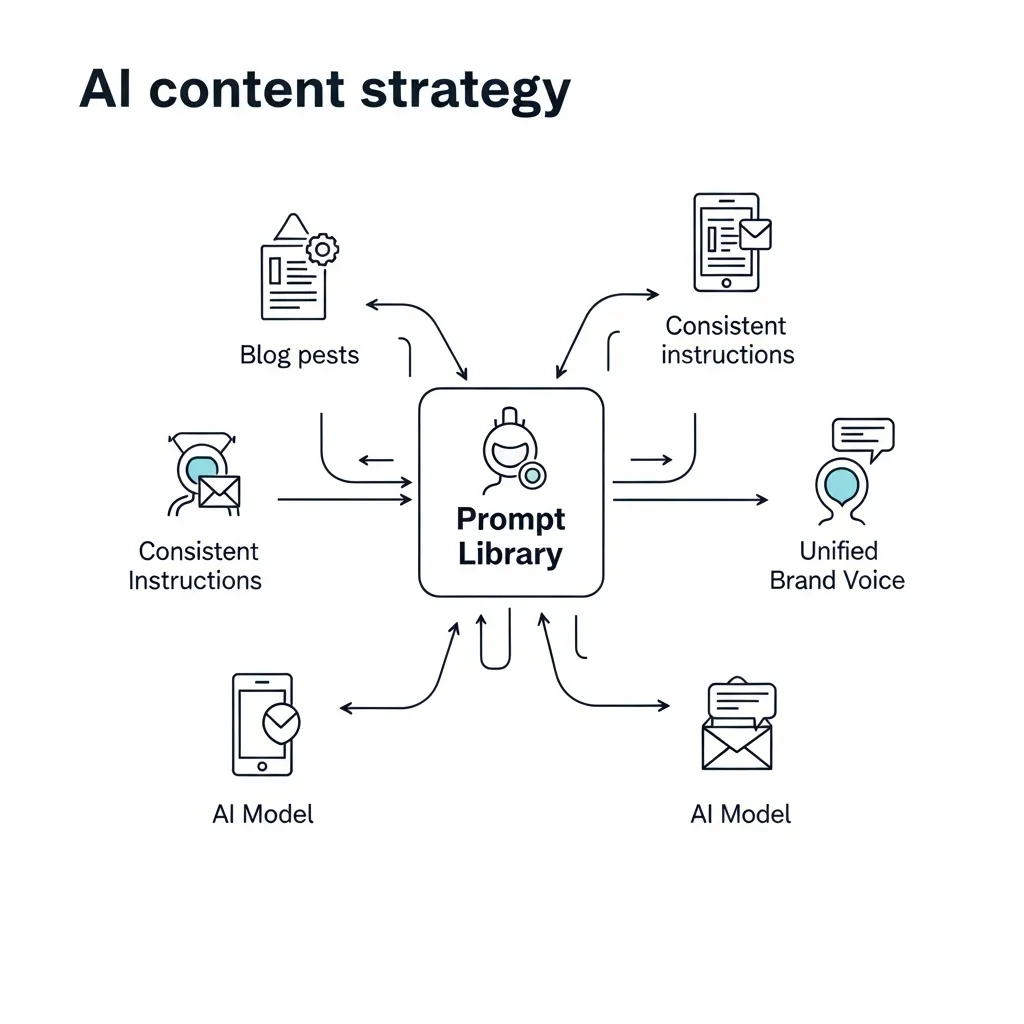
Maintaining stylistic consistency across all AI-generated content is paramount for a cohesive brand identity. A centralized prompt library is an indispensable tool for achieving this. This library should house meticulously crafted prompts that clearly define your brand's voice, tone, specific terminology, target audience personas, and desired content structure.
For instance, a prompt might specify: "Write in an authoritative yet approachable tone, using industry-specific jargon explained simply, targeting marketing managers. Ensure active voice, incorporate a clear call to action, and maintain a slightly conversational flow." A common mistake I've encountered is teams using varied, ad-hoc prompts, leading to disparate and off-brand outputs; centralizing these prompts ensures AI consistently understands and adheres to your brand's unique guidelines, fostering a unified content experience.
Managing Risks, Accuracy, and Ethical Standards
Managing AI's output requires vigilance. A primary danger is AI hallucinations, where models generate confident but factually incorrect information. In my experience, relying solely on AI output without rigorous human review often leads to factual inaccuracies that can severely damage brand credibility. A common mistake I've seen is underestimating this tendency; to fix it, always cross-reference AI-generated facts with reputable sources before publication.
Navigating copyright concerns and plagiarism also demands careful attention. Treat AI-generated text as a first draft, not a final product. Implement robust originality checks to ensure the content is unique and doesn't inadvertently mimic existing copyrighted material, safeguarding your brand from potential legal issues.
Finally, transparency with your audience regarding AI usage is paramount for building trust. Clearly disclose when AI tools have assisted in content creation, especially for pieces where authenticity and human insight are highly valued. This ethical practice respects your readers and reinforces your brand's integrity. In my view, the most effective approach is to embed mandatory human review for all AI-generated drafts, focusing on accuracy, originality, and brand alignment.
Final Thoughts on Long-Term Strategic Success
Achieving long-term strategic success with AI balances efficiency and unwavering quality. While AI amplifies output, human oversight is paramount for brand voice and accuracy. I firmly believe AI is a strategic partner, not just a volume tool.
The AI landscape evolves rapidly; continuous learning and adaptability are essential. In my experience, attempting a full-scale AI overhaul from day one often creates hurdles. A common mistake is neglecting human refinement, which reduces content effectiveness. Instead, begin incrementally. Start by revisiting the 'Step-by-Step Roadmap' to apply its initial actions to your next content sprint and unlock the full potential of your AI content strategy.
FAQ
What is an AI content strategy?
An AI content strategy is a framework for using artificial intelligence to orchestrate the entire content lifecycle, from research and ideation to drafting, optimization, and distribution, while maintaining human oversight.
How do you maintain brand voice in AI-generated content?
To maintain brand voice, train AI models on internal style guides, use a centralized prompt library, and implement a "human-in-the-loop" editorial workflow for final refinement.
What are the risks of using AI for content creation?
Key risks include AI hallucinations (factual errors), copyright concerns, and a lack of brand personality. These are mitigated through rigorous human fact-checking and editing.
Can AI improve SEO performance?
Yes, AI helps identify semantic keyword clusters, analyzes competitor content structures, and optimizes content for generative search snapshots and user intent.