The Evolution of Content Creation in the Digital Age
The landscape of content creation has undergone a profound transformation. Once a manual endeavor requiring extensive human effort for every piece, it now increasingly integrates automated assistance from sophisticated AI tools. This shift has sparked a central debate in content marketing and SEO regarding how to leverage AI's efficiency without compromising the depth and authenticity that resonates with audiences and search engines alike.
At present, the core of this discussion revolves around balancing automation with manual creation. Field experience demonstrates that search algorithms increasingly value content exhibiting clear expertise, experience, authoritativeness, and trustworthiness—critical factors for SEO success. For a comprehensive overview, see E-E-A-T in AI content.
This article will define the scope of the AI vs human content comparison, not as a simplistic contest, but as an exploration of where each excels in crafting valuable, high-ranking informational content. Consider a scenario where a startup needs to produce vast amounts of educational material; the primary challenge lies in maintaining quality amidst the need for speed.
Analyzing the Fundamental Differences in Output Quality
Analyzing the output of both AI and human creators reveals distinct strengths. Automated tools excel in speed and scalability, generating vast amounts of content rapidly. This is ideal for foundational drafts or high-volume, low-complexity tasks. However, this efficiency often comes at the cost of creative depth. Human writers bring nuanced understanding, critical thinking, and the ability to craft truly original, insightful narratives that resonate on a deeper level.
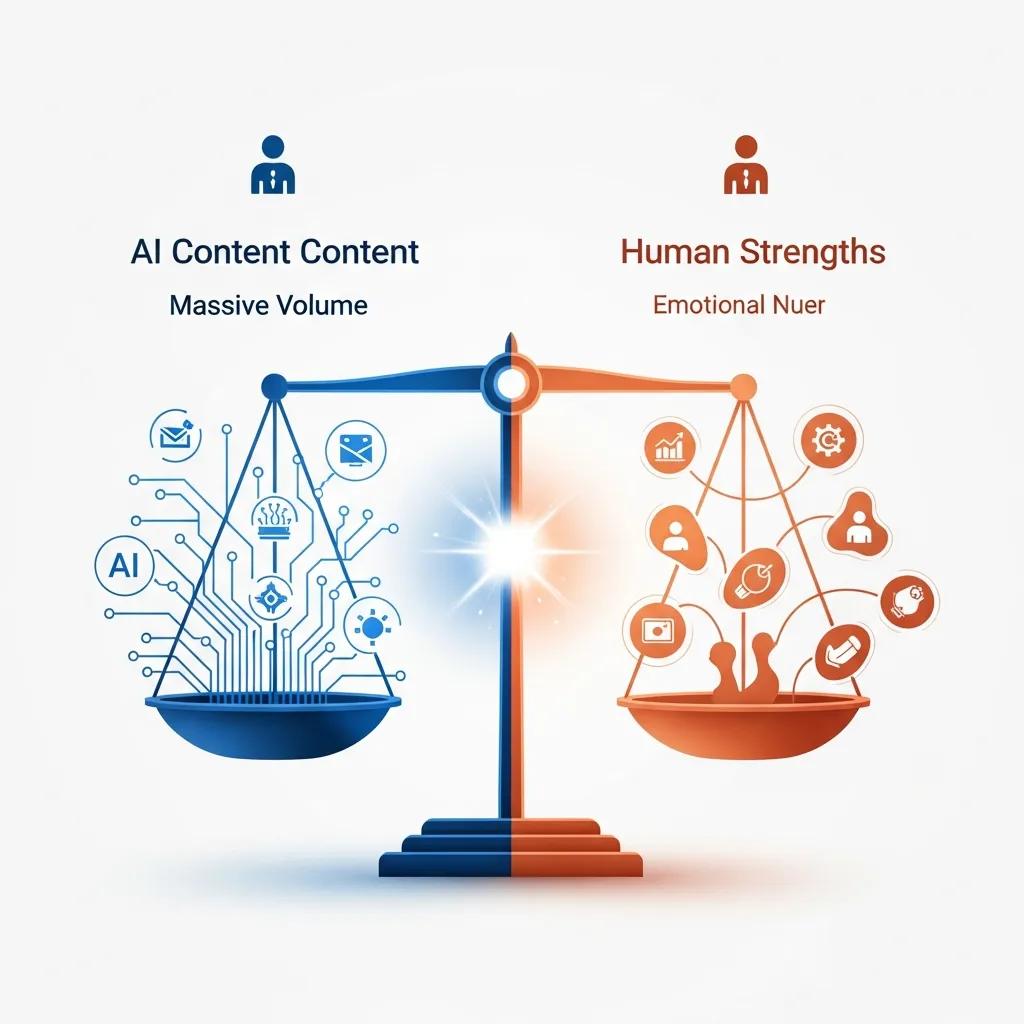
Furthermore, the subtle art of emotional intelligence and embodying a consistent brand voice remains a significant differentiator. AI currently struggles to genuinely convey empathy, humor, or the specific tone that defines a brand's personality, often producing generic or formulaic prose. In my view, the nuanced application of emotional intelligence and the consistent articulation of a distinct brand voice remain exclusively human strengths, crucial for forging genuine audience connections.
Finally, factual accuracy is a paramount concern. While AI can process immense datasets, it is prone to "hallucinations," confidently presenting incorrect or fabricated information. A common mistake I have encountered is content teams overlooking this critical requirement. Through many projects, I have found that neglecting thorough human verification often leads to costly revisions and reputation repair, far outweighing any initial efficiency gains. When I first experimented with leveraging AI for initial content drafts, I found its speed impressive for generating basic information, but enriching these drafts with unique angles always necessitated significant human input.
Search Engine Performance and the Role of E-E-A-T
The shift in how search engines evaluate content has a profound impact on strategy, moving beyond mere keywords to prioritize Helpful Content that genuinely serves user intent. Algorithms are now sophisticated enough to discern depth, comprehensiveness, and real value from content designed solely for search engine manipulation. When evaluating AI vs human content, search engines increasingly prioritize the latter for topics requiring firsthand experience. This evolution underscores the critical role of the E-E-A-T framework: Experience, Expertise, Authoritativeness, and Trustworthiness.
For content to achieve high rankings and sustained visibility, Experience and Expertise are non-negotiable. While AI can aggregate and rephrase information efficiently, it cannot replicate the unique insights, nuanced perspectives, or practical wisdom gained from years of hands-on involvement in a field. Field observations indicate that articles crafted or substantially informed by human professionals with demonstrable real-world experience resonate more deeply with audiences and are subsequently favored by search algorithms. This human touch ensures the content offers genuine value beyond surface-level information.
Ultimately, Trustworthiness remains a profoundly human-centric metric. A brand's authority and credibility are built on a foundation of consistent accuracy, transparency, and a verifiable track record—qualities that AI cannot inherently possess. Practical experience shows that content attributed to credible authors and backed by a reputation for reliability establishes the foundational trust essential for long-term search engine performance. Without human oversight providing this critical layer of accountability, content risks being perceived as generic or unreliable, hindering its ability to truly connect and rank.
The Hybrid Content Strategy: Integrating Human Oversight with AI Efficiency
The current landscape of content creation demands a sophisticated approach that marries the speed of technology with the irreplaceable depth of human intellect. A hybrid content strategy is not merely about using AI, but about strategically integrating it into a workflow where human oversight remains paramount for quality, accuracy, and brand authenticity. This framework provides a roadmap for balancing AI vs human content production within a single workflow, allowing marketers to scale output without compromising the intrinsic value that satisfies search engine requirements.
Developing such a strategy requires a clear understanding of where each component—human and artificial intelligence—excels. Practical experience shows that the most effective content pipelines are those that delineate distinct roles, allowing humans to focus on higher-order tasks like ideation, strategic direction, and nuanced refinement, while AI handles repetitive, data-intensive, or preliminary tasks. This integrated approach ensures both efficiency and the creation of truly helpful, authoritative content.
The Human-AI Content Co-Creation Framework
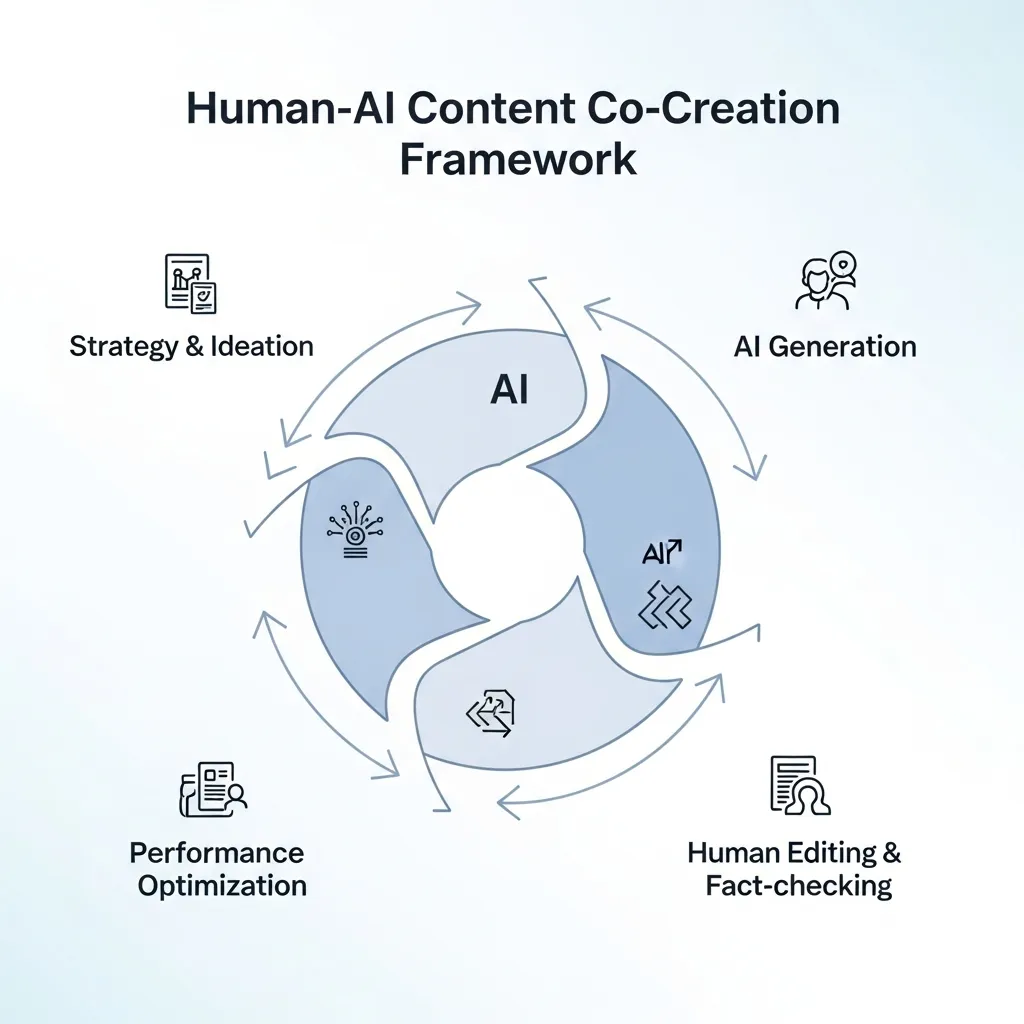
Implementing a successful hybrid strategy can be broken down into a structured, iterative process. The Human-AI Content Co-Creation Framework outlines a four-phase cycle designed to maximize the strengths of both human expertise and technological capabilities, ensuring that every piece of content is both optimized and authentic.
| Phase | Description | Human Role | AI Role | Key Outcome |
|---|---|---|---|---|
| 1. Data-Driven Research & Structural Outlining | Initiate content creation with comprehensive data analysis and foundational structure. | Define target audience, identify strategic gaps, interpret data insights, establish unique angles, approve outline. | Rapidly gather market trends, keyword data, competitor analysis, topic clusters, identify common questions, suggest structural elements. | Strategic content brief and detailed outline, validated by human insight. |
| 2. Human-Led Drafting & Storytelling | Develop the core narrative, injecting unique perspectives and brand voice into the outlined structure. | Craft compelling narratives, develop unique arguments, inject personal experience, establish tone, ensure brand voice consistency, write initial drafts. | Assist with expanding on specific points, generate alternative phrasing, summarize complex information, suggest related concepts. | Engaging, original content draft with distinct human voice and perspective. |
| 3. SEO Optimization & Readability Enhancement | Refine content for search engine visibility and user experience. | Review AI suggestions for natural integration, ensure keyword relevance without stuffing, maintain flow and readability for human readers. | Suggest keyword insertions, optimize meta descriptions, analyze readability scores, identify opportunities for internal/external links, check for grammatical errors. | Search-optimized and highly readable content, validated by human review. |
| 4. Fact-Checking & Editorial Refinement | Perform critical evaluation for accuracy, quality, and brand alignment. | Conduct thorough fact-checking, verify sources, refine tone and style, ensure accuracy of all claims, make final editorial decisions, approve for publication. | Identify potential factual discrepancies (flag for human review), check for logical inconsistencies, suggest minor stylistic improvements. | High-quality, accurate, brand-aligned, and error-free final content. |
Phase 1: Data-Driven Research & Structural Outlining
The initial stage of content creation benefits immensely from AI's ability to process vast amounts of data quickly. Tools can identify trending topics, analyze competitor content gaps, and unearth long-tail keywords or semantic clusters that humans might miss. However, the human role here is critical: to interpret this data, identify strategic opportunities, and translate raw insights into a cohesive, audience-centric outline. Field observations indicate that while AI can generate a basic structure, a human strategist is essential for defining the unique angle and ensuring the outline aligns with overall marketing objectives.
Phase 2: Human-Led Drafting to Inject Unique Perspectives and Storytelling
This is where human creativity and expertise truly shine. While AI can generate text, it struggles with genuine empathy, original thought, and the nuanced storytelling that builds connection. Humans should take the lead in drafting the core content, infusing it with personal anecdotes, unique insights, and a distinct brand voice. AI can then act as an assistant, perhaps expanding on specific paragraphs, summarizing complex information, or generating alternative phrasing, but always under the guidance of the human author who maintains creative control.
Phase 3: Leveraging Tools for SEO Optimization and Readability Checks
Once the human-driven draft is complete, AI tools become invaluable for refinement. They can analyze the content for SEO best practices, suggesting keyword placements, optimizing meta descriptions, and identifying opportunities for internal or external linking. Furthermore, AI-powered readability checkers can highlight complex sentences or jargon, ensuring the content is accessible. The human role here is to review these suggestions critically, ensuring that optimization does not come at the expense of natural language flow. Over-optimization, often a pitfall of unchecked AI use, can detract from overall content quality.
Phase 4: The Critical Role of Human Fact-Checking and Editorial Refinement
This phase is non-negotiable and unequivocally human-centric. AI models, by their nature, are predictive and can "hallucinate" or present outdated information as fact. Therefore, every claim, statistic, and source must be meticulously fact-checked by a human editor. Beyond accuracy, human editors provide the final layer of polish, refining tone, style, and grammar to ensure the content is flawless and perfectly aligns with brand guidelines. This editorial gatekeeping is crucial for maintaining credibility and trust with the audience.
Pro Tip: Establish a clear content governance policy that mandates human review at every critical juncture. This prevents errors from propagating and ensures that the final output consistently meets your brand's quality and accuracy standards.
Maintaining a Consistent Brand Persona Across Mixed-Methodology Content
One of the most significant challenges in a hybrid content strategy is ensuring a consistent brand persona and voice. AI tools can be trained on existing brand guidelines, but they lack the intuitive understanding of brand nuances, humor, or specific sensitivities that a human possesses. Therefore, human editors and content managers must act as the ultimate guardians of the brand voice, ensuring that every piece of content, regardless of its AI contribution, speaks with a unified and authentic voice.
When to Automate and When to Write: A Decision Framework
Deciding where to deploy AI and human effort requires a strategic framework. For high-volume, low-complexity content, automation shines. Think product descriptions that pull data from a database or data summaries of market trends. AI excels at generating consistent, factual text quickly. Understanding the strengths of AI vs human content allows for better resource allocation; in my experience, attempting to manually write thousands of unique product descriptions is not only time-consuming but often leads to inconsistencies that AI can easily avoid.
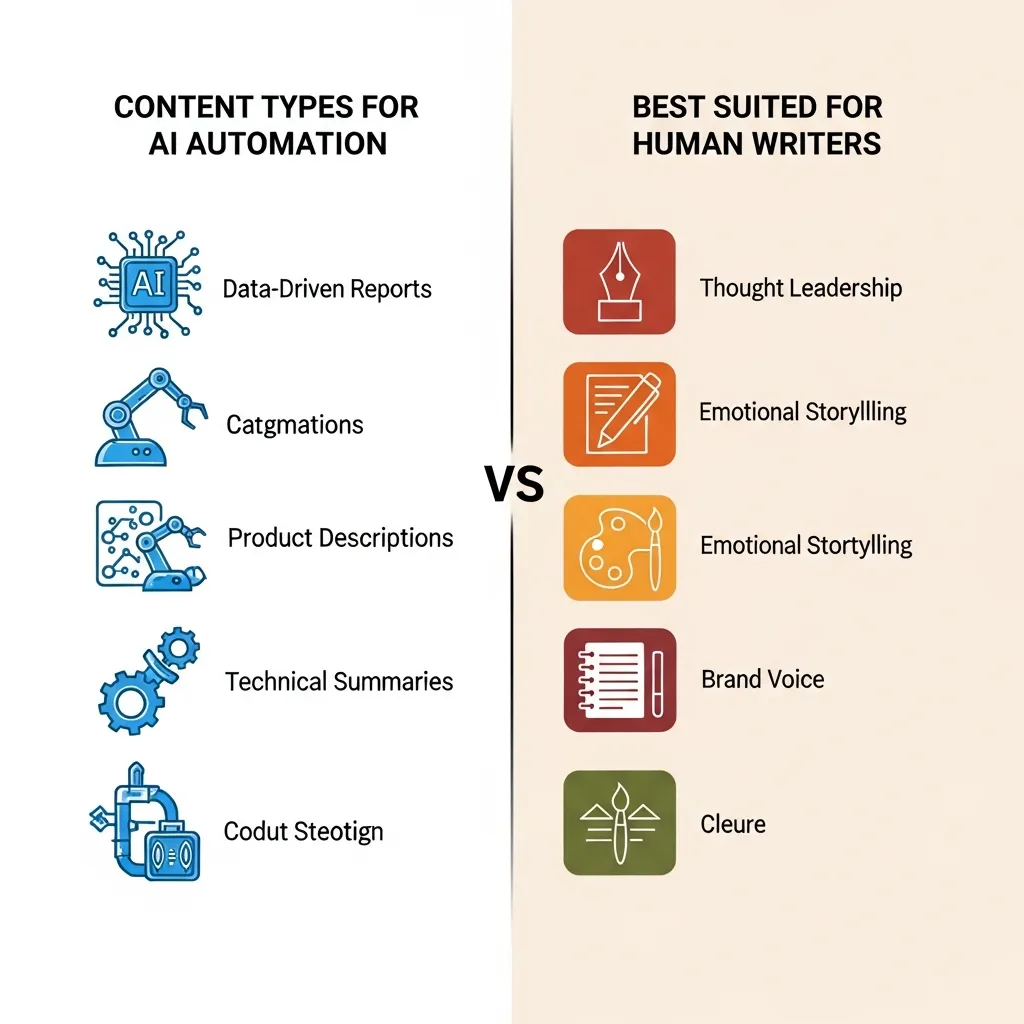
Conversely, content demanding nuance, empathy, or original thought necessitates human writers. This includes thought leadership pieces that establish expertise, in-depth case studies that tell compelling stories, and opinion pieces that reflect a unique perspective. These are crucial for building brand authority and connection. A common mistake I have encountered is using AI for these high-value pieces without significant human editing, which often results in generic output that fails to resonate.
Ultimately, the decision hinges on evaluating the ROI of time versus quality across different content tiers. In my view, the most effective approach is to tier content by its strategic impact: automate the foundational, data-driven layer, and reserve human expertise for the top-tier, relationship-building content. This ensures optimal resource allocation and maximizes overall content strategy effectiveness.
Navigating Ethics and the Reality of Content Detection
Current AI content detection tools face significant limitations, frequently yielding unreliable results and false positives. A common mistake I have encountered is over-reliance on these scores, which often mislabel human-written content. Ethically, the debate over AI vs human content requires transparency about AI's role, ensuring originality and avoiding plagiarism. Over-automation, without human refinement, risks repetitive or generic output. In my view, human oversight is indispensable for crafting truly distinctive and valuable content, preventing monotony and delivering the authentic insights audiences seek.
The Future of Synergy in Content Marketing
The future of content marketing hinges on a balanced synergy between AI efficiency and human ingenuity. In my experience, blindly automating content often leads to generic output, failing to resonate deeply with audiences. A common mistake I have encountered is over-relying on AI for emotional nuance, which dilutes brand voice.
Human creativity remains the ultimate differentiator, infusing unique insights, empathy, and strategic storytelling that AI cannot replicate. The most effective approach, in my view, is to adapt to new tools, using AI to streamline tasks while allowing human experts to focus on high-value creative and strategic thinking. This intelligent collaboration amplifies impact without losing the essential human touch.
To start optimizing your content, apply the Hybrid Content Strategy Framework to your next project.
Frequently Asked Questions
Is AI content better than human content for SEO?
Neither is inherently better. Search engines prioritize high-quality, helpful content that demonstrates E-E-A-T (Experience, Expertise, Authoritativeness, and Trustworthiness). A hybrid approach that leverages AI for efficiency and humans for quality typically performs best.
Can search engines detect AI-generated content?
While detection tools exist, they often produce false positives. Search engines like Google focus more on the value and accuracy of the content rather than the specific tools used to create it.
What is a hybrid content strategy?
A hybrid content strategy is a workflow that combines AI's speed for research, outlining, and basic optimization with human expertise for storytelling, brand voice, and critical fact-checking.
How does AI affect E-E-A-T?
AI lacks real-world experience and personal expertise. To satisfy E-E-A-T requirements, human professionals must oversee AI tools to ensure content is accurate, authoritative, and based on genuine insight.